Beyond Color and Cost: Evolving Expectations for Quartz Specification
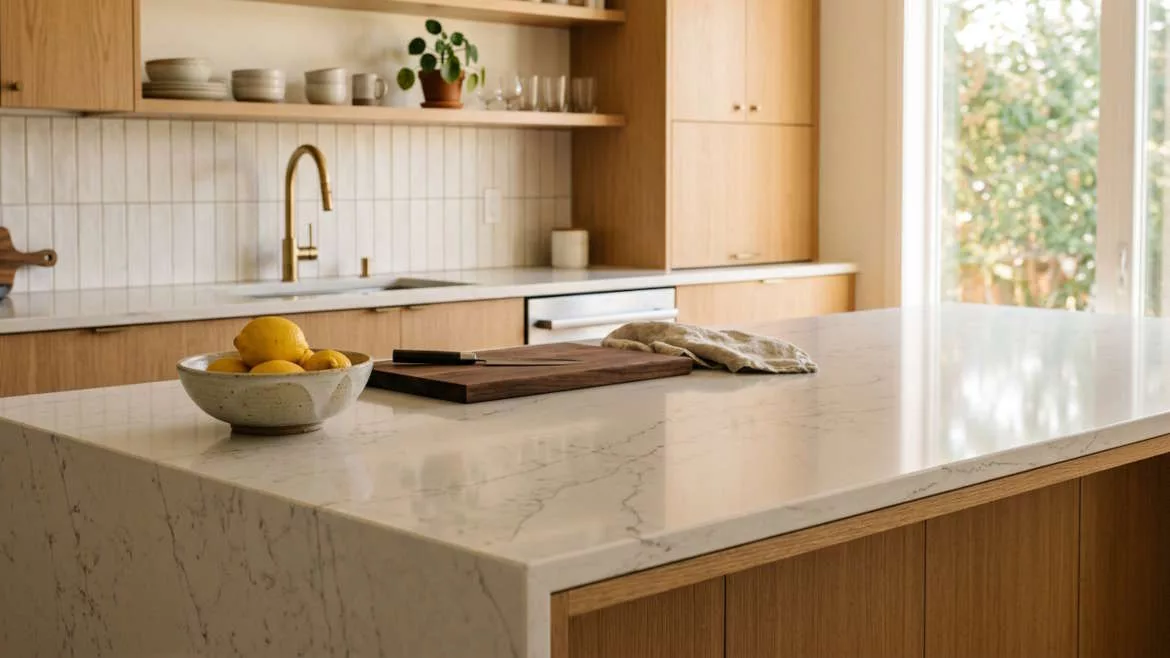
As countertop islands have grown in size, understanding span limits and support requirements has become increasingly important.
Need to Know
- As quartz has been applied across larger surface areas and longer spans, its thickness, required support and pattern matching implications have become significant factors in specification.
- Material transparency has become more important in the built environment. Quartz specifiers are expected to document composition and compliance with recognized transparency standards.
- Sustainability and occupant wellness are now central design drivers that affect material specification.
Specifying quartz used to be relatively straightforward. Confirm the color, select the edge details, coordinate with the fabricator and stay within budget. Quartz performance was assumed, compliance was uncomplicated and material composition was seldom scrutinized.
Today, specifying quartz is a different experience. With project owners focusing more on sustainability and contractors addressing increasingly demanding applications, specifiers are tasked with providing the technical acumen and documentation that supports material choices and informs broader project objectives. For everyone, this means understanding the fundamentals of quartz as a design material within the broader context of modern construction goals and expectations.
Thickness, Support and Pattern Matching
When selecting quartz today, project owners and contractors are concerned with several material characteristics that reach far beyond color. As quartz has been applied across larger surface areas and longer spans, its thickness, required support and pattern matching implications have become more critical considerations.
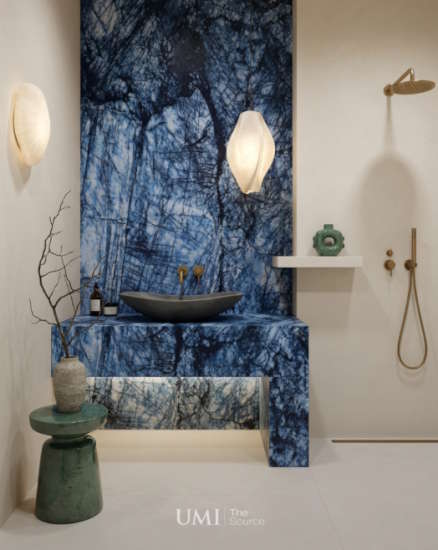
Thinner 2 cm quartz is often specified for vertical applications such as backsplashes, wall cladding and shower surrounds where structural loads are minimal. Photo courtesy of UMI Stone
Thickness and Application
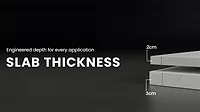
Engineered quartz slabs are typically produced in nominal thicknesses of 2 cm (approximately ¾ inch) and 3 cm (approximately 1 ¼ inch), with each thickness suited to different installation conditions. Thinner 2 cm material is often specified for vertical applications such as backsplashes, wall cladding and shower surrounds where structural loads are minimal. It may also be used for countertops when installed over a full substrate, such as plywood, that distributes loads evenly across the cabinet structure. Thicker 3 cm slabs are commonly preferred for countertops, islands and other horizontal surfaces because they provide greater rigidity and impact resistance without requiring a full substrate. In addition, 3 cm material allows designers to achieve a thicker visual edge profile without the need for lamination in many installations.
Span Support and Overhangs
As countertop islands have grown in size, understanding span limits and support requirements has become increasingly important. Despite their high flexural strength, quartz slabs still require adequate support when extending beyond cabinet structures. Most manufacturers recommend that unsupported overhangs of 3 cm quartz be limited to approximately 10 to 12 inches without additional bracing, while larger overhangs typically require structural reinforcement such as brackets, corbels or concealed steel supports. For 2 cm material, support requirements are more restrictive and typically involve a continuous substrate and additional reinforcement for extended spans. Exact span allowances vary by manufacturer, edge profile and installation configuration, so fabrication guidelines and engineering recommendations should always be verified during specification and detailing.
Pattern alignment has become a prominent design concern as quartz products increasingly feature large-scale veining and stone-inspired patterns. Photo courtesy of UMI Stone
Pattern Matching and Visual Continuity
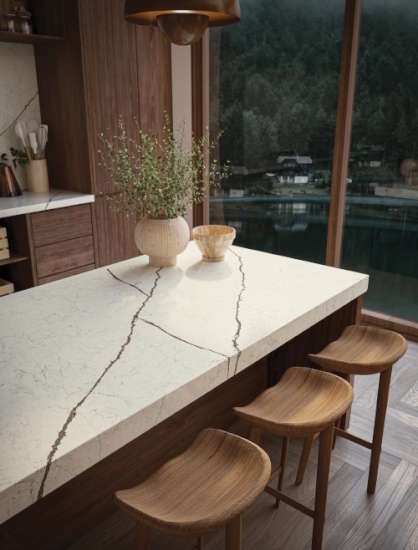
In addition to structural considerations, pattern alignment has become a prominent design concern as quartz products increasingly feature large-scale veining and stone-inspired patterns. Unlike many natural stones, quartz slabs are manufactured in controlled patterns that may repeat from slab to slab. When projects involve waterfall edges, bookmatched panels or large islands fabricated from multiple pieces, careful planning is required to maintain visual continuity. Fabricators typically review slab layouts with designers or project teams prior to cutting to ensure that veining direction, seam placement and edge transitions align with design intent. Early coordination during specification and fabrication can help avoid visible pattern disruptions and ensure the finished installation reflects the intended aesthetic.
For specifiers, thickness selection, span support requirements and pattern alignment must be considered early in the design and specification process to ensure that quartz installations meet both structural performance expectations and the intended visual outcome.

Span allowances vary by quartz manufacturer, edge profile and installation configuration, so fabrication guidelines should always be verified during specification and detailing. Photo courtesy of UMI Stone
Material Transparency and Ingredient Disclosure
In addition to application-specific considerations, project stakeholders are increasingly focused on material ingredients and sourcing practices as sustainability objectives and material transparency become more important in the built environment. Specifiers are now expected to provide clear, verifiable ingredient lists and supply chain details for evaluation of environmental impact. While corporate responsibility reporting has existed for decades, the formalization of Environmental, Social and Governance (ESG) frameworks in the mid-2000s, and their rapid expansion over the past decade, have elevated transparency from a voluntary initiative to a mainstream expectation.
For quartz specifiers, this means documenting composition and compliance with recognized transparency standards. Clients frequently request third-party verification rather than relying solely on manufacturer claims, expecting quartz products that have Health Product Declarations (HPDs), Declare labels or other certification statements. These tools provide detailed accounts of material content and sourcing that allow project teams to answer questions about substances of concern.
Specifiers can benefit from proactively meeting these transparency expectations and preparing such documentation in advance. This reduces the amount of back and forth during submittals and demonstrates due diligence in material selection. Additionally, specifiers who familiarize themselves with HPDs, Declare labels and similar certifications can identify important distinctions among quartz products and their manufacturers that can have a positive impact on project outcomes.
Integration with Sustainability and Wellness Goals
Sustainability and occupant wellness have moved from niche priorities to central design drivers over the past two decades. Early green building initiatives largely focused on energy efficiency and resource conservation. As research linked indoor environments to human health, that attention broadened and introduced rating systems and corporate sustainability commitments that made environmental and wellness performance measurable.
Examples of how carefully specified quartz can contribute to the metrics of these types of initiatives include:
-
LEED v4/v5 – Building Product Disclosure and Optimization (BPDO)
Quartz products that provide HPDs or Declare labels can support multiple credits related to material transparency and responsible sourcing. HPDs document the full ingredient makeup of a product, while Declare labels indicate whether a product contains chemicals restricted under the Red List. By specifying quartz with these disclosures, design teams can provide verifiable evidence for LEED submittals, streamlining the review process and demonstrating alignment with sustainability goals. -
WELL Building Standard – Material and Air Quality Concepts
Products with Greenguard Gold certification or equivalent verified low-emission testing can contribute to WELL standards that address indoor air quality, chemical exposure and occupant health. Greenguard Gold confirms VOC emissions remain within strict limits, which is particularly important in sensitive environments such as schools and healthcare facilities that serve more vulnerable populations. Specifiers can easily identify manufacturers that carry certifications that support WELL credits and provide their clients with documented assurances. -
Living Building Challenge (LBC) – Material Petal
Quartz products that are Red List compliant or Red List approved avoid chemicals of concern. Compliance with the Red List supports the LBC Material Petal requirements, which emphasize the use of safe non-toxic materials throughout the built environment. Specifiers can provide Red List documentation to verify that selected quartz aligns with the project’s regenerative design goals and to address client expectations for both material health and environmental responsibility.
Learning the requirements of these — and other sustainability and wellness-focused initiatives — allows for more thoughtful and efficient material selection.
Work That Comes with Reward
As application specificity, material transparency and sustainability standards for quartz continue to evolve, specifiers, as well as retailers, distributors, fabricators and installers, must invest in understanding and applying these new frameworks to differentiate themselves competitively. While specifying quartz is now a more involved process, all parties must recognize that the work of vetting materials and manufacturers ultimately benefits everyone. By actively engaging with these changing expectations, each player positions themselves as a knowledgeable, forward-thinking partner in this new generation of design and construction.
Looking for a reprint of this article?
From high-res PDFs to custom plaques, order your copy today!