AI Talk Is Everywhere -- Where Does a Countertop Fabricator Begin?

Need to Know
- Before exploring any AI tools, stone fabricators need to identify the specific problem they want to solve.
- AI has the potential to streamline processes like quoting, project management, production planning, and customer communication, helping countertop fabrication shops operate more efficiently and reduce costly errors.
- Scale AI adoption gradually. Start small and focus on measurable ROI. Then, expand on what works.
Walk into any industry event, scroll LinkedIn or sit in on a peer group meeting and you will hear it: artificial intelligence (AI) is everywhere. For stone countertop shop owners, that can feel both exciting and overwhelming. Every week brings new tools, new promises and new buzzwords. The pressure builds quickly — especially when competitors begin talking about automation, voice agents or ERP-connected “agentic AI.”
But the real question is not whether AI matters. It does. The real question is where to begin in a way that produces measurable financial results.
After more than a decade inside the stone industry, I have seen firsthand how fabrication shops operate — the margin pressures, scheduling bottlenecks, rework headaches, labor constraints and the constant balancing act between craftsmanship and throughput. What makes this AI moment different is that it offers something rare in our industry: step-change performance gains instead of incremental ones.
The key is not chasing hype. The key is starting strategically.
Start With Clarity: What Do You Want AI to Fix?
Before evaluating a single tool, shop owners need to answer a fundamental question: What outcome are we trying to improve?
AI is not a strategy by itself — it is a capability. Your strategy must come first. In most shops, the biggest financial levers tend to fall into a handful of categories:
- Improving material utilization
- Reducing rework
- Optimizing scheduling and labor allocation
- Increasing quoting speed and accuracy
- Capturing more inbound leads
- Scaling revenue without adding headcount
When AI is aligned with these core drivers, the financial impact can be dramatic. We are already seeing solutions targeting:
- 30 to 50% cost reductions
- 2x revenue per employee
- EBITDA improvement from industry averages near 5% toward 30% or more
- Each solution can have a 10x ROI when implemented correctly
Those numbers are not incremental. They are transformational. But they only happen when AI initiatives are directly tied to clear financial objectives.
Educate Your People Before You Buy AI Software
One of the most common mistakes I see shops make is jumping into tools before their team understands what AI actually is or how to use it effectively. Without that foundation, even good technology struggles to gain traction.
That is why education must come first. An AI bootcamp tailored specifically for fabrication operations levels the playing field across ownership, sales, production management and office staff. When teams learn how AI models work in practical terms — how prompts influence outcomes, how to structure inputs properly and how to build simple internal GPT tools — skepticism quickly turns into engagement.
In these bootcamps, teams typically learn to:
- Break down AI concepts in plain English
- Write effective prompts that drive useful results
- Build simple private GPT tools using company policies or SOPs
- Understand how more advanced “agentic AI” connects to ERP systems and workflows
AI does not replace strong operators. It amplifies them. A production manager who can instantly model scheduling scenarios gains leverage. A sales team that drafts proposals and marketing content in minutes instead of hours becomes more productive without increasing payroll.
Deploy Practical High-Impact Use Cases First
Once your team has a working understanding, move quickly into real applications. The most successful shops start with use cases that solve daily operational pain points. Three examples are gaining strong traction in fabrication shops today:
-
AI Voice Agents for Inbound Calls
An AI voice agent can answer routine questions about turnaround times, material options, pricing and scheduling availability while escalating complex calls to the appropriate person. The result is fewer missed leads, faster response times and less employee overload.
-
AI Virtual Showrooms
Rather than staging and reshooting endless combinations of materials and cabinetry, AI enables digital swapping of countertop materials, cabinet finishes, hardware and lighting. Designers gain flexibility and sales conversion often improves immediately.
-
Internal Employee GPT Systems
By loading employee handbooks, safety procedures and HR policies into a private GPT, shops reduce repetitive interruptions and increase internal efficiency. Small time savings across dozens of employees add up quickly. These are not theoretical ideas. They are working implementations delivering measurable impact.
Build an AI Roadmap That Matches Your Appetite
Not every shop wants to modernize at the same pace. Your AI roadmap should align with your strategic priorities, budget and leadership appetite for change.
Most shops progress through three phases:
- AI Augmentation – Training, internal GPT tools, marketing and sales productivity improvements.
- AI Automation – Voice agents, workflow automations, quoting assistance, scheduling optimization.
- Agentic AI Integration – ERP-connected agents that optimize material utilization, programming, rework prediction and production planning.
The most effective approach is to pilot initiatives, validate the results and then scale deliberately.
Tie Every Initiative to Your Fabrication Shop's ROI
AI must be treated with the same financial discipline as any major capital investment. You would not purchase a CNC machine without analyzing throughput, labor offsets and payback periods. AI deserves the same scrutiny. A typical ROI evaluation might examine:
- Labor hours saved
- Scrap and material reduction
- Increased lead capture
- Reduced rework costs
- Revenue per employee improvement
When multiple initiatives compound, the EBITDA shift can be substantial. Moving from single-digit margins toward 20% or higher does not just improve cash flow — it changes the long-term valuation and competitive positioning of your business. The difference between a 5% EBITDA shop and a 25% EBITDA shop is not incremental. It is strategic.
Governance Matters
As AI adoption accelerates, guardrails are essential. A simple AI policy outlining acceptable use, data privacy expectations and approval processes for automation keeps innovation structured rather than chaotic. Designating an internal AI champion — someone who understands operations and leadership — ensures that experimentation remains aligned with business objectives. Structure creates scale.
The Competitive Gap Is Opening Now
The opportunity exists because fabrication has always been operationally complex and margin-sensitive. AI directly addresses those friction points. The shops that will lead the next decade are not necessarily the largest today. They are the ones willing to:
- Set annual AI goals
- Budget for AI strategically
- Invest in ongoing training
- Pilot, measure and scale
AI is not a one-time upgrade. It is an evolving operational capability. Just as CNC technology once reshaped fabrication throughput, AI is poised to reshape decision-making, efficiency and scalability. Early adopters will compound gains year after year, widening the performance gap between modernized shops and those that hesitate.
So where should you begin? Start with clarity about your financial objectives. Educate your people. Pilot one or two high-impact initiatives. Measure aggressively. Then scale what works.
AI is already reshaping the competitive landscape of stone fabrication. The only remaining question is whether your shop will lead that transformation — or work to catch up later, or worse.
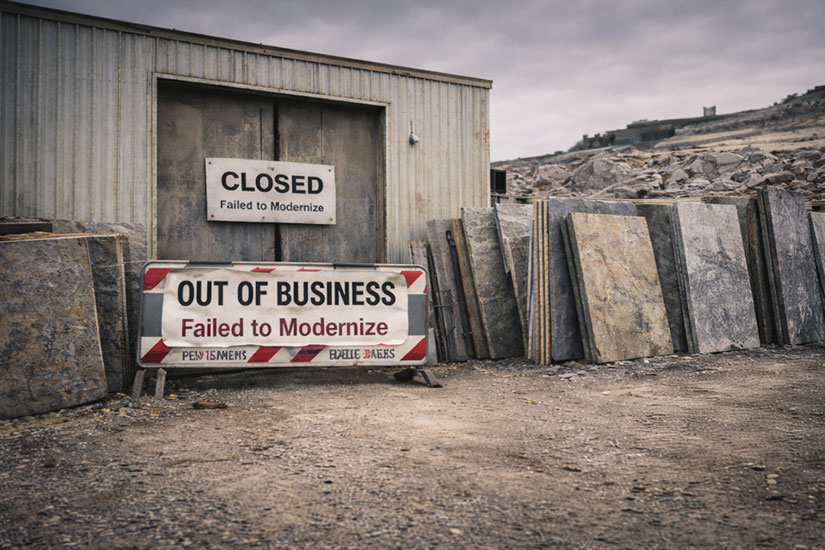 Image courtesy of Thryve Innovations
Looking for a reprint of this article?
From high-res PDFs to custom plaques, order your copy today!