AI and the Shop of the Future: How Fabrication Could Look by 2030
From personal AI agents shopping for countertops to customers templating their own kitchens with a smartphone, the stone shop of 2030 may look very different from the shop of today. That is the vision laid out by Rich Katzmann of Thrive Innovations, who joined the Stone World Podcast to discuss his company's recent report on the future of the stone shop.
Katzmann has spent a dozen years in the industry, starting with laser templating products before moving into commercial installation and cut-to-size work. For more than four years he has run the Rockheads Group, a network of 120 of the largest fabrication shops in the country focused on best practices and benchmarking.
"That's all we did was talk about how they could get better," said Katzmann. "From there, last December, I started a company called Thrive, which provides AI solutions just for stone shops."
During the podcast, Katzmann announced the official release of the company's first product, ThriveIQ. The platform pulls together a shop's data sources, including CRM and ERP systems, slab inventory software, employee information and accounting programs such as QuickBooks, into what the company calls a data lake. Users throughout the company can then query that data directly.
"Financial questions, strategic questions, reworks, utilization, you name it," said Katzmann. "All of that is a prompt away."
For fabricators worried about a painful implementation, Katzmann said the onboarding process is largely hands-off. Shops provide login credentials and access to shared files, and Thrive builds the data lake in about two weeks. From there, users are asked to submit 10 questions a day for three to four weeks, rating the answers with a thumbs up or thumbs down to train the system.
"That's the learning phase that takes us from 90 to 99," said Katzmann. "Basically you're just getting us access to these systems, and we do all the heavy lifting."
Agents talking to agents
Thrive's report, which looks ahead to 2030, was developed with input from the company's developers and industry experts, including marketing consultant Anthony Milia and process specialist Ed Young. Katzmann stressed that nothing in the report is science fiction.
"It may not be plausible today, but these are all things that experts believe are possible in the next couple of years," said Katzmann.
The customer journey of 2030 starts before a homeowner ever contacts a shop. Katzmann said consumers will soon have personal AI agents that learn their tastes, budgets and design preferences over time. When a homeowner decides to replace their countertops, that agent will go out and negotiate with the AI agents of local fabrication shops to find the best match.
The warning for fabricators is that shops without an AI-enabled online presence simply will not appear in that process.
"It's not like SEO now, where you have meta text and you can do Google," said Katzmann. "Agents want to have a conversation with another agent, not just find static information on a website."
Some of that technology is already creeping into the market. Katzmann pointed to cutting-edge shops using geo-tracking to serve ads to consumers whose phones show up at competitors' showrooms or big box retailers.
Quoting in a half hour
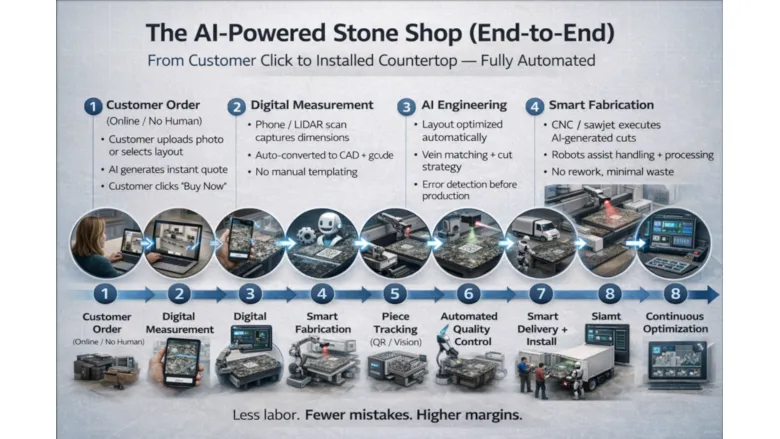
Once a customer selects a shop, Katzmann envisions a quoting process that requires little more than photos of the kitchen. An automated system will calculate square footage, linear footage and sink cutouts from the images, suggest upgrades such as waterfall edges and render the customer's chosen material directly into pictures of their own home.
The system will also work in the shop's favor, steering customers toward high-margin materials, overstocked inventory or private label products that cannot be cross-shopped, with dynamic pricing similar to hotels and airlines.
"An automated system is going to be pushing upgrades. It has no concern about that," said Katzmann. "All in one half-hour transaction, a customer can have it bought, have the deposit paid for and be on the schedule."
Self-templating with a phone
Katzmann, who has a background in laser templating, said his favorite part of the report involves the template process. Modern iPhones ship with LiDAR sensors capable of measuring to a sixteenth of an inch, matching standard template accuracy. What is missing today is the AI layer that guides a homeowner through capturing the right angles, photos and reference points.
By 2030, he said, customers will template their own kitchens through an app minutes after paying a deposit.
"Think about the impact that has on the shop," said Katzmann. "No templator salary, no truck, no insurance, no $25,000 laser. All of those costs essentially go away."
He estimated self-templating could handle roughly 80% of jobs in its first year of implementation, with shops sending out templators only for complex projects. Larger shops with four or five templators could repurpose those employees elsewhere.
Automation on the shop floor
Inside the shop, Katzmann described a workflow that moves from template to machine without human intervention. Software will automatically nest kitchen layouts on slabs, search for usable remnants, batch jobs together and route work to the most efficient machine based on real-time capacity. Machines will report their own status, flagging when they will finish a job so material keeps moving.
Humanoid robots, he said, will handle material movement with the help of existing cranes. He pointed to a recent 60 Minutes segment showing bipedal robots working in Hyundai plants as evidence the technology is closer than many think.
Katzmann also connected automation to the industry's ongoing silicosis crisis, noting that hand fabrication, even wet, can still expose workers to dust.
"Absolutely, robots should be able to take that dangerous part off the plate of humans," said Katzmann.
Smart cameras positioned throughout the shop will track every piece, measure cycle times and flag potential reworks before they become expensive problems. Katzmann said shops running 15% to 20% rework rates today could see that number fall to around 3%, since data-related causes such as templating errors dominate current rework reasons.
Optimized installs and robot helpers
On the installation side, AI will optimize routes, match crews to the jobs they handle best and track consumables and materials. Katzmann also cited new research from Arizona State University on artificial muscle structures that could allow a bipedal robot to lift 100 times its own weight, opening the door to robots carrying island tops into homes by 2030.
Where fabricators should start
For fabricators overwhelmed by the pace of change, Katzmann offered several starting points. First, shops should secure a business account with their preferred AI platform to protect proprietary data such as price lists and financials from entering public training data. Second, they should use AI to run competitive analysis, since competitor pricing and quotes are often publicly available online.
He also recommended every shop adopt an AI policy to prevent well-meaning employees from exposing company data, and said he has a vetted policy template available for shops that reach out. Finally, he urged fabricators to learn prompt structure, citing a methodology his company uses that reduced tasks that once took seven attempts down to one or two.
"If you're frustrated with your results on AI, it's probably not AI," said Katzmann. "It's probably the structure of how you're interacting with it."
Fabricators with questions can reach Katzmann at thrivein.ai or by email at rich@thrivein.ai.
Looking for a reprint of this article?
From high-res PDFs to custom plaques, order your copy today!

Jason Kamery is the Managing Editor and Group Digital Editor of Stone World. With more than a decade of experience covering the stone and countertop industry, he has conducted hundreds of interviews with fabricators, manufacturers, and industry leaders, and hosts the Stone World. podcast. He reports from events worldwide, including TISE, Coverings, and Marmomac, and his coverage extends to worker safety and silicosis, trade policy and tariffs, and fabrication technology. Kamery has also served as a speaker and panel moderator at The International Surface Event (TISE). He graduated from Purdue University with a B.A. in Mass Communication.
email: kameryj@bnpmedia.com | office: (248) 833-7356