U.S. Domestic Production · Dimension Stone
How Much Natural Stone Does the U.S. Actually Quarry?
A snapshot of domestic dimension stone output in 2025, set against 2024 drawn from federal mineral statistics. The short story: production held flat, value crept up, the producer base shrank, and the country still imports the overwhelming majority of the stone it uses.
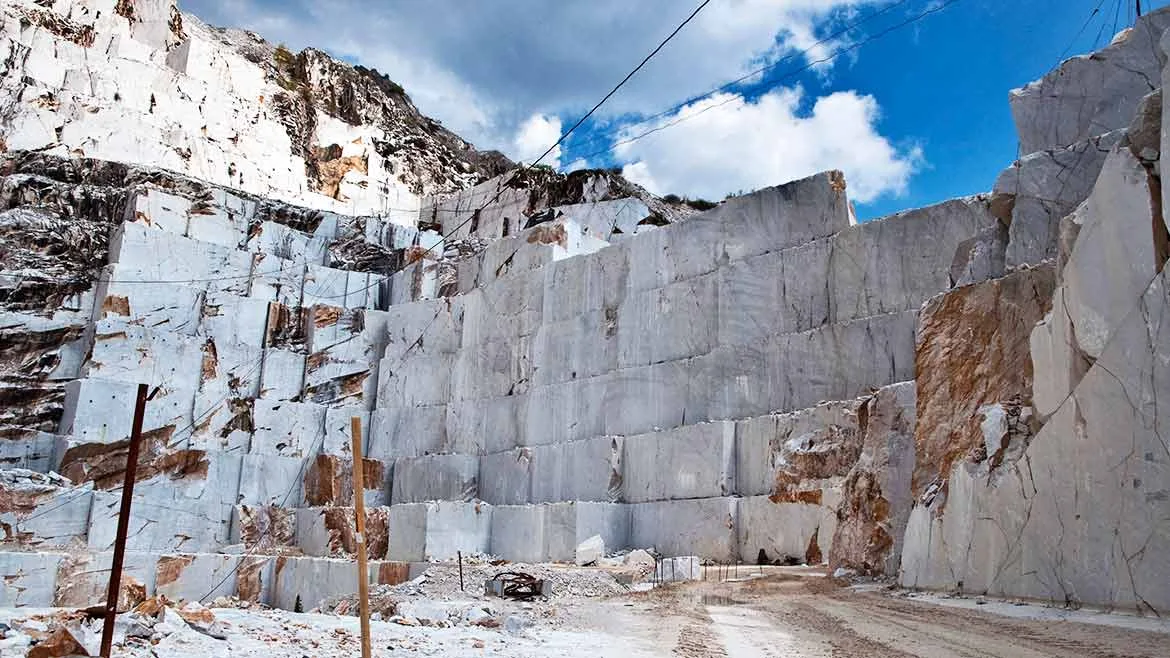
U.S. producers sold or used about 2.3 million tons of dimension stone in 2025, holding domestic output near that mark for a third straight year even as the value of that stone climbed to a five-year high of $460 million, according to the U.S. Geological Survey.
The figures, drawn from the agency's Mineral Commodity Summaries 2026, describe a domestic industry quarrying roughly the same volume of stone for more money while still supplying only a small share of what the country consumes. Net imports accounted for 81% of U.S. dimension stone consumption by value in 2025, down a single point from the year before.
The producer base also thinned. The USGS counted 150 companies operating 215 quarries across 34 states in 2025, down from 171 companies a year earlier, even as the number of active quarries held nearly steady. Texas, Wisconsin, Vermont, Indiana and Georgia again led the country, together accounting for 73% of production by tonnage.
Limestone remained the backbone of domestic output at roughly 46% of tonnage, followed by granite at 18% and sandstone at 17%. Granite, the only stone type the USGS reports with its own figures, continued a multi-year decline that deepened in 2025 as one of the country's largest producers pulled back at two quarries.
The Headline Numbers
All dimension stone sold or used by U.S. producers. "Sold or used" is treated as equivalent to production.
A Small Slice of a Big Market
Domestic quarries supply only a fraction of what the U.S. market consumes. Most dimension stone arrives as imports, a structural feature of this industry, not a one-year blip.
Domestic vs. Imported
Domestic producers sold roughly $460M of output into a market that consumed about $2.4B worth. Imports for consumption ran near $2.0B, while exports were a slim $43M, down from $51M a year earlier.
Compared with 2024, the picture barely budged. Net import reliance edged down a single point, from 82% to 81%. That small gain for domestic producers came less from a flood of new U.S. stone than from the math underneath it: domestic production value rose about 7% while imports held essentially flat near $2.0B and total consumption stayed around $2.4B. In other words, the U.S. share crept up at the margins, but the country remains overwhelmingly import-dependent year to year.
For a trade audience, the takeaway is that domestic quarrying is not where the volume lives. Brazil, Italy, China and India together account for the bulk of incoming stone.
What Kind of Stone
Composition of domestic output by tonnage. Limestone dominates; the "other" group covers slate, dolomite, marble, quartzite and miscellaneous stone. Travertine, where quarried domestically, is folded into the limestone figure and is negligible in U.S. output.
Production Mix by Tonnage
2025 Composition
This is as granular as the federal data allows. In its annual summary USGS tracks only granite with its own volume and value figures. Every other stone type, including marble, slate, dolomite and quartzite, is reported only as a share of the total, never as a standalone tonnage or dollar amount. So a clean "U.S. marble production" or "U.S. travertine production" number simply does not exist in the current release. Fuller per-type tables appear only in the USGS Minerals Yearbook, which lags by several years and is still limited by producer confidentiality. For a 2025 vs. 2024 view, the four-way split above is the deepest breakdown the source supports.
Granite Under Pressure
Granite is the only single stone type USGS tracks with its own volume and value series. In 2025 it kept slipping, and the producer base took a couple of notable hits.
One of the largest U.S. granite producers (Polycor, the Quebec firm widely described as the world's largest natural stone processor) reshaped its footprint over the period. Its Concord, New Hampshire quarry, run under the Swenson Granite name, was temporarily halted in summer 2024 for changes meant to cut quarrying costs, with material removed in the interim expected to be sold as construction aggregate. In August 2025 the company sold its Mount Airy, North Carolina quarry to an aggregates producer (Luck Stone), which plans to reopen the site in 2027. Both moves were expected to weigh on granite output in the near and longer term. Net import reliance for granite alone stood at about 85% by value.
Who's Doing the Quarrying
The producer base contracted meaningfully in 2025 even as the number of active quarries barely moved, a consolidation signal worth watching.
Leading Producing States, 2025
73%
27%
57%
43%
The five leaders drew 73% of national tonnage but only 57% of value in 2025, a gap that points to higher-dollar stone being quarried more widely across the remaining states. The same five led in 2024, when they held 63% of value.
We know the rank order and the combined totals, but not what any single state produced on its own. USGS does not publish state-level output for dimension stone because most of these states have only a handful of producers, sometimes one or two, so a state total would effectively reveal an individual company's proprietary volume. To protect that confidentiality, USGS withholds the breakdown and reports only the ranked leaders and their combined share. That is why this section shows order and concentration rather than a number for each state.
Where These Numbers Come From
All figures are from the U.S. Geological Survey Mineral Commodity Summaries 2026, prepared by the USGS National Minerals Information Center, with the 2024 stone-type split drawn from the 2025 edition. The MCS is the earliest comprehensive federal source for the prior year's mineral data, which is why the 2025 figures carry an "estimated" flag.
The important caveat for reporting: these are estimates built from voluntary producer canvasses. Not every quarry or company responds, so USGS models the gaps, and there is a known undercount baked into the totals. The numbers are reliable for direction, scale and year-over-year shape, but they are not a precise census of every ton quarried the way customs data captures every imported shipment. Treat them as the best available rather than authoritative to the dollar.
USGS also revises prior years in each new edition. The 2024 production value, for example, was first published as roughly $370M in the 2025 summary and later revised up to about $430M in the 2026 summary. This dashboard uses the newer 2026 figures for both years so the comparison stays internally consistent. If you pull last year's sheet you will see different 2024 numbers, and that is expected.
A few definitional notes: "sold or used" is treated as equivalent to production; value is in current dollars and is not inflation-adjusted; tonnage is metric. Stone-type detail is limited because only granite is tracked with its own volume and value series. Everything else is reported as a share of the total, and travertine is not a separate domestic category. For deeper per-type tables you would need the USGS Minerals Yearbook, which lags by several years.
Primary source: USGS MCS 2026, Stone (Dimension) data sheet. Hub: USGS Dimension Stone Statistics and Information.
Looking for a reprint of this article?
From high-res PDFs to custom plaques, order your copy today!

Jason Kamery is the Managing Editor and Group Digital Editor of Stone World. With more than a decade of experience covering the stone and countertop industry, he has conducted hundreds of interviews with fabricators, manufacturers, and industry leaders, and hosts the Stone World. podcast. He reports from events worldwide, including TISE, Coverings, and Marmomac, and his coverage extends to worker safety and silicosis, trade policy and tariffs, and fabrication technology. Kamery has also served as a speaker and panel moderator at The International Surface Event (TISE). He graduated from Purdue University with a B.A. in Mass Communication.
email: kameryj@bnpmedia.com | office: (248) 833-7356