Stone Industry Professionals Learn Tips for Closing a Sale
Joe Alva of Poseidon Industries shared sales techniques he has learned through the years to a group of industry members at The Poseidon Experience 2026
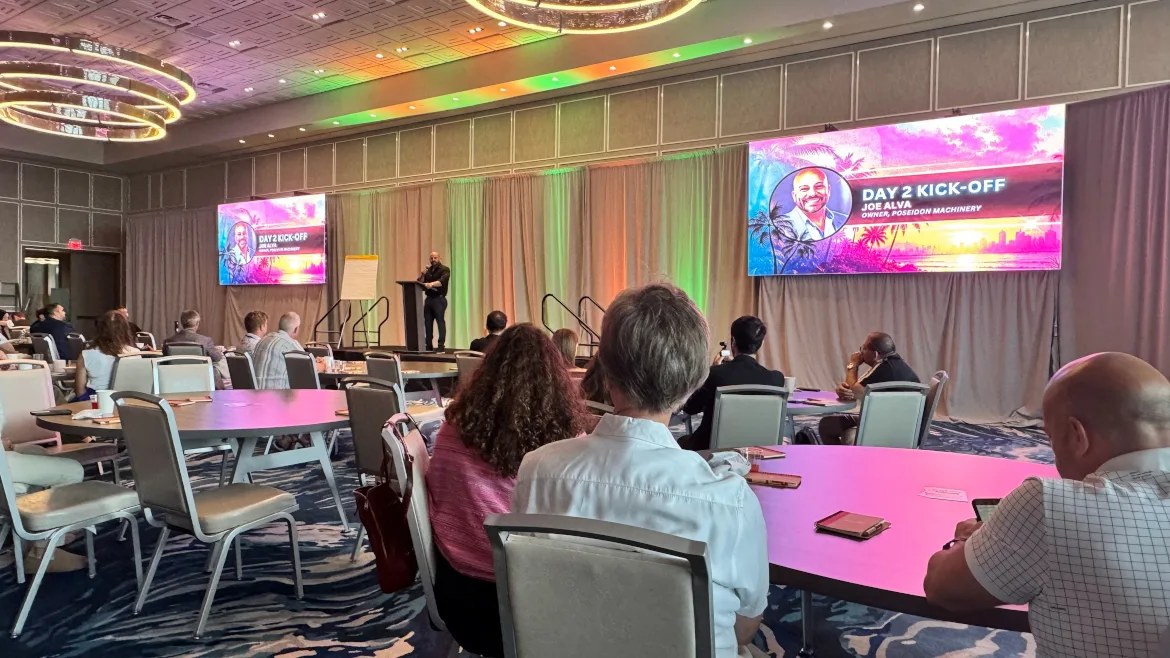
During the Poseidon Experience, which brought fabricators and other members of the countertop industry together for several days of learning and networking, Joe Alva, CEO of Poseidon Industries, spoke to the group about the art of sales. The conference was held at the Hilton Sunseeker Resort in Port Charlotte, FL, in late May 2026.
Alva explained that early on in his career he learned a way to disarm potential customers he would meet. “When you walk into a place, people have their barriers up,” he said, and then asked, “How many people here look forward to going cold calling? There's a few of us, right? There are some who love that challenge.”
Alva then inquired how many times people have gone on cold calls and got turned down. “I call it, the 22nd sales visit. You walk in, and you say ‘hi,’ and they say, ‘We are not interested.’ Then you say, ‘Okay, see you later.’ That happened to me a lot.”
Alva shared that when he started going out to sell diamond tools and supplies to fabricators, he was about 21 years old. “I was much different than I am now,” he said. “I was probably 155 pounds, a lot of hair but not a lot of facial hair. I walked into a showroom sometimes and they thought I lost my parents who were shopping for a kitchen,” he joked.
“The thing that I had going for me was that it was a big Latino community,” Alva continued to explain. “Latinos are a little more intimate. They are a little more empathetic -- a little warmer. And so, they saw this young kid that was trying to do something. Someone who was trying to live the American Dream. That helped me, sometimes, to open up the conversation, because they could tell I was not going to hose them.”
The Strategy and Art to Cold Calling
Alva explained that there is a strategy and art to cold calling. “I opened up with some funny remarks,” he said. “Humor is a great way to disarm people. It lets people relax. It also shows confidence. And it has to be done in the right way, at the right level, at the right time.”
According to Alva, he believes the number one way to disarm people is calling out the elephant in the room. “You want to build trust,” he said. “So, there's nothing better for building trust than to just say the honest thing that nobody ever wants to say. As business owners too, we always have to try to open up relationships. We want to go in full on the big builder, the big designer, the big contractor. It is not easy to go in there just by yourself.”
Alva told the audience that asking to speak to the “decision maker” is probably the worst thing you could say. “You might as well say, ‘Can I speak to somebody that's not you?” he said. “As soon as I walk [into a shop] I'll make eye contact with the gatekeeper. There's usually a gatekeeper who’s trying to defend the owner, right? Someone who does not want him wasting his time with people that he doesn't want to talk to. I'll walk in and I'll immediately apologize. And I'll say, ‘Hello, my name's Joe Alva. I'm really sorry but I just happened to be in the area. I do not have an appointment but was hoping that maybe the production manager had a minute to speak.’ That's it.”
Another point that Alva made was that you don’t have to sell to everyone. “That's something that as a kid I thought I had to do – that I had to make every deal happen.
“I found like there's three types of people,” he went on to say. “People operate on different frequencies. You have people that are very abundant-minded -- very positively charged people. There are also people that are a little more neutral. They're analytical. They're logical. You might think that they're nicer because they are looking at your product, but they are just trying to logically analyze it. And then you have people that are at a lower energy. What I try to do is to gauge people's energy. I also want to do business long term so I don't have to sell to everybody. I want to do business with people that are on frequency.”
Alva explained that as a salesperson, you have to accept rejection. “You have to be willing to get shot down,” he said. “I try to reduce the number of ‘no’s’ but you can’t get to a ‘yes’ unless you are willing to walk-through it.”
“How do you minimize the ‘no’s’?” Alva asked. “You want to be an expert in your craft – whether you are selling slabs or kitchens. You have to be solution oriented as well.
Integrity and Trust
“The other thing is integrity and trust,” Alva continued. He asked the group how many of them had Poseidon machinery, and for the ones who did purchase his machinery, how many still call him once in a while when they have a problem. He also asked that those who bought machinery, do they remember talking to him before making the investment.
“Do I answer my phone differently before, during, after, or when there's a problem and you're super stressed out about the machine?” he asked. “I made sure that the realest thing that I can do is answer my phone the same way when I'm trying to pitch you or when you already have the machine or when you're upset because the service department probably didn't get back to you as quickly as we needed to. Why? This is a long road. The way we look at relationships at Poseidon is it’s a long-term commitment. We're getting married. You're honoring us with the highest privilege – we are the heart of your company. Your whole business is going to die if that machine goes down. And you're saying that you believe in us so much that you’re willing to put your whole business in our hands. For me, that's not just business. It is an honor. I try to emit that trust and integrity when I'm visiting somebody for the first time.”
Be An Expert in Your Field
Alva also emphasized the importance of listening and asking questions when working with prospective customers. He explained that being an expert in your field is important, but equally important is understanding the customer's perspective. When a prospect says they have been using a competitor for years and they are loyal to that company, he advises against arguing with them. Instead, he recommends acknowledging and respecting that loyalty. As he puts it, "We respect that a lot. We respect that loyalty," because strong relationships are valuable and increasingly difficult to find.
He compares these conversations to a volleyball match, saying, "You want to see the ball go over the net." In other words, rather than blocking a customer's concerns or objections, salespeople should acknowledge them and keep the conversation moving. After recognizing the value of the competitor relationship, the focus should shift to the company's unique value proposition. Alva explained that every company needs a "unique identifying value "-- something that differentiates it from the competition. He often tells customers that even respected competitors "could not literally offer you the efficiency that we can offer you" because of the unique processes and solutions his company has developed.
Alva concluded his talk by highlighting key takeaways, including the importance of being disarming and building rapport. Complimenting people and showing genuine respect can help lower barriers and create a more productive discussion. When meeting with shop owners or production managers, he quickly explained that his company is not simply selling machines but offering "a different method that will make life easier."
Ultimately, he stressed that customers care more about how a solution will improve their daily lives than about technical specifications. Rather than focusing on machine speeds or engineering details, he frames the conversation around practical benefits. He asks customers to imagine having fewer headaches, fewer systems to manage and fewer operational concerns. The real value, he explained, is making the customer's work simpler, more efficient and less stressful.
Looking for a reprint of this article?
From high-res PDFs to custom plaques, order your copy today!