California's STOP Act Sets Strictest Silica Rules in U.S. for Stone Fabricators
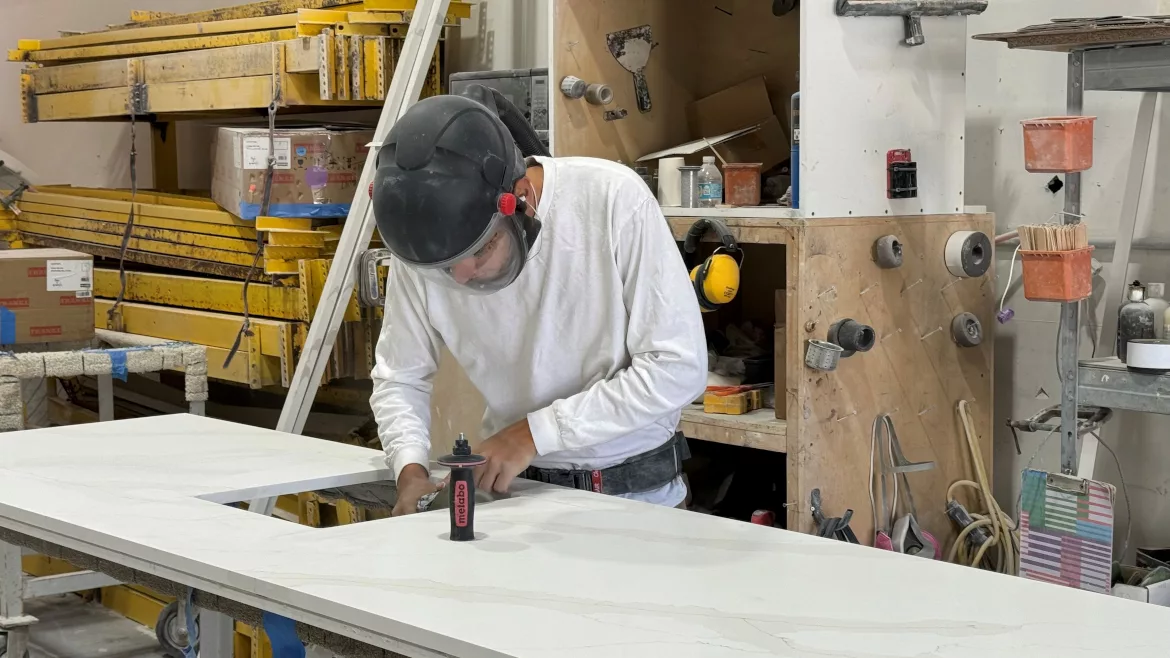
The legislation, authored by State Senator Caroline Menjivar, D-San Fernando Valley, is a direct response to what public health officials have called an epidemic of accelerated silicosis among engineered stone countertop workers in California.
Need to Know
- The STOP Act focuses on preventing silicosis among stone workers.
- The law bans certain fabrication practices, such as dry cutting, and mandates safety training for employees who perform high-exposure tasks involving silica dust.
- A phased enforcement timeline will reshape how fabrication shops operate in the state over the next 18 months.
California's Silicosis Training, Outreach and Prevention (STOP) Act (SB 20), the most aggressive state-level regulation targeting silica exposure in the stone countertop fabrication industry, took full effect on January 1, 2026, after Governor Gavin Newsom signed it into law on October 13, 2025. The law bans dry-cutting methods, mandates shop certification, classifies silicosis as a serious injury under the Labor Code and establishes a phased enforcement timeline that will reshape how fabrication shops operate in the state over the next 18 months.
The legislation, authored by State Senator Caroline Menjivar, D-San Fernando Valley, is a direct response to what public health officials have called an epidemic of accelerated silicosis among engineered stone countertop workers in California. According to the California Department of Public Health, the agency confirmed 432 cases of silicosis among countertop workers as of November 13, 2025, including at least 25 deaths and 48 lung transplants. The CDPH surveillance dashboard showed the count had climbed to 519 confirmed cases as of February 26, 2026, with the number of workers requiring lung transplants rising to 54.
"The San Fernando Valley continues to be the epicenter of silicosis cases in our state," said Menjivar. She called the bill her top legislative priority for 2025, noting that more than 120 new cases had been identified in California during the legislative process alone.
What the Law Requires
SB 20 prohibits the use of dry methods for any task the statute defines as a "high-exposure trigger task," a category that includes cutting, drilling, grinding, polishing, abrading, chiseling and the cleanup of associated dust and debris. Employers must use wet methods to suppress respirable crystalline silica dust during all such activities.
The law also bans dry sweeping and compressed air cleaning in fabrication environments, requiring wet mopping or HEPA-filtered vacuums for cleanup.
Training and attestation requirements take effect on a rolling timeline. Beginning July 1, 2026, fabrication shop owners and operators must ensure that employees performing high-exposure trigger tasks have received appropriate safety training, and they must submit a written annual attestation to the Division of Occupational Safety and Health confirming compliance. The State Department of Industrial Relations is required to adopt a formal training curriculum by the same date.
The certification provisions carry a longer runway. By January 1, 2027, the department must have developed an application and certification process for fabrication shops. Beginning July 1, 2027, shops must hold a valid three-year certification, or have a pending application, to lawfully engage in fabrication activities on slab solid surface products. Suppliers will be prohibited from selling stone slabs directly to uncertified shops after that date.
Enforcement and Penalties
The STOP Act reclassifies silicosis and silica-related lung cancer as serious injuries under the California Labor Code. That designation triggers mandatory Cal/OSHA investigation when cases are reported and carries steeper penalties for violations.
Cal/OSHA can issue an Order Prohibiting Use to immediately halt machinery or fabrication processes if dry-cutting is observed. Serious violations can result in fines of up to $25,000, while repeat offenses can trigger penalties as high as $162,000.
The law also strengthens data-sharing between agencies. CDPH is required to report confirmed silicosis cases to Cal/OSHA within three days for investigation. Cal/OSHA must notify CDPH of cases identified through enforcement activities within five days and share silica exposure assessment data within 30 days.
Employers must report confirmed cases of silicosis and silica-related cancers to both Cal/OSHA and CDPH within five days of identification.
Compliance Challenges Persist
The STOP Act builds on emergency temporary standards Cal/OSHA adopted in December 2023 and made permanent in February 2025. But enforcement of existing rules has been uneven. According to an NPR report in January 2026, Cal/OSHA inspections of more than 100 fabrication shops over a six-month period found that none of the workers observed were using the appropriate level of respiratory protection during high-risk tasks, and an estimated 25% of shops continued to dry-cut stone.
Jenny Houlroyd, a research scientist at Georgia Tech who has worked with fabrication shops for more than 20 years, said consistent compliance remains rare. Her research has found that even when companies used wet-cutting methods with engineered stone, nearly 50% of workers still exceeded OSHA's permissible exposure limit of 50 micrograms per cubic meter of air.
"It's incredibly hard to guarantee that these workers are protected from this exposure," said Houlroyd.
Scope of the Crisis
Engineered stone, also known as artificial stone or quartz, typically contains more than 90% crystalline silica by weight, significantly more than natural granite, which averages 30% to 45%, or marble, which contains less than 10%. Workers who cut, grind, polish and finish slabs made from the material can be exposed to high concentrations of respirable silica dust.
California is the only state actively conducting systematic surveillance for silicosis cases linked to engineered stone fabrication. The CDPH dashboard tracks cases by county, with the highest concentrations in Los Angeles County, where the San Fernando Valley has been designated as ground zero for the epidemic.
The bill's legislative findings note that the first cases of engineered stone silicosis were reported in Spain in 2010, Israel in 2012 and the U.S. in 2015. Australia became the first country to ban the use of engineered stone in July 2024 after documenting hundreds of cases among its countertop workers.
The affected workforce is overwhelmingly composed of young Latino immigrant men. CDPH data show a median age at diagnosis of 46 and a median age of death of 48. Silicosis became a reportable disease in California in June 2025, though public health officials have acknowledged that confirmed case count likely underestimate the true burden.
The Stone Industry's Response
The STOP Act targets fabrication processes rather than the engineered stone product itself, a distinction that aligns with the position of major slab manufacturers such as Cambria, the largest domestic stone slab manufacturer. Micah Aberson, executive vice president of Cambria, has argued that silicosis is a process issue, not a product issue, and that fabrication shops can operate safely with proper wet cutting, ventilation and air monitoring.
"All you need is wet tooling, wet processing, appropriate ventilation and air monitoring. And you can run a safe operation," said Aberson.
Meanwhile, the Western Occupational and Environmental Medical Association, a group of workplace health experts in seven Western states, has petitioned California's Occupational Safety and Health Standards Board to go further and ban the cutting of engineered stone with high silica content. That petition, along with the broader question of whether workplace controls are sufficient to protect fabricators, is expected to remain a central point of debate as the STOP Act's phased deadlines take effect.
Federal Context
At the federal level, California's regulatory push stands in contrast to a separate legislative effort in Congress. H.R. 5437, the Protection of Lawful Commerce in Stone Slab Products Act, introduced in 2025, would prohibit civil actions against manufacturers or sellers of stone slab products for harm resulting from a fabricator's alteration of the product. A House Judiciary subcommittee held a hearing on the bill on January 14, 2026, titled "Between a Rock and a Hard Place: Protecting the American Stone Slab Industry from Lawfare."
David Michaels, who served as OSHA director from 2009 to 2017, told NPR that the proposed federal legislation would remove a key incentive for manufacturers to ensure downstream safety. He said there are simply not enough federal inspectors to visit the more than 10,000 countertop fabrication employers operating nationwide.
What's Next for Stone Fabricators
The next major compliance milestone arrives July 1, 2026, when the annual training attestation requirement takes effect and the state must have its formal training curriculum in place. The certification application process must be developed by January 1, 2027, with mandatory shop certification beginning July 1, 2027.
The Department of Industrial Relations, CDPH, and Cal/OSHA are currently developing the rules, curricula and certification criteria that will govern the program. Industry stakeholders, occupational health specialists and labor groups have been involved in the process.
Menjivar signaled that additional legislation is likely. "While this bill alone will not end silicosis from stone fabrication activities, we are taking decisive steps to increase tracking, accountability and enforcement," said Menjivar after Newsom signed the bill. "This is the building block we will stand upon, and I am committed to coming back and working on the next step."
Key Dates
October 13, 2025:
Governor Newsom signs SB 20 into law.
January 1, 2026:
Law takes full effect. Dry-cutting ban enforced.
July 1, 2026:
Training curriculum adoption deadline. Annual attestation requirement begins.
January 1, 2027:
Certification application process must be developed.
July 1, 2027:
Mandatory three-year shop certification takes effect. Suppliers barred from selling to uncertified shops.
Looking for a reprint of this article?
From high-res PDFs to custom plaques, order your copy today!

Jason Kamery is the Managing Editor and Group Digital Editor of Stone World. With more than a decade of experience covering the stone and countertop industry, he has conducted hundreds of interviews with fabricators, manufacturers, and industry leaders, and hosts the Stone World. podcast. He reports from events worldwide, including TISE, Coverings, and Marmomac, and his coverage extends to worker safety and silicosis, trade policy and tariffs, and fabrication technology. Kamery has also served as a speaker and panel moderator at The International Surface Event (TISE). He graduated from Purdue University with a B.A. in Mass Communication.
email: kameryj@bnpmedia.com | office: (248) 833-7356