Why Improved Customer Service Leads to More Sales
During StoneBiz on the Beach, keynote John DiJulius explained how elevating the customer experience is a crucial part of building a profitable business
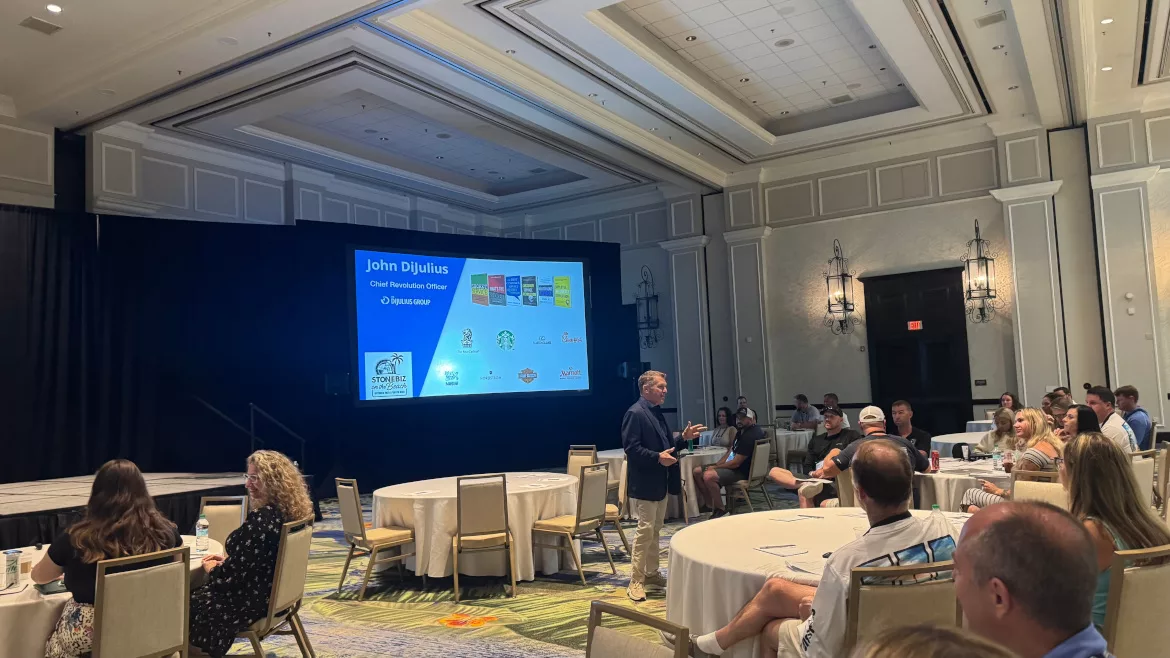
Fabricators and other stone industry professionals recently gathered for an intensive workshop on customer service excellence during StoneBiz on the Beach, a three-day conference organized by the Stone Fabricator’s Alliance, which took place from October 15 to 18, 2025 in Rio Grande, Puerto Rico. John DiJulius, founder of The DiJulius Group, delivered strategies specifically tailored to countertop fabricators, designers and industry partners looking to stand out in a crowded market.
DiJulius opened with a striking statistic. Most businesses spend 98% of training time on technical skills and just 2% on soft skills like empathy and rapport building. He challenged attendees to rethink their approach. Of the hours spent training new employees, how much actually focuses on making customers feel valued versus learning operational systems?
"World-class customer service companies remove personal interpretations," said DiJulius. Instead of vague directives to "go above and beyond," top organizations give employees specific measurable actions that define great service.
Understanding Your Customer's Journey
DiJulius presented a core problem. Most customer-facing employees have never been in their customers' shoes. They have never been a homeowner undertaking a major renovation or a contractor juggling multiple deadlines. He showed a powerful video depicting a typical customer's chaotic day. The message? Employees need to understand the stress and pressure customers face before walking into a showroom.
For fabricators, this means recognizing that customers are not just buying countertops. They are managing stressful renovations, coordinating multiple vendors and making decisions that significantly impact their homes. Understanding these pressures helps teams respond with appropriate empathy and communication.
The Experience Action Statement
DiJulius introduced the Customer Experience Action Statement as a company's north star. Unlike vague mission statements, action statements tell employees exactly what to do during every customer interaction.
In 2010, DiJulius helped Starbucks create their customer experience action statement, which is printed inside every green apron so employees see it multiple times daily.
The statement needs three pillars. First, expertise. But DiJulius flipped conventional thinking here. "Expertise is demonstrated in the questions you ask, not the answers you give," he said.
Second, emotional connection. Employees must be fully present with customers, treating them as individuals rather than appointments or transactions. Third, going above and beyond. But these moments do not have to be grand gestures. Most memorable moments cost nothing. They are about remembering what a customer mentioned last time or taking an extra minute to solve a problem.
Never Say, Always Do
The presentation included practical lists of non-negotiable standards for customer interactions. These are not suggestions. They are requirements.
Never:
- Point (always walk customers where they need to go)
- Say "no problem" (use "my pleasure" or "certainly" instead)
- Overshare about internal challenges or staffing issues
- Make assumptions without asking questions
- Accept "fine" as feedback (dig deeper to find the real response)
Always:
- Introduce yourself, even to returning customers
- Use the customer's name multiple times
- Beat the greet (acknowledge everyone within 15 feet)
- Ask "Is there anything else I can help you with today?"
- Focus on what you can do, not what you can't
DiJulius was adamant about these standards. "Never say 'no,'" he instructed. "Focus on what you can do. Don't use the word 'no' at all."
Measuring What Matters: Earned Growth
DiJulius introduced a metric most fabricators are not tracking. It is called Earned Growth, and it reveals the percentage of revenue from repeat customers and referrals versus advertising spend.
He shared a case study of a law firm that increased earned growth from 30% to 67%. The result? Dramatically lower marketing costs and higher profitability.
The formula is simple. Take repeat and referral revenue and divide by total sales. But tracking it requires one critical step. Every new customer must be asked how they found you, and that information must be recorded in your CRM before moving forward.
"If your earned growth is in single digits, you're too dependent on advertising," DiJulius warned. "But if it's in the 60s, you're generating your own business."
Being in the Certainty Business
DiJulius shared research showing that uncertainty is a primary cause of customer anxiety. People hate not knowing. In fact, studies show people would rather receive an electric shock immediately than wait in uncertainty about whether they will receive one.
For countertop projects, this insight is critical. Customers are already anxious about major financial decisions and home disruptions. Fabricators who excel at "the certainty business" stand out by proactively managing expectations.
What does this look like? Consistent communication about timelines, upfront discussion of potential delays, clear next steps and follow-up even when there is no new information to share.
"People would rather have bad news than no news," said DiJulius. "Be in the certainty business."
The Power of Connection
Building authentic customer relationships follows a simple formula, DiJulius explained. It is called the FORD method. Learn about their Family. Their Occupation. Their Recreation. Their Dreams.
The rule is straightforward. In any conversation, you must learn two or more new things about the other person. If you do, you have built a relationship. If you do not, you have just talked at them about yourself.
"We're all genetically coded to be preoccupied with what’s going on in our own lives," said DiJulius. "You have to fight that urge."
Removing Employee Roulette
DiJulius introduced a term that resonated with the audience. "Employee roulette" happens when customer experience quality depends entirely on which team member they encounter.
One customer gets exceptional service from a knowledgeable friendly employee. Another gets indifference from someone having a bad day. This inconsistency destroys brands.
The solution? Document specific behaviors and train relentlessly. Every employee must deliver the same standard of service, regardless of their mood, experience level or personal style.
Finding Your Fumble
Every business has a critical moment where customers are lost or revenue leaks away. DiJulius calls this "the fumble."
He shared the story of a mortgage company losing 15% of approved customers every month. The reason? Loan officers stopped communicating once approval was secured. They moved on to the next sale while approved customers felt abandoned.
The fix was simple but powerful. If a loan officer did not contact an approved customer every 48 hours, the loan froze in the system. Management phones started ringing. The fumble rate dropped to 8%, saving $1.4 million monthly.
DiJulius challenged fabricators to identify their fumbles. Is it follow-up after the initial quote? Communication during fabrication? Post-installation service? Find it, fix it and make it impossible to fumble again.
The Bottom Line
DiJulius closed with a sobering statistic. Approximately 80% of companies believe they provide excellent customer experiences. Only 8% of their customers agree. This gap represents the opportunity for fabricators willing to do the work.
In an industry where technical quality is expected, customer experience becomes the real differentiator. Companies that invest in service training, create clear standards and make every interaction meaningful can make price irrelevant.
"Discounting is a tax you pay for being average," said DiJulius. “The goal is to build relationships so strong that customers never price shop your competitors.”
For fabricators serving homeowners who renovate once per decade, the stakes are even higher. The experience you provide determines whether customers become advocates or cautionary tales.
DiJulius’s session made it clear. In today's market, being good at fabrication is the entry point. Being exceptional at customer service is how you win.
Looking for a reprint of this article?
From high-res PDFs to custom plaques, order your copy today!

Jason Kamery is the Managing Editor and Group Digital Editor of Stone World. With more than a decade of experience covering the stone and countertop industry, he has conducted hundreds of interviews with fabricators, manufacturers, and industry leaders, and hosts the Stone World. podcast. He reports from events worldwide, including TISE, Coverings, and Marmomac, and his coverage extends to worker safety and silicosis, trade policy and tariffs, and fabrication technology. Kamery has also served as a speaker and panel moderator at The International Surface Event (TISE). He graduated from Purdue University with a B.A. in Mass Communication.
email: kameryj@bnpmedia.com | office: (248) 833-7356