Fabricating and Installing Vertical Applications
Two industry veterans share similar thoughts on the growing popularity of large slab installations and points to consider when working with these materials
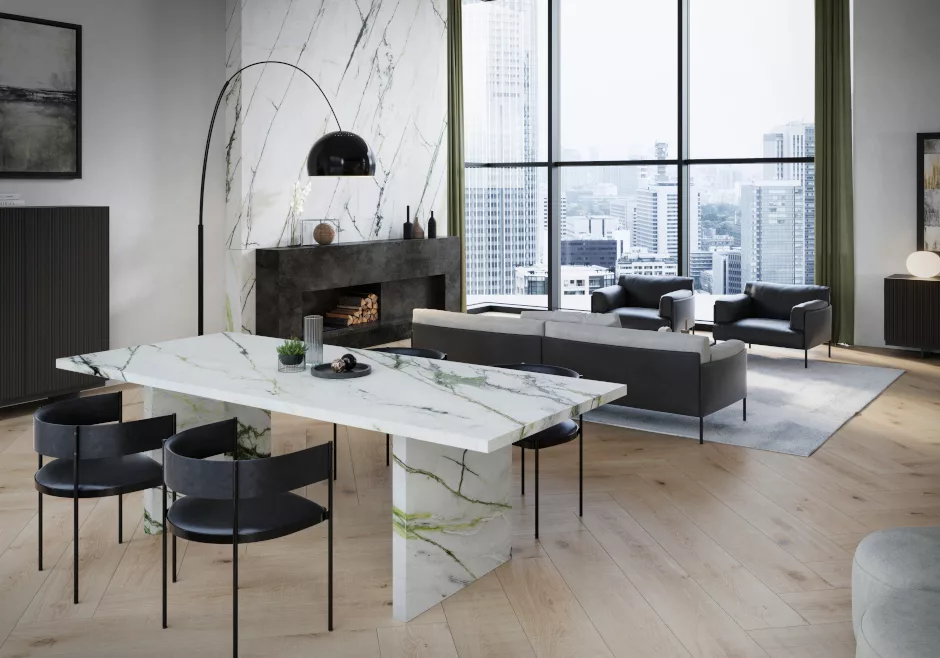
Photo courtesy of XTONE by Porcelanosa
With advances in technology leading to the explosion of thin and large-format porcelain and sintered stone slabs flooding the market, consumers are drawn to these materials for their beauty, durability and ease of maintenance. They are becoming highly sought-after for various vertical applications – particularly in residential design. Stone World was excited to catch up with two past Fabricator of the Year Award winners, Sandya Dandamudi, president of GI Stone in Chicago, IL (2020), and Ron Hannah, president of Cadenza Granite & Marble in Concord, NC (2007), to ask them to share their observations and experiences of working on vertical surfaces.
SW: Do you find that you are fabricating/installing more vertical applications lately?
SD: We are definitely seeing an increase in vertical applications. Vertical applications provide a “cleaner” look and are easier to maintain. But I feel what really is driving this are the thinner and lighter materials like porcelain and Dekton now available in the marketplace. These materials are easier to install and therefore not cost prohibitive.
RH: We are definitely seeing an increase in vertical applications primarily due to the availability of thin large-format porcelain and sintered stone slabs. Homeowners have always loved the look of marble, but historically, have not been willing to deal with the inherent natural characteristics of the stone. While marble shower walls and backsplashes, etc. look great on the day of installation, their beauty progressively declines as the end-users are rarely willing to carry out the necessary maintenance to maintain the product. Sintered stone and porcelain slabs have changed that. With these products, you can achieve the desired look and feel without any required upkeep. The product is virtually bullet-proof. Porcelain and sintered stones do not stain, etch or scratch. From an installation perspective, the slabs are thin and light (6mm, 8mm, 10mm), and can be hung with simple thin-set adhesives without the need for mechanical fasteners.
SW: In particular, which types of vertical applications are currently most popular?
SD: Shower walls and full-height splashes are now in vogue, but we are also seeing an increase in accent walls. People like the fact that once again these are easier to maintain and there are a variety of colors/patterns and finishes to choose from.
RH: We are seeing a huge demand for full showers, including ceilings, full-height backsplashes and floor-to-ceiling fireplace surrounds.
SW: You both mentioned porcelain and sintered stone slabs are the most common materials being used for vertical applications. Why do you think that is?
SD: Porcelain and Dekton slabs are more in demand for these applications than natural stone or quartz because they are thinner and lighter. Using quartz in wet spaces is not always advisable because of its resin content, and this can potentially cause warping. Natural stone is great and still a “gold” standard, but it is more expensive and requires some maintenance.
RH: Without question, we are seeing thin sintered stone and porcelain slabs pushing the others out of the market due to their light weight and high-resolution images.
SW: What are some considerations when working on a vertical installation?
SD: Surface prep, surface prep! It is important to make sure that walls are even and level. In cases like showers, water proofing will be required.
RH: One false move with this material and it shatters. Which brings up safety. When porcelain breaks, it does not just crack like natural stone, it shatters. The resulting broken pieces are as sharp as razor blades. Long pants, long sleeve shirts and gloves are a must. When possible, we purchase material that comes with a mesh backing, as this mesh will hold the pieces together should we suffer a mishap.
SW: What are some challenges that can be encountered when working on vertical applications?
SD: As in any case, you need qualified installers that know how to handle stone. If you break a piece then the whole wall gets affected.
RH: We have realized that we need to carefully monitor and evaluate the preceding contractor’s work. Standard industry-accepted framing is no longer acceptable. Due to the large size of the panels and brittle nature, it is imperative that all surfaces be extremely flat, level, plumb and on plane. Clear unobstructed jobsite access is now a greater concern for all the same reasons. We are now bringing in full slabs of 1/4-inch-thick material instead of boxes of tiles.
SW: Is any certification/training needed for anchoring systems for these applications?
SD: Training is required. Anchoring systems are often not required for interior applications where the walls are less than 10 feet, but walls need to be well reinforced for support and in the case of thinner materials like Dekton and porcelain, additional reinforcement may not be required.
RH: Like anything new, everyone is eager to climb aboard what I call the “Large-Format, Thin Slab Train.” Every slab distributor now carries a thin slab line. In their haste to climb on board, few are taking the time to learn about the products and even fewer are producing any documentation covering acceptable fabrication and installation practices. While the products are relatively inexpensive compared to natural stone, working with them is not. Everything must slow down. The truck drivers delivering the material need to be trained on how to properly and safely handle these thin slabs. Shop employees need to be trained on how to unload, store and move the products around the shop. The required blades, feed rates, RPMs etc. are not only different from those used on natural stones but also vary between the various thin slab manufacturers. Not all sintered stones or porcelains are created equal. Like natural stone, each slab needs to be approached with caution.
We have seen some horrible installations of these products that leave the industry with a black eye. Distributors need to provide training/certification in order to maintain the quality of fabrication and install the product demands.
All that being said, with sintered stones and porcelain, the possibilities are endless. When fabricated and installed correctly, the results can be nothing short of stunning.
Looking for a reprint of this article?
From high-res PDFs to custom plaques, order your copy today!