Fabricators Discuss Safety in the Shop
Stone World asked two fabrication shops to share their policies and procedures for maintaining a safe and clean working environment
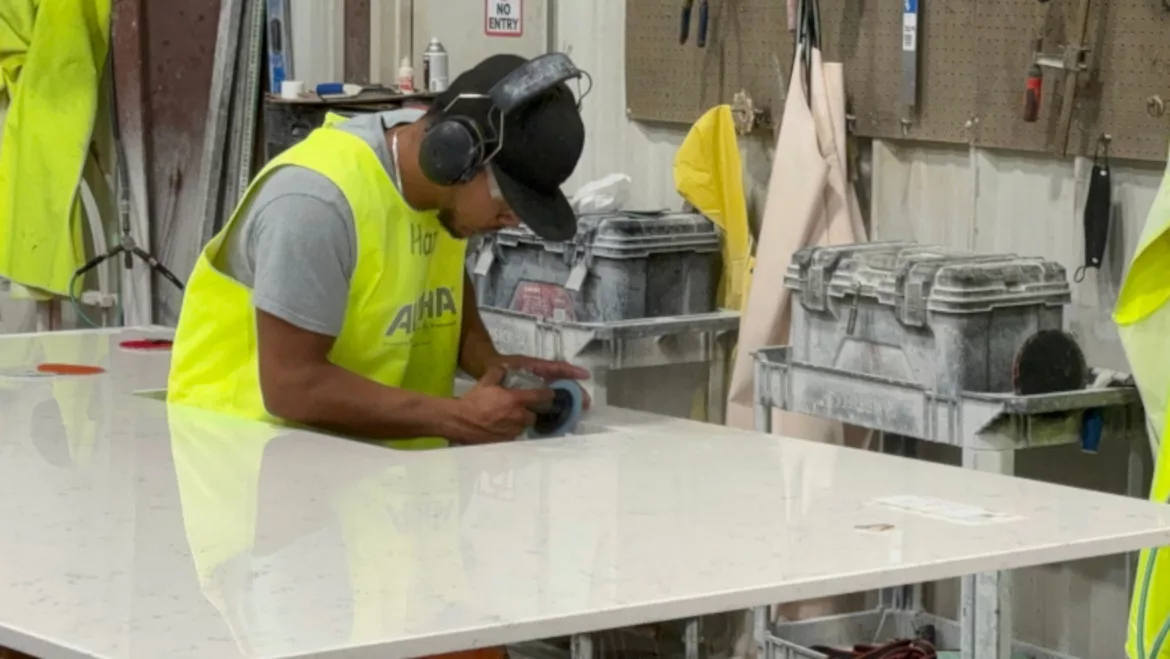
Photo by Jennifer Richinelli/courtey of The Colorado Floor Co.
Safety in the shop should always be at the forefront of fabricators minds, but with the Occupational Safety and Health Administration (OSHA) tightening its regulations, and silicosis currently being a “hot” topic, it is even more crucial to take proper measures to protect employees in the workplace. Jeff Erickson, founding partner of Cutting Edge Countertops in Perrysburg, OH, and his team, as well as Jason Laski and Richard Pelayo of The Colorado Floor Co., took time to explain what precautions and policies they have in place to ensure shop safety is given the upmost importance by their entire staff.
SW: What safety procedures do you currently have in place at your shop?
CF: Colorado Floor has been OSHA certified since 2019, and we are striving to achieve their STAR program, which is the highest level for exemplary worksites with successful safety and health management systems and low injury and illness rates.
CEC: CEC has a comprehensive safety plan that has been developed with the team over time. We have a dedicated safety officer that handles not only the development, but the employee engagement. There are many aspects to the overall plan. Here are a few critical examples:
|
|
|
|
|
|
|
SW: How often do you have hearing and breathing tests performed on your workers?
CF: Annual hearing tests are performed on all current employees. We have all new hires tested for existing silica issues, which include a chest x-ray, pulmonary function test, respiratory clearance exam and TB skin test. This testing is readministered every three years on existing employees who meet that timeline.
We test to protect the employees, as well as the company, and to provide knowledge to all individuals about the harmful potential of silicosis.
CEC: We complete pre-employment pulmonary function tests, chest x-rays and audiogram on all shop and warehouse personnel to establish a baseline. In addition, we monitor several aspects of our environment, including noise levels and silica levels. The silica exposure assessments for production and installation crews show that the expected Respirable Crystalline Silica (RCS) exposures are below the Action Level for RCS.
The reason for the testing is to demonstrate compliance with specific provisions of OSHA regulations, and to continue our best practices to help CEC administer a continuing, effective hearing conservation program.
SW: How has the recent OSHA regulations regarding silica in California influenced the best practices in your shop?
CF: Currently it doesn’t, as we feel we have been practicing these standards since 2019.
CEC: CEC refocused efforts to review compliance -- on a point by point basis -- with the OSHA Respirable Crystalline Silica standard. Federal OSHA – possibly in response to CAL OSHA’s earlier actions -- helped our review process by issuing its detailed September 23, 2023 letter to the regulated community. In the letter, OSHA provides most of the topics its inspectors may ask about when they arrive for a silica inspection. Our review process was useful, and we encourage ALL fabricators to look at the topics in the letter and formulate responses.
As is well known, but maybe not appreciated enough, the events in California prompted the Natural Stone Institute (NSI) to expend a great deal of effort for the betterment of the industry. One of the several big accomplishments was the joint publication (NSI and ISFA -- International Surface Fabricators Association) --with Yale University School of Medicine -- of two guidance documents regarding Respirable Crystalline Silica exposure monitoring in the workplace. The NSI and ISFA have taken many opportunities to promote these tools to the industry, and we think they would appreciate additional promotion and use of these two documents to help fabricators complete high-quality RCS exposure monitoring.
Following the Yale guidance will help to show regulators that an individual fabricator believes that silica exposure monitoring should be serious, scientific and well documented. Perhaps more importantly, it will show a willingness to work with others to move towards developing a consensus industry standard. Consensus industry standards are a foundational block of OSHA’s regulatory approach. We can all help ourselves and our industry by collecting high-quality RCS exposure data in the same professional way across the country.
Additionally, on August 22, 2024 OSHA published a detailed million-dollar list of fines proposed for a Chicago fabricator. It is another blueprint of what questions/topics may be explored during an OSHA RCS inspection.
CEC has always been a wet shop. Our understanding is that most of the illnesses in California occurred in small contract-based dry shops. CEC’s experience and actions are guided by the NIOSH hierarchy of controls system to reduce hazards, and we do not want to miss an opportunity to encourage ALL to go to the CDC website and look under NIOSH’s page: https://www.cdc.gov/niosh/learning/safetyculturehc/module-3/2.html#:~:text=Hierarchy%20of%20Controls-,Hierarchy%20of%20Controls,PPE%20when%20compounding%20chemotherapy%20drugs).
SW: What resources do you use to learn about the most current safety regulations and best practices?
CF: Our safety manager keeps us complaint on all OSHA regulations. Also, working towards their STAR program keeps us up-to-date with any/all changes.
CEC:
- The OHSA standards https://www.osha.gov/
- Topic specific content from the Centers for Disease Control and NIOSH
- The Natural Stone Institute
- Ohio Bureau of Workers’ Compensation – links to their safety content library
- Insurance company -- links to their safety content library
- Third party professional’s opinions
SW: What are some ways you make your employees aware of the importance of shop safety?
CF: Monthly safety meetings which review all different topics from straps on carts to eye wear and hearing protection, as well as a myriad of other important topics.
CEC:
- All new hires go through an orientation on their first day, which includes an aligned message from Human Resources (HR) and Operations on safety. Additionally, new hires are scheduled to meet with our HSE specialist who reviews our safety procedures and provides the new hire with PPE. Additionally, all new hires are given a copy of the CEC safety manual which provides reinforcement of the company’s position.
- All material handling equipment (forklift and crane) training is done in person – in small groups of one or two employees -- to allow for greater effectiveness and exchange of knowledge. Other safety training is done in-person and in an on-line format.
- Regular inspections of forklifts, cranes and company trucks are completed, shared and tracked electronically. Supervisors can track completion daily, and do not have to seek out paper-based forms.
- Regular conversations with employees occur with supervisors on the floor and in the supervisor office.
- Specific small group discussions have been held with installation and production crews after safety incidents or near misses to learn of similar crew experiences and to inform all of the event.
- We have television display monitors in all employee areas -- in all service centers -- that cycle through interesting and ever-changing slides. The monitors display company news and topic-specific safety-based slides.
SW: What policies do you have in place if an employee does not comply with your safety protocol?
CF: We use a “Red Card” system where when one of our employees is not following our current safety protocol the red card is given to the employee and then they are required to speak to their direct supervisor. These red cards are logged and tracked, and depending on the violation, a three-strike termination will be implemented.
CEC: Employee counseling and shop-floor base re-training is generally the first response to behavioral safety issues. When needed, we do have a progressive discipline policy which will be utilized based on the situation. People have been terminated for exhibiting grossly unsafe behavior.
SW: Is there anything else you would like to share on shop safety?
CF: None of this is simple. It is time-consuming and tedious. But if we strive to be the best, safety for our employees has to be paramount. It took us almost two years to resolve all of our OSHA and silica compliance, but once we got there it was clear that we had to maintain this level of certification for not only the business, but more importantly, our employees.
CEC: CEC strives to make safety a first mentality in our organization – two examples:
- Our production employees keep the production area floors washed down. Our silica training program focuses on how to recognize sources of the invisible Respirable Crystalline Silica particles -- less than 10 microns in diameter -- from being present in the breathing zone. Keeping the floors washed down moves silt to the in-floor trenches and then on to the water reclamation and filtering system. Settled silt from that has dried on floors can be disturbed by walking on it, which can reintroduce these very small particles to the breathing zones - which is only 5 to 6 feet away. Our employees know this from their training program, and they take actions on their own many times a day to keep the floors, countertop pieces and workstations washed down and the invisible particles headed to the water filters.
- Our employees know that the falling stone is heavy and unforgiving. We have trained on and discussed this issue ahead of time. Each person knows not to try to stop falling stone and to move out of the way. There will be plenty of time after the two-second event to understand what happened and why.
Workplace environment monitoring provides the best feedback on our process controls and informs us on ways to improve. Also, there is no substitute for regular training and communication up and down the organization. There are several ways to do this. CEC has an HR Generalist with a strong safety training background who works closely with an HSE representative. Together, they take technical HSE matters and create digestible, fit-for-purpose training programs and content. These can be delivered via several mediums, including online. Training attendance is tracked and documented.
Looking for a reprint of this article?
From high-res PDFs to custom plaques, order your copy today!





.webp?height=200&t=1754445337&width=200 "osha")