Reducing Our Carbon Footprint with Tile
Natural ingredients, material transparency and standardized reporting contribute to the reduction of global warming potential
.webp?t=1725988564)
If the goal is to use environmentally friendly, durable and resilient building materials, ceramic tile is the natural choice. This article is a refresher for the many ways ceramic tile contributes to sustainable project goals. Anecdotally, tile and stone have long been recognized as durable and sustainable materials. Recent strides in material and performance reporting requirements of sustainability rating systems now offer the data to prove it. From its manufacturing, its transparency in reporting material ingredients, its long service life and its installation by qualified labor, ceramic tile can help reduce the global warming potential of our buildings.
Manufacture of Tile
Ceramic tile is manufactured from raw materials that are plentiful and naturally occurring like clay, feldspar and quartz. These natural materials are extracted from the earth, mixed together, pulverized, spray-dried, formed into shape, then glazed and fired, creating a strong and durable product. Techniques like water recovery during drying and the use of abatement filters to capture dust emissions during firing have greatly reduced the impact of tile manufacturing.
The result is a material that is resistant to moisture, abrasion, impact, fire, bacteria and mold; a product that, when installed by trained and qualified labor, will last a lifetime.
Building Materials Transparency
The American Institute of Architects (AIA) defines building material transparency as “Manufacturers disclosing the environmental, health and social impacts of their products.” When design professionals really understand what goes into a particular building material, they can make educated decisions about what materials to specify.
Material transparency is the foundation of a document recently published by the Tile Council of North America (TCNA), the Material Ingredient Guide. In producing this guide, TCNA collaborated with 17 manufacturers of tile, setting materials and grouts, gathering detailed information about the makeup of their products.
Full disclosure of product information leads to manufacturers optimizing their products by phasing out harmful ingredients and processes. The first step to building sustainably is selecting natural and lasting materials like ceramic tile, stone and masonry. Transparency in disclosing building ingredients keeps manufacturers accountable. The Material Ingredient Guide lists four steps to transparency: inventory, screening and assessing, disclosing and optimizing.
Step One: Inventory
Inventorying ingredients is how manufacturers categorize and quantify the makeup of their products. It is good practice to report all the ingredients in a material. If compliance with sustainable building rating systems is a goal, the reporting should be to the minimum specificity of 1,000 parts per million (ppm), with additional incentives possible when ingredients are reported to the higher degree of 100 ppm.
For example, consider ceramic tile and its composition of clay, feldspar and silica. Manufacturers break down those ingredients even further, to the substance level, quantifying the quartz, aluminum oxide and iron oxide within the clay, each according to the substance’s unique chemical abstract service registry number (CASRN). The end result is a manufacturer's inventory report with all ingredients reported to the required level of precision.
Step Two: Screen and Assess
Once manufacturers have quantified their material ingredients in an inventory report, they move to step 2 of the transparency process, screening and assessing. In this stage, the ingredients are evaluated by an objective set of criteria to determine their relative level of toxicity. One common screening tool is the GreenScreen® assessment which scores substances based on persistence (the length of time a chemical can exist in the environment before being destroyed by natural processes), bioaccumulation (the process in which a chemical substance is absorbed by an organism), human toxicity and ecotoxicity.
Under this GreenScreen benchmarking method, ingredients are given a score 1 through 4. Benchmark 1 indicates substances to avoid due to high toxicity concerns. Benchmark 2 indicates substances that may be okay, but it is advisable to use a safer substitute. Benchmark 3 indicates substances that may be used, but still have opportunity for improvement. Finally, benchmark 4 indicates preferred substances with low or no toxicity.
With the transparency goal in mind, the Material Ingredient Guide presents chemicals and substances common to tile, setting materials and grout with their corresponding GreenScreen benchmark scores, helping to communicate with designers and specifiers who require material ingredient disclosure.
Step Three: Disclosure
Once the inventory and assessment stages are complete, manufacturers disclose their material ingredient information to design professionals who are intent on specifying safe and sustainable materials. This disclosure should be done using a standardized reporting format, for example, a Health Product Declaration (HPD), a Manufacturer Inventory (MI), a Declare label, or another recognized vehicle for reporting. These reports present the GreenScreen benchmark scores for each material ingredient in a clear and standardized way.
Step Four: Optimization
If the first three steps toward transparency in construction materials are borne by the manufacturer, the final step, optimization, is the responsibility of the design professional.
Optimization occurs when a design professional specifies materials with the most thorough level of material ingredient reporting and the least impact to environmental and human health.
LEED v4 sets forth a good example of optimization in their Material Ingredient Reporting credit. When a project uses 20 different permanently installed products from at least five manufacturers who report their ingredients via health product declaration (HPD) or manufacturer inventory (MI) disclosing ingredients to at least 1,000 ppm, it is eligible for one point; and if at least five of those products from three manufacturers report ingredients to 100 ppm, an additional point may be achieved.
A project doesn’t necessarily need to seek certification with LEED or any other rating system to optimize materials. The most basic step to building sustainably is selecting natural and lasting materials like ceramic tile, stone and masonry. Transparency in disclosing building ingredients keeps manufacturers accountable. Tools like the Material Ingredient Guide help unify and standardize the reporting process.
Environmental Product Declarations (EPDs)
Introduction to EPDs
In addition to material ingredient transparency, North American tile manufacturers also report their materials’ impacts on environmental and human health in the form of Environmental Product Declarations (EPDs). EPDs provide a standardized and convenient way to comparatively predict relative environmental impact of building materials during the product selection stage.
EPD Product Category Rules (PCRs)
EPDs are useful for comparing impacts of different building materials because they present information in a standardized format. The validity of any EPD assumes that it was prepared in accordance with its associated Product Category Rules (PCRs) developed by an unbiased program operator.
PCRs are developed with input by material manufacturers and trade associations under the umbrella of a program operator, an independent agency that conducts, administers and supervises EPD development according to ISO standards. PCRs set the basis for measuring the environmental attributes of a product in a certain group -- flooring for example. The PCR will inform the Life Cycle Analysis (LCA), and in turn the LCA and the PCR together inform the EPD.
The PCRs for flooring were developed jointly by many flooring companies and organizations coming from the resilient, carpet, tile, wood and laminate flooring industries. UL Environment is the program operator for all flooring EPDs.
According to the PCRs for flooring EPDs, a 75-year building service life must be considered, along with the number of replacements or refurbishments of the flooring within the service life. Put another way, the PCRs for flooring require a cradle-to-grave evaluation, therefore they must consider extraction, production, construction, use and end-of-life stages for the flooring material. Since the Reference Service Life (RSL) of the tile assembly is also 75 years, routine maintenance is considered in its projected Global Warming Potential (GWP), but replacement of the flooring is not. Therefore, this cradle-to-grave analysis favors tile, stone and other hard flooring materials since their service life is 75 years. Unlike vinyl, wood, carpet and laminate, no tile replacement need be considered for the purposes of the EPD.
Tile’s Industry Wide EPDs
Many individual tile and setting material companies in North America offer single-company, single-product EPDs, and these documents are helpful when the exact product to be used is known. But for a broad overview of these materials, it is convenient to refer to the industry-wide EPDs produced by TCNA and their manufacturer partners, which present the industry average GWP values for domestically produced tile, mortar and grout based on values reported by the major manufacturers of these materials.
The key output of any EPD is the material’s GWP measured in kg of CO2 per m2 of building area, making it easy to compare GWP of different flooring materials.
Design professionals are encouraged to download the industry wide EPDs for tile, mortar and grout from TCNA’s website and closely examine the health and environmental benefits of tile and stone relative to other floor finishes. While these materials may not have the cheapest initial cost, they use safe ingredients, and when installed with qualified labor, they will last the life of the building and reduce its carbon footprint.
Flooring GWP Comparison
To accurately compare the environmental impacts of competing flooring materials, it is important to have consistent and reliable EPDs that conform to their industry’s Product Category Rules when reporting GWP. EPDs should not be biased toward one material or another.
When flooring manufacturers substitute a “cradle-to-gate” Life Cycle Analysis (LCA) for the PCR-required “cradle-to-grave” LCA, the results are unfortunately skewed to an artificially low GWP. For example, not declaring GWP during the product use stage of a building’s 75-year service life, especially if it’s a product that will need replacing at least once in those 75 years, is misleading at best and deceptive at worst.
The purpose of the Flooring PCR’s standard requirements for cradle-to-grave LCAs is so we can have consistent and reliable EPDs from which to make material selections. Thankfully, most manufacturers of soft flooring goods are forthcoming with their products’ shorter service life and publish EPDs that are accurate and useful. But because a few take liberties with the PCRs, we advise specifiers to take a close look at the EPDs of the materials they are considering, particularly in the Product Use stage of the LCA.
Importance of Qualified Labor
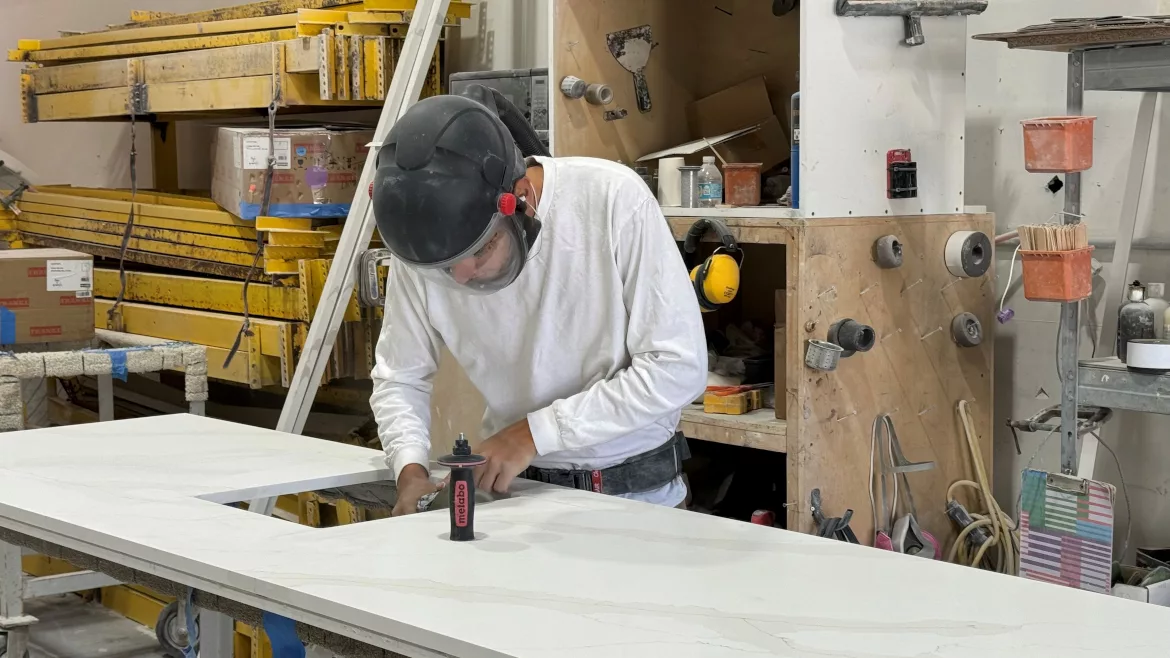
A material assembly’s longevity is a key measure of its sustainability. The longevity and durability of a tile installation is reliant on its installation methods and the skills of the installers. The tile industry has well-established benchmarks to help identify tile contractors and installers with the qualifications necessary to provide durable and long-lasting installations.
Best practice tile installers are distinguished by their training and other credentials. For example, tile contractors who are signatory with the International Union of Bricklayers and Allied Craftworkers (BAC) have the technical and business skills and experience for even the most complex installations. The International Masonry Training and Education Foundation (IMTEF) delivers comprehensive tile training for pre-apprentice, apprentice and journeyworker tile setters and finishers. Installers who hold an Advanced Certifications for Tile Installers (ACT) certification have demonstrated outstanding technical efficiency. Requirements for minimum levels of competence can be written into a project’s specifications to ensure appropriate installation.
Conclusion
When tile was first manufactured and laid in buildings centuries ago, there were no sustainability standards or rating systems because durable materials were used everywhere, to the credit of the builder. But now, with the proliferation of cheaper synthetic materials and focus on reducing initial cost, the construction industry has begun to standardize ways we measure health and human impacts of building materials and to discourage the use of materials that may be harmful.
Fortunately, today, building material manufacturers are paying more attention to their manufacturing and other practices, including transparency in reporting. Since tile has always been made of natural ingredients and of durable performance, the GWP data reported in tile’s material disclosures, LCAs and EPDs, all point to the fact that, when installed by qualified labor, tile will last the lifetime of the project.Looking for a reprint of this article?
From high-res PDFs to custom plaques, order your copy today!