Valuable Insight into Stone Countertop Restoration
Stone restoration experts shared experiences and advice about repairing stone countertops
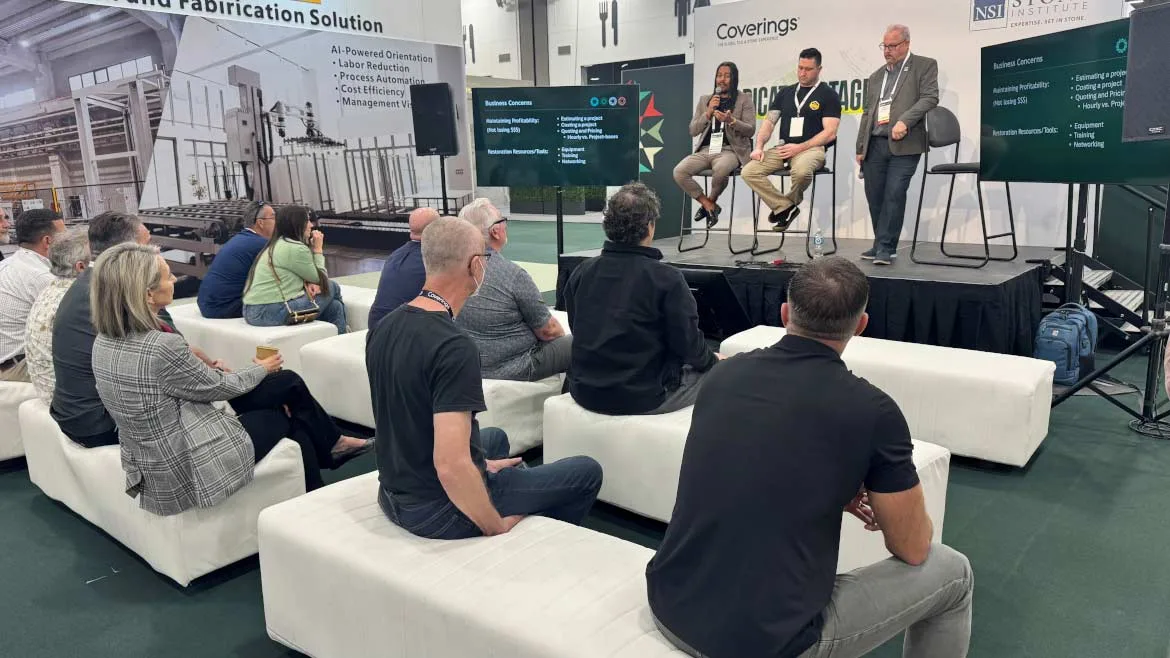
Alexander Zambrano of Fabrizio & Sons in Tampa, FL; Cameron DeMille of MB Stone Care of Wilson, NC; and Mark Meriaux, technical and accreditation manager of the Natural Stone Institute (NSI).
Mark Meriaux, technical and accreditation manager of the Natural Stone Institute (NSI), moderated a session on stone restoration at Coverings earlier this year. Alexander Zambrano of Fabrizio & Sons in Tampa, FL, and Cameron DeMille of MB Stone Care of Wilson, NC, lent their expertise to the discussion, which hit on topics such as:
- “What Stone is This?”
- Chip Repairs
- Failed Sinks/Rods
- Face Polishing
- Flooring Honing
- Scratch Removal
Meriaux started out by saying that he often hears similar points from restoration professionals throughout the industry on a regular basis. These include issues they run into, skills they need to improve or areas where they may not be the strongest.
“One of the biggest concerns when looking at restoration as a business is maintaining profitability,” said Meriaux. “Maybe you're getting into it simply as a service to your existing customers or maybe you're using it to make your installation or fabrication jobs more profitable. But if you're getting into restoration as a business, you have to understand how the labor hours add up, how consumables affect costs and how to estimate and price projects properly.”
DeMille explained that restoration for his dad's company started out as a way to service existing clients from the previous 10 to 15 years. “He had someone on staff dedicated solely to repairs,” said DeMille. “In the beginning, it was simply to cover the overhead associated with that type of work. Later, I turned it into a separate business entity and an additional source of revenue.”
DeMille showed the audience a project, saying that this often occurs after installation or during fabrication. “The travertine slab on the left is how it came from the factory, and in my opinion, it was unacceptable,” he said. “We refilled the fissure to make it blend better so the customer would be satisfied with the product.
“You have to be able to service your own product -- especially when you're working with natural materials,” he went on to explain. “If you're not servicing your own product, you're giving customers a reason to call someone else. You want them to have no reason to do that.”
DeMille showed a photo illustrating how the factory fill came in with a very light white color in the vein. “The customer complained about the white fill, so we went in, refilled it, and they were happy.”
Meriaux asked, “So, this wasn't a revenue opportunity?” “No, it was support,” said DeMille. “The same thing as a warranty issue -- the cost of doing business to support your installation division.”
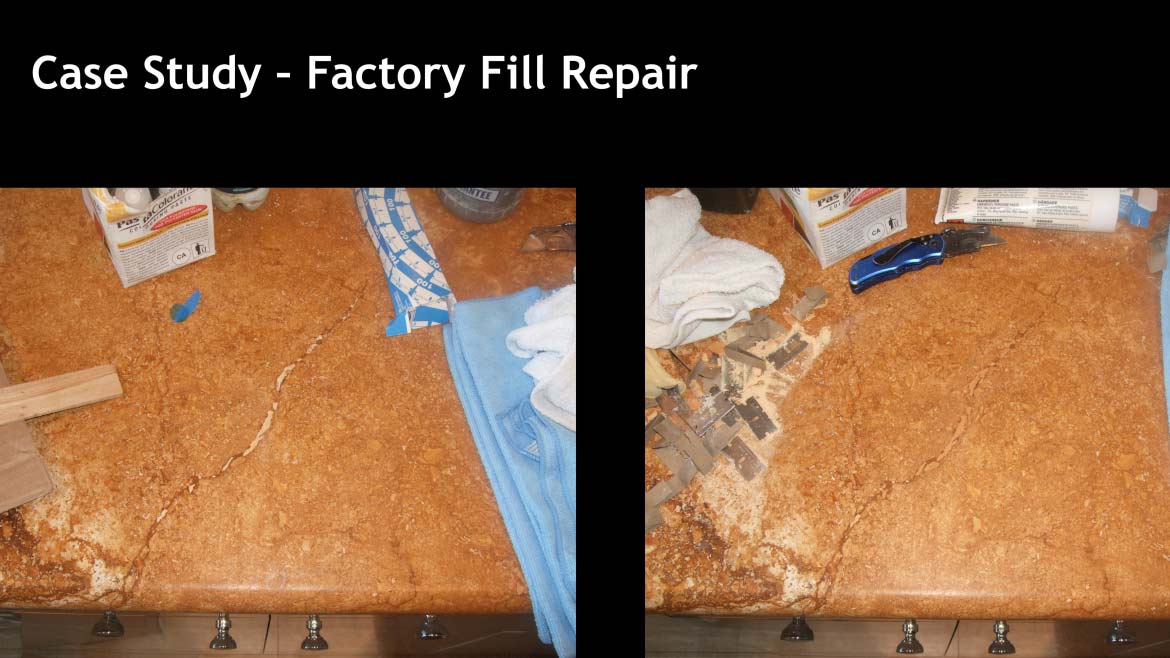
In this case, a fissure was refilled to make it blend better with the stone. Photo courtesy of MB Stone Care
Another example was a limestone piece with an inclusion in the stone that wasn't acceptable. “The guys in the shop cut it out and performed a Dutchman repair,” said DeMille. “They inserted a new piece, then ground and finished it so it looked seamless. That's a more advanced repair, but most fabricators should be able to handle it, including reprofiling the edge. Again, it's the difference between a customer paying or not paying when they're unhappy with something. Yes, it's natural stone, but you can't always dismiss everything as ‘natural’ and leave it at that. There has to be a certain standard for the product you're putting out there.”
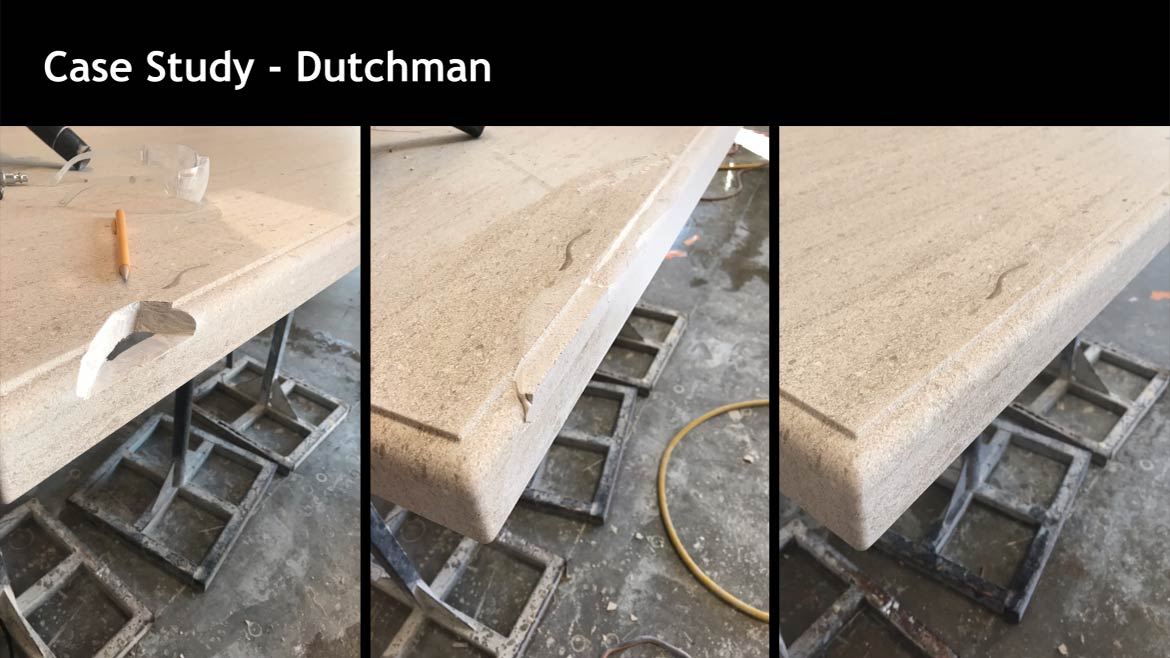
An unacceptable inclusion in a limestone piece was cut out and given a Dutchman repair. Photo courtesy of MB Stone Care
Meriaux then brought up another situation fabricators get called about. “This one may actually be a revenue opportunity,” he said.
According to DeMille, his father’s shop installed a marble bathroom vanity top. “Most people understand they're going to get etches, although many don't really listen when you explain it,” he said. “This was an additional revenue opportunity. The customer called about a year later after etching the marble. This was approximately a $500 service at the time, which was additional revenue on top of the regular business. This wasn't a warranty issue, despite what the customer may have thought. Marble gets etched. As long as you're setting expectations properly during the sales and installation process, you can justify charging for this service.”
Zambrano added, “From a field perspective, when you're working on something like this, you need to refinish the entire surface. Customers often ask, ‘Can you just fix the spot?’ No, you can't. I compare it to painting a car. You don't just paint the hood; you paint the entire car so everything matches. Take that into account. You need to address the entire surface, not just the damaged area.”
Meriaux asked how a job such as this is priced – A day rate? Hourly rate?
“We priced it by the job,” said DeMille. “Sometimes we use square footage to help generate a number, but we present the customer with a total project price. We don't really charge by the square foot.”
Meriaux asked, “By the time you did this repair did you already have a sense of how long it would take?”
“Yes, and like Alexander said, with marble, travertine and limestone, there are usually etches throughout the surface,” said DeMille. “By the time you try to spot repair and blend everything, you've spent as much time as it would take to refinish the entire top. Granite and quartzite are different, but for this type of material, we don't entertain spot refinishing.
“This job is probably 13 years old,” he went on to say. “Back then, it was around $500, and there were additional projects throughout the house that filled a couple of days.”
DeMille explained that the photo on the right shows the result after he corrected it. “Making money from your competitors' mistakes can be a good source of revenue,” said Meriaux. “It may sound negative, but it's reality.”
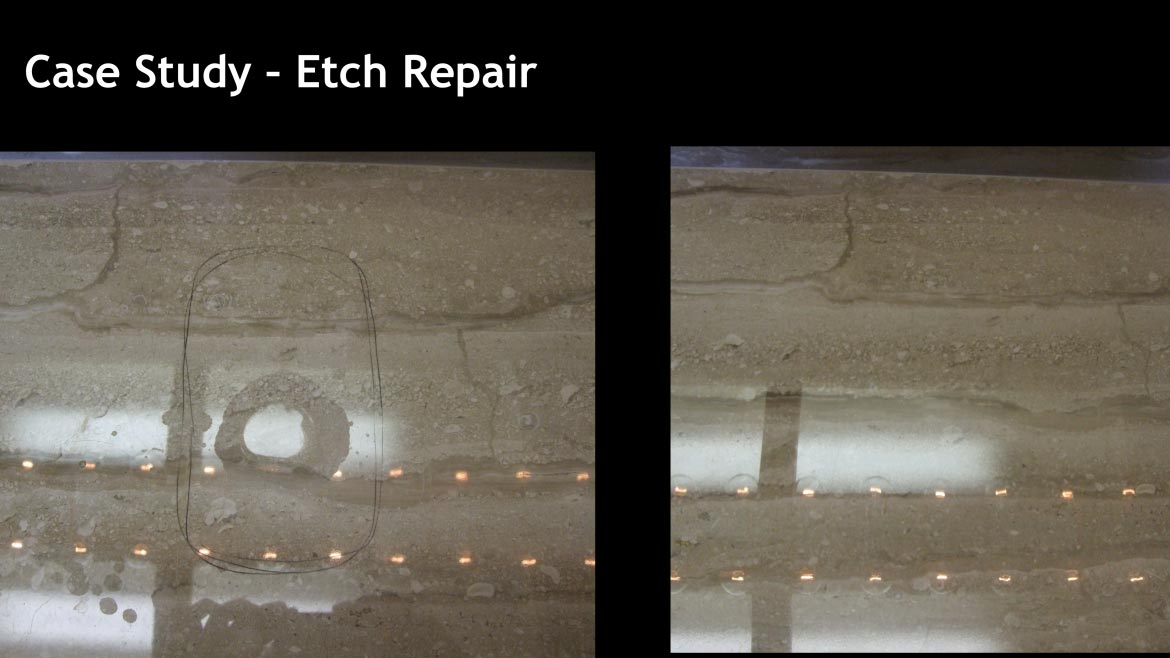
Etched Surface (left) Repaired Etched Surface (right). Photo courtesy of MB Stone Care
Zambrano agreed. “I make a lot of money from people not knowing what they're doing,” he said.
DeMille then shared a photo of a scratch in an island top that was in his showroom. “A customer wanted to purchase the island, but it had a scratch in it, and they wanted it removed before they would buy it,” he explained.
“The factory finish was very nice, but one of our salespeople had apparently slid samples across the surface and created the scratch,” said DeMille. “This diagram shows my process at the time. I drew a circular target area to keep the repair zone as small as possible and avoid unnecessary work. Each line represents the next progressive grit, followed by the final finish. The customer accepted the material, the shine was better than the factory finish, and the sale was completed.”
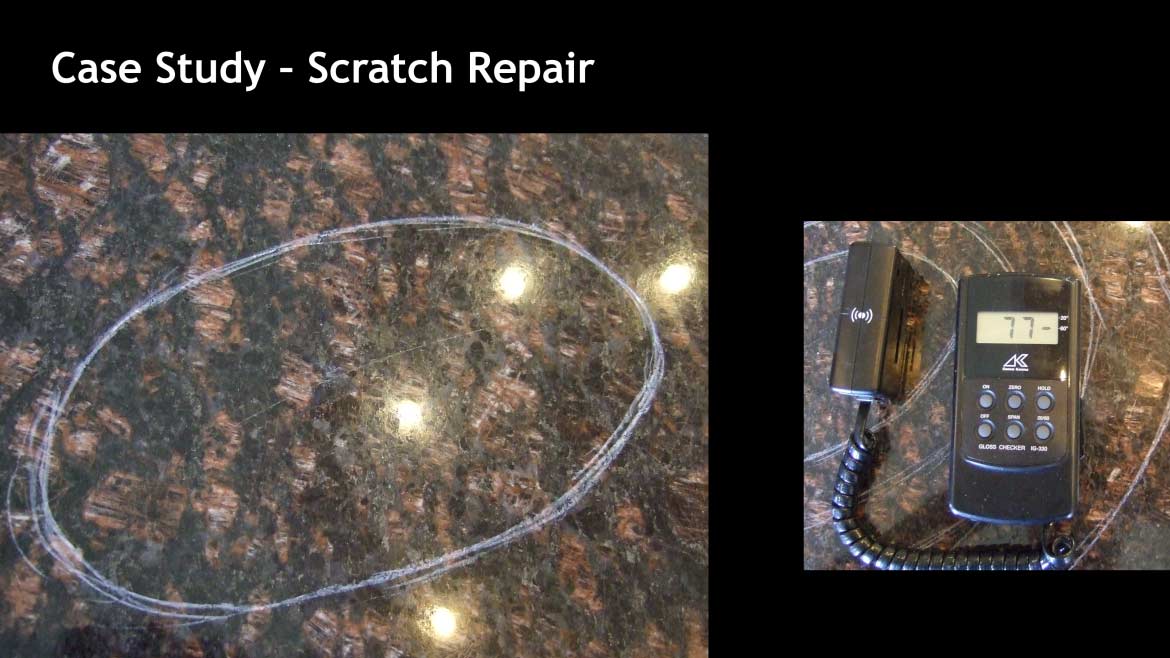
“This diagram shows my process at the time,” said “Cameron DeMille of MB Stone Care. “I drew a circular target area to keep the repair zone as small as possible and avoid unnecessary work. Each line represents the next progressive grit, followed by the final finish. Photo courtesy of MB Stone Care
DeMille pointed out that if you can't remove a scratch, you may not be able to sell the material. “The same thing applies after installation,” he said. “If there is a mishap during transportation or installation and the customer says they won't accept it, having someone on staff who can perform this type of repair is a non-issue,” he said. “It might take only an hour or two, and it saves you from a recut or a huge discount.”
Zambrano pointed out that when dealing with scratches, many fabricators automatically run through an entire series of pads. “That's not always necessary,” he said. “You need to evaluate the depth of the scratch and determine the minimum grit so you know what to cut with. You don't always need to start at 50 grit because you are creating unnecessary work.
“You'd be surprised how many scratches can be removed with a 400-grit pad,” he said. “At that point, you're doing only a slight cut and then everything else is polishing. Generally speaking, a 400 grit and below is cutting, while 800 grit and above is essentially polishing.”
DeMille said for that last example he showed he started with a 500-grit ceramic rigid turbo pad. “Depending on the abrasive you're using, some products remove more material at higher grits than others,” he said.
Looking for a reprint of this article?
From high-res PDFs to custom plaques, order your copy today!