Stone Restoration Revives Detroit Landmark
Michigan Central Station has regained its prominent position in Detroit -- sporting a complete makeover, including the restoration of its beautiful Indiana limestone architecture
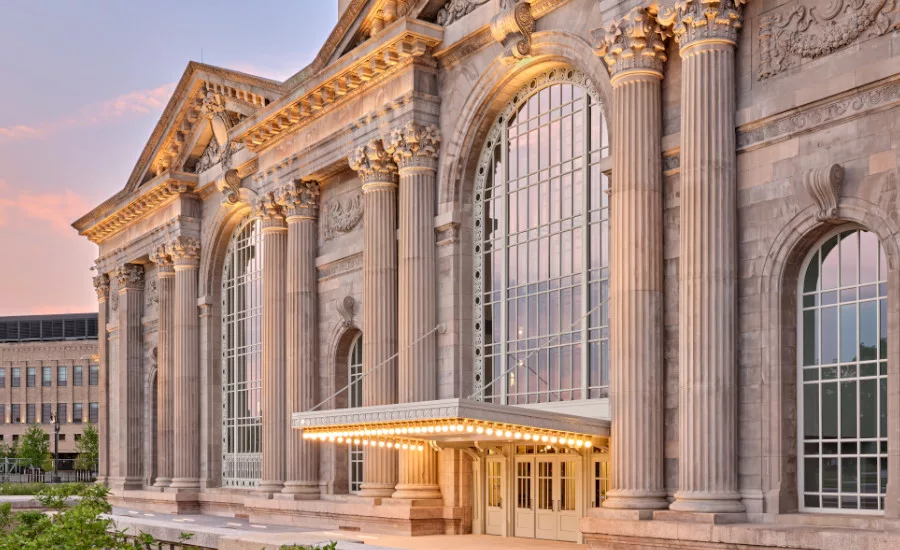
Michigan Central Station, now apart of the new Ford Motor Co. research and technology campus in Detroit, MI, has been restored to its original grandeur, including its beautiful exterior limestone facade.
Photo by Jason Keen
Once praised as one of the nation’s most prominent early 20th-century train stations, Michigan Central Station in Detroit was in jeopardy of being demolished in recent years. Built in 1913, the iconic 18-story structure -- designed by Warren & Wetmore and Reed & Stern, who also served as the architectural team for New York City’s Grand Central Station -- was restored to its magnificent luster and reopened on June 6, 2024 after being non-functional for nearly 40 years. Work on the city landmark commenced in 2018, when Ford Motor Co. realized the value of the building and purchased it to be the anchor of its new 30-acre research and technology campus, located in Corktown, Detroit’s oldest neighborhood. Among the efforts, led by the architectural and design team of Quinn Evans, was to restore the Indiana limestone that adorns the exterior and interior design.
“The limestone base of the building was heavily saturated and had suffered many spalls and displacement due to being abandoned for three decades,” explained Angela Wyrembelski, senior associate at Quinn Evans. “The roof above the front portion of the station was historically a copper batten roof and that material was quickly looted from the building once the station was closed. This left the top cornice exposed to the elements and allowed water infiltration from the top into the masonry assembly -- wreaking havoc on the steel perimeter structure and leading to stone damage.”
Assessing the damage
According to Wyrembelski, Quinn Evans along with its structural engineers, Silman, collaborated to understand the assembly of the building and investigate the conditions of the masonry envelope. “We were lucky to have access to many of the historic drawings through local libraries and the state archives, including several historic stone and steel tickets from the original construction,” she said. “We also conducted several probes and material tests to understand key conditions, assemblies, and material properties. We worked with the construction manager, Christman Brinker Joint Venture, to do an early mock-up and material procurement package so we could test out repair and cleaning approaches, as well as identify matching replacement materials.”
Wyrembelski explained there were points of consideration regarding the stonework that were discussed with Ford Motor Co. before work on the building began. “It was important to us, and to the client, to acknowledge and celebrate the age of the building, and that meant we needed to set some expectations on how far the restoration treatment would go and what that final appearance would look like,” said the architect. “While major deterioration and damage would be tackled, smaller knicks or slight erosions were kept as is. As the north elevation had retained so much moisture through the years, we also had to educate the client on what a cleaned stone building of this age would be and that variation of coloration would still be visible. In the end this variation and visible aging across the main facade helps tell the story of the building.”
When asked what the primary design goal for the project was, Wyrembelski explained it was to transform the neglected, and almost demolished, historic train station into the centerpiece of a new mobility hub for Ford Motor Co., a place for innovation and development in the rapidly evolving field of mobility and a place for the public to enjoy and celebrate Detroit’s history and promising future.
Restoring the stonework
The design team spent several months documenting, surveying, and analyzing the condition of the stonework. “We worked through probe investigations and material testing to understand the root causes of damage and assembly failures,” said the architect. “From there, the design team worked with the contractor manager to right-size several bid packages of the masonry repair work so that multiple local masonry contractors could work simultaneously on the project. Early mock-ups were done to test cleaning approaches, find suitable patching and mortar mixes, and to identify replacement stone sources. The first part of the restoration involved removing cornice stones down to the top of the stone capitals along the main facade to expose the perimeter steel. Steel was then repaired and the original stone was set back into place. Each piece of stone that was dismantled was surveyed and repair treatments devised to determine if the original piece could be put back into place or if a replacement was needed. Where pieces of stone were too badly damaged, portions of the piece were retained for other smaller dutchman repairs. While the steel repairs and back-up masonry rebuild was underway, the new or missing stone pieces were carved and fabricated. Once the facade was put back together, all joints were repointed, spalls were either repaired with dutchman or patching, and finally the masonry was cleaned.”
According to Wyrembelski, the architectural team was successful in retaining a significant amount of the original stone, but still ended up replacing nearly 8,000 cubic feet of limestone. “Most of these were smaller pieces to replace missing or too badly damaged features, such as the cornice rosettes, dentils, and balustrades,” she said. “Several stones along the frieze were replaced due to the placement of steel behind them that caused severe deterioration and two of the column capitals had to be replaced.”
Finding the original quarry
Through Quinn Evan’s local masons, the team was able to track down the original quarry that supplied the limestone. It was from the Dark Hollow Quarry in Bedford, IN.
“While the quarry was closed in 1988, the same year the station was, they did have archival records of the original stone order and extraction location, as well as documentation that several blocks were removed at the same time of the original extraction and were still on the quarries property,” said Wyrembelski. “Road access had to be reestablished and the material was shipped to our regional fabricator’s shop. It was remarkable to be able to not only use the same stone, but stone extracted at the same original time; making blending in the new with the old a lot easier. And while the newly tooled stone does have a more Buff appearance at first, it quickly changes to match the original gray.”
When discussing the entire experience, Wyrembelski said it was quite unique to see the use of traditional craftsmanship and new technology implemented together. “For instance, on the two large capitals that needed to be replaced, the original was laser scanned to pick up the majority of the scale and size of the decorative elements,” she said. “A CNC machine then created the overall shape and mass of the capital and then nearly 400 hours were spent hand carving in the remaining details. I was fortunate to oversee some of the production in the shop and the blend of technology and artistry was truly fantastic and really emphasized the care and approach that was taken to restore this building.
“One of the most challenging aspects of this project were all the unique materials -- from limestone and terra-cotta on the exterior to plaster, Guastavino and Mankato stones on the interior, and the existing conditions those materials were in,” the architect went on to say. “It was important to us, and the client, to retain as much as the original fabric of the building, and given its state of neglect and deterioration, this proved to be challenging. It pushed us to think creatively on how best to restore and approach repairs.”
In total, the stone restoration was completed in a little more than two years, while the entire project took nearly six years. “This project was truly a once in a lifetime,” said Wyrembelski. “Michigan Central Station’s restoration and transformation epitomizes Detroit’s spirit of renewal. Restoring its presence and grand public spaces as vibrant community hubs and supporting industry innovation, this project exemplifies how historic preservation can drive sustainable and community-focused development. By embracing the past while adapting for the future, Michigan Central Station reclaims its role as an icon for Detroit, embodying the city's enduring legacy and promising evolution.”
Looking for a reprint of this article?
From high-res PDFs to custom plaques, order your copy today!