New Museum Wing Exhibits Ties to Historical Stone
The recently renovated Michael C. Rockefeller Wing at the Metropolitan Museum of Art (MET) features both newly fabricated and refinished Stony Creek granite floor tiles
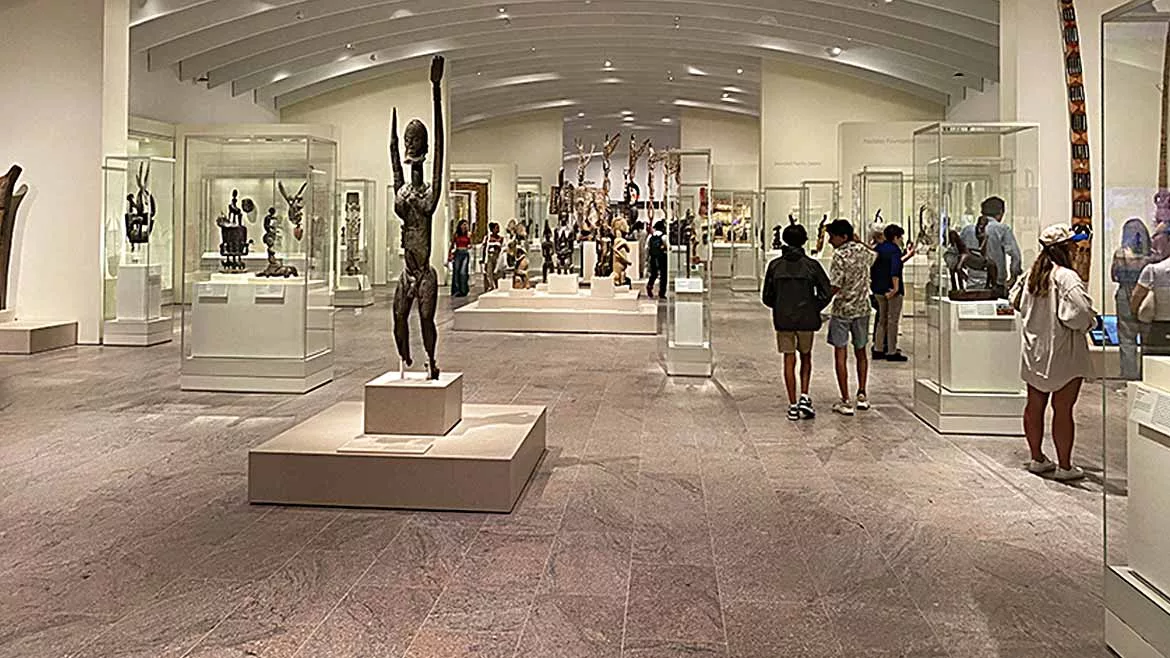
A four-year renovation of the Michael C. Rockefeller Wing at the Metropolitan Museum of Art (MET) in New York City involved matching the original Stony Creek granite floor tiles from 1982, as well as resurfacing the existing stone panels for a more contemporary aesthetic.
Need to Know
- The Michael C. Rockefeller Wing at the Metropolitan Museum of Art (MET) reopened in 2025 following a four-year renovation.
- The project modernized the museum while respecting the original structure. The Stony Creek granite flooring matches the original building materials, reinforcing a visual and material link to the structure’s history.
- Effective communication and close collaboration between teams were key contributors to the project's success.
In May of 2025, the Michael C. Rockefeller Wing at the Metropolitan Museum of Art (MET) in New York City reopened to the public after a four-year renovation project, which included reviving and matching its historic Stony Creek granite flooring. Originally opened in 1982, the wing houses the museum’s collections of the arts of Africa, Oceania and the ancient Americas — presenting works from hundreds of cultures across three continents. The redesigned spaces showcase improved lighting, circulation and display while incorporating new scholarship and cultural perspectives.
The renovation of the wing included preserving the original floor tiles made from Stony Creek granite, a durable stone quarried by Stony Creek Quarry Corp. in Branford, CT, and historically known for its use in numerous high-profile architectural projects in the New York City area. Approximately 5,000 cubic feet of dimensional block was produced to match the existing flooring. The design team worked closely with Stony Creek Quarry and A. Lacroix Granit based in Saint-Sébastien, Québec, the supplier and fabricator of the granite, on a custom surface finish which demonstrated how an existing historic material could be reinterpreted within a contemporary museum renovation. Each new granite floor tile measured 32 x 16 x ¼ inches. The installation team from Wilkstone LLC installed a total of 5,652 pavers — equivalent to 20,853 square feet of floors.
“This was a match-to-existing project,” said Darrell Petit of Stony Creek Quarry Corp. “The renovation of the Michael C. Rockefeller Wing of the Metropolitan Museum called for adding Stony Creek granite floor pieces to match the existing Stony Creek floor tiles. In the end, the MET decided to refinish the entire floor so its surface finish was seamlessly integrated.”
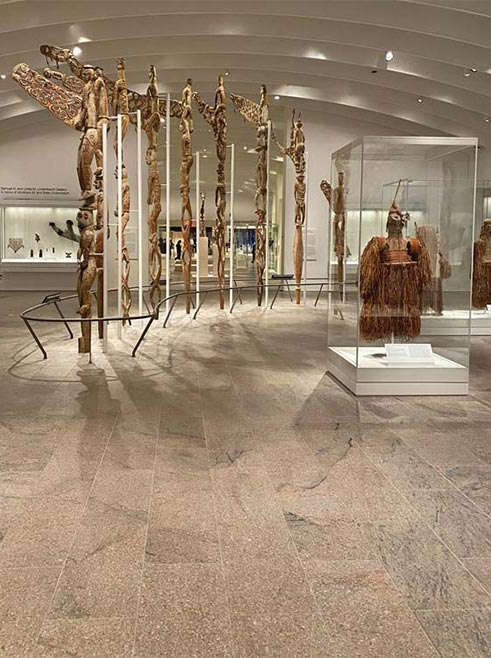
The Michael C. Rockefeller Wing houses the museum’s collections of the arts of Africa, Oceania and the ancient Americas — presenting works from hundreds of cultures across three continents. Photo courtesy of Wilkstone
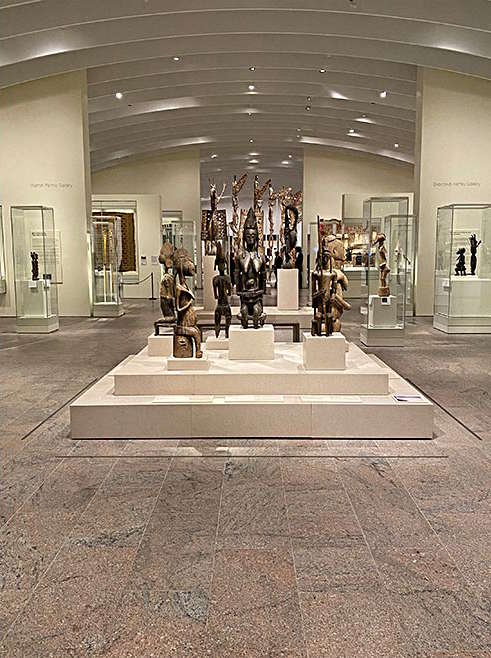
“It has been a real challenge for us because we had to supply a uniform floor with a stone that has a lot of variations,” said Jacques Drouin, sales director for A. Lacroix Granit. Photo courtesy of Wilkstone
Tight Communication Between Teams
Petit explained that the design team was in close communication about the current operation and production of the quarry. “They did visit us at the quarry a few times,” he said. “The whole MET team – the architects from wHY Architects and Beyer Blinder Belle (BBB) Architects and Planners LLP; the general contractor, Tishman; and the installer, Wilkestone LLC — all visited the quarry. They are a great example of an ideal client that does their own due diligence, which importantly, should always include a direct in-person visit to the quarry source.”
The use of Stony Creek granite as flooring of the MET was first initiated by Kevin Roche John Dinkeloo Architects in the 1980s. Stony Creek Quarry worked closely with the architects on those early projects too. “This time, Stony Creek first introduced wHY Architects and BBB to senior leadership at Roche so they could review Roche’s original specification and learn how the team — designers, quarrier, fabricator and installers — had achieved the compositional pattern while working with the variegated nature of Stony Creek granite,” explained Petit.
According to Petit, MET leadership wanted collaboration with a North American company to fabricate the floor tiles, as they could not rationalize a sustainable process by sending the material overseas to their stakeholders. “They were impressed with the NSI 373 sustainability certification, and while they wanted Stony Creek granite all along, this certification made an additional difference and substitution never became much of an issue,” he said.
“The architects wanted a ‘lighter’ surface finish of Stony Creek granite than the deeply honed finish previously used on the floors of the existing wing,” Petit went on to say. “With the extensive glass transparency of the west wall facing Central Park, the architects wanted to achieve a much lighter custom finish. Stony Creek Quarry accepted the challenge and worked closely with A. Lacroix Granit to develop a custom finish that the architects felt integrated more holistically within their overall design.”
When collaborating on a large high-profile project such as the Michael C. Rockefeller wing of the MET, there are important points of discussion between the fabricator, quarrier and installer. They include:
- Is the bench in the quarry yielding enough material to complete the job?
- Are characteristics of the blocks extracted consistent, where they can expect the slabs to have the same color background / vein color and shade within the range required by the project?
- Are blocks extracted from the quarry the correct size to minimize waste?
- Does the quarry have capacity to produce blocks according to the construction schedule?
- Is the fabricator receiving sufficient blocks in a timely manner?
- Once the slabs are produced, is the fabricator having problems with a range variation?
- Is the fabricator finding defects on the slabs produced?
- Can the fabricator produce cut-to-size pieces according to the construction schedule?
- Can the fabricator produce the correct finish for the pieces supplied?
- Will the fabricator crate the pieces in such a way that they can be easily moved onsite?
Working with Color Variations
A crucial component of the project was the collaborative process of educating the architects and MET managers about the power of using the natural wholeness of the stone, according to Petit. “[We had to explain] to let the material’s extraordinary variegation and imperfect but natural beauty become the palette with which the architect and installers would work,” he said. “Natural stone is natural, and it has a harmony that cannot be found in manmade standardized engineered stone. The more that architects move away from in-person visits to the source of natural stone — the origin, the quarry — the higher the risk of misunderstanding what natural stone is and what it can do. We were lucky to have a combination of experienced and inexperienced team members in the MET collaborative so that this issue could be worked out together.”
Jacques Drouin, sales director for A. Lacroix Granit, reiterated the close communication between all those involved. “Our conversations were mostly regarding the variation of color within the blocks,” he explained. “It has been a real challenge for us because we had to supply a uniform floor with a stone that has a lot of variations. We have been very careful and critical on the selection of the blocks. Since the finish was sawn, it gave us a bit of room to achieve a pretty decent uniform floor. We also did several day lays for different areas as we were working at full speed to meet the design team’s specifications and requirements.”
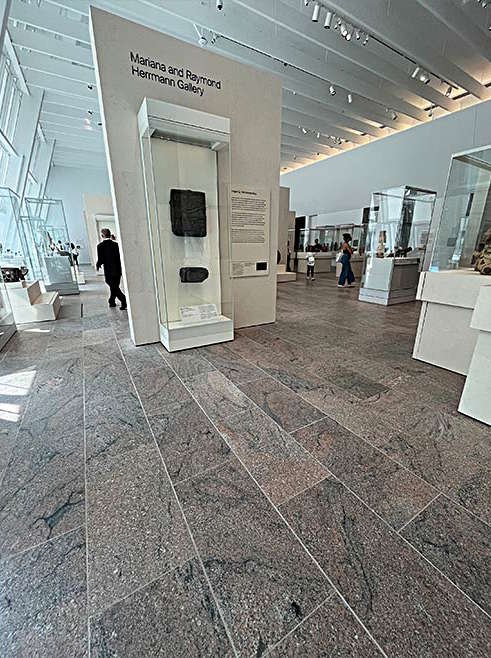
Approximately 5,000 cubic feet of dimensional block was produced to match the existing flooring. Photo courtesy of Darrell Petit/Stony Creek Quarry Corp.
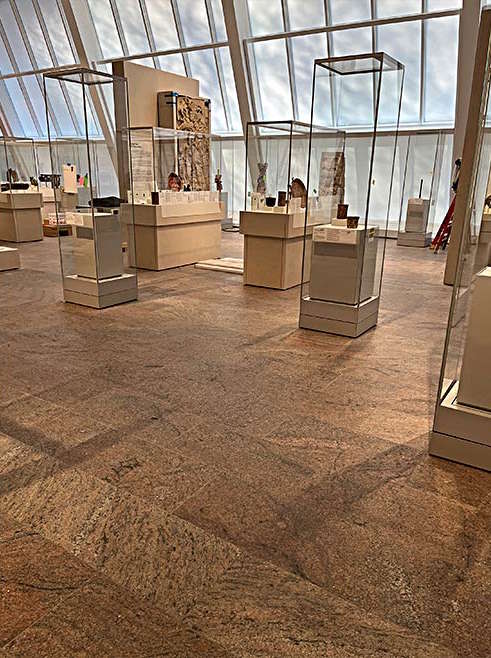
“With the extensive glass transparency of the west wall facing Central Park, the architects wanted to achieve a much lighter custom finish,” said Darrell Petit of Stony Creek Quarry Corp. Photo courtesy of Darrell Petit/Stony Creek Quarry Corp.
The Stone Installation
The Stony Creek granite pavers were installed using a traditional “fresh set” system where the mortar-bed (thick-set) is laid over a cleavage membrane and reinforced with 16-gauge, 2- x 2-inch galvanized wire mesh. The mortar is packed firmly, and stones are then set into the bed using a cementitious bond coat while the mud-bed is still fresh.
Installing the granite pavers proved to be somewhat of a challenge, according to William Torres, president of Wilkstone. “Since we needed to connect two different galleries, installed in previous decades, disconnected from each other, we had to spend a lot of time determining the width of the new pavers to guarantee the brick pattern (running bond) layout ended up being consistent at both ends of the new installation while maintaining the offset by 50% in each row,” he said. “Problems came when we discovered some of the installed pavers had different widths.
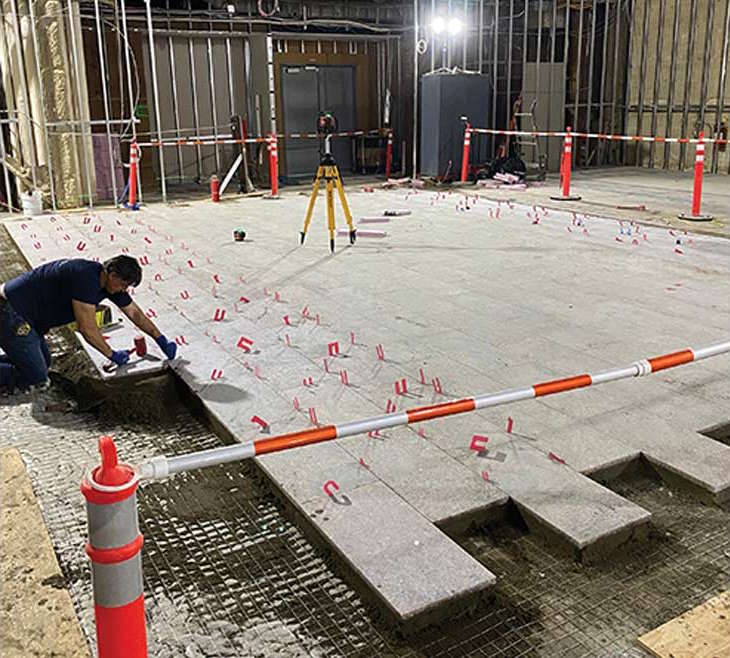
Wilkstone LLC of Paterson, NJ, worked closely with the architects, quarrier and fabricator to ensure a successful installation. Photo courtesy of Darrell Petit/Stony Creek Quarry Corp.
“In addition to the pattern, we also had to work to achieve different elevations throughout the space, given the fact, old pavers to be maintained as part of the installation were at different heights in reference to the benchmark,” Torres went on to explain. “The above, preventing to produce lippage on the new floor being installed.”
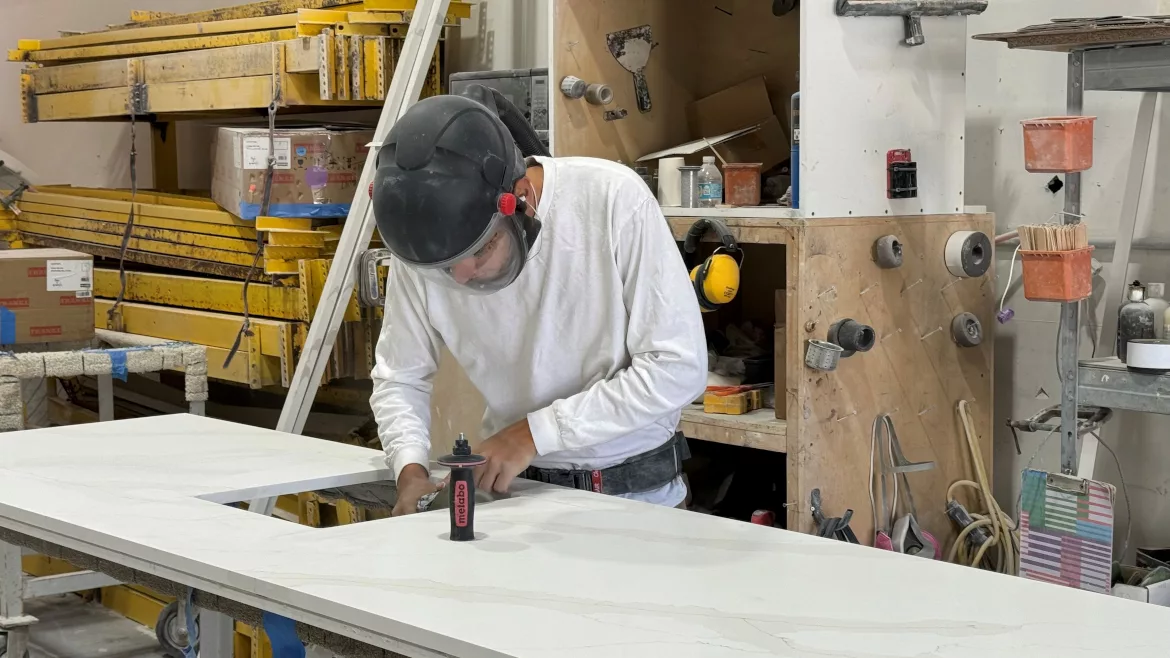
Achieving the final finish of the granite pavers was the focus of this floor renovation, according to Torres. “Even though the fabricator provided us with diamond finish pavers, after installed, we had to grind the entire floor, old and new, to provide a consistent finish throughout the space,” he said. “A honed finish floor would be exposing more the ‘salmon/pink’ color of the Stony Creek granite. Therefore, we had to offer a lower-level grit finish to achieve a grayish looking surface, with the risk of having swirl marks produced by the grinding diamonds. It took several weeks of attempts and a combination of equipment, diamond grits, cleaning pads and a number of steps to achieve the finish desired by the client.”
Additionally, the Wilkstone team installed a total of 146 pieces, equivalent to 1,248 square feet of Basaltite Classic, filled and honed, from Italy. The material was used for five saddles and six portals. Moreover, 2,224 square feet (318 pieces) of Rosal limestone with a honed finish from Portugal was employed for six cantilevered display walls and the large partition wall.
The entire stone installation took the Wilkstone team approximately 11 months to complete. “We are very proud and honored to have been a part of this iconic project,” said Torres.
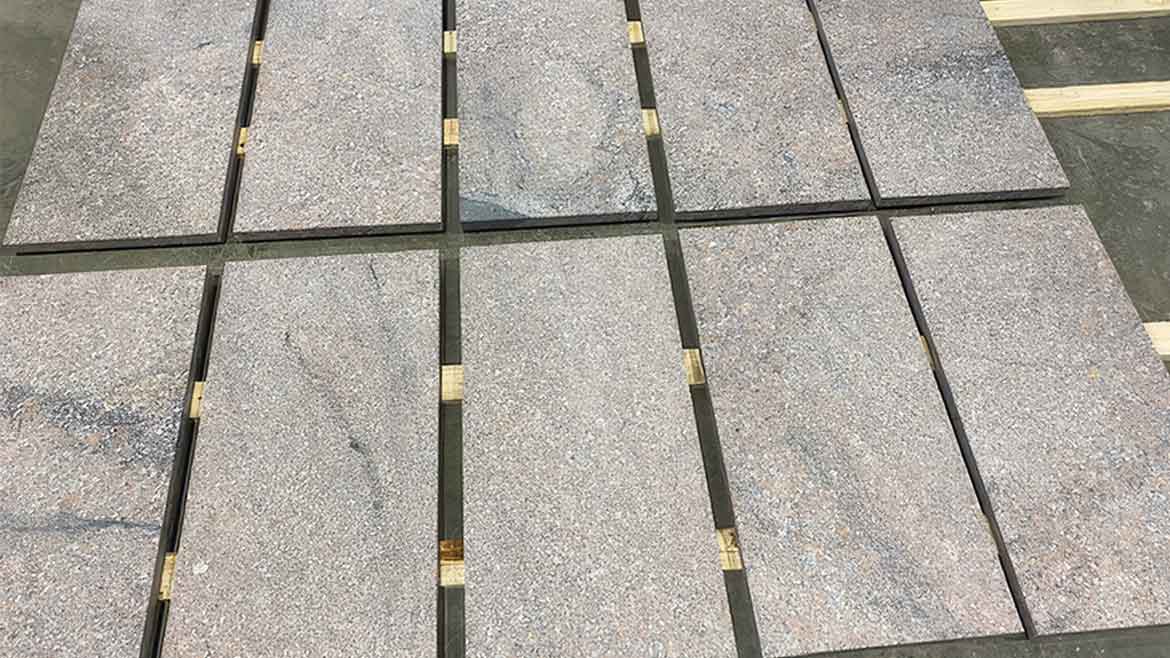
Each new granite floor tile measured 32 x 16 x ¼ inches. Photo courtesy of Darrell Petit/Stony Creek Quarry Corp.
Stony Creek Quarry’s collaboration with the MET and with its experienced partners at A. Lacroix, Beyer Blinder Belle and Tishman, along with the collaboration with new partners such as Wilkstone and wHY Architects, made this project memorable for Petit. “This project is another example of Stony Creek granite being provided for a project of international significance over a long period of time and seamlessly integrated within an existing use,” he said.
The stone producer was first contacted and began reviewing this project in 2016. It quarried and provided the dimensional blocks to A. Lacroix in two months.
Looking for a reprint of this article?
From high-res PDFs to custom plaques, order your copy today!