State of the Stone Industry Addressed Tariffs and Silicosis Lawsuits

Need to Know
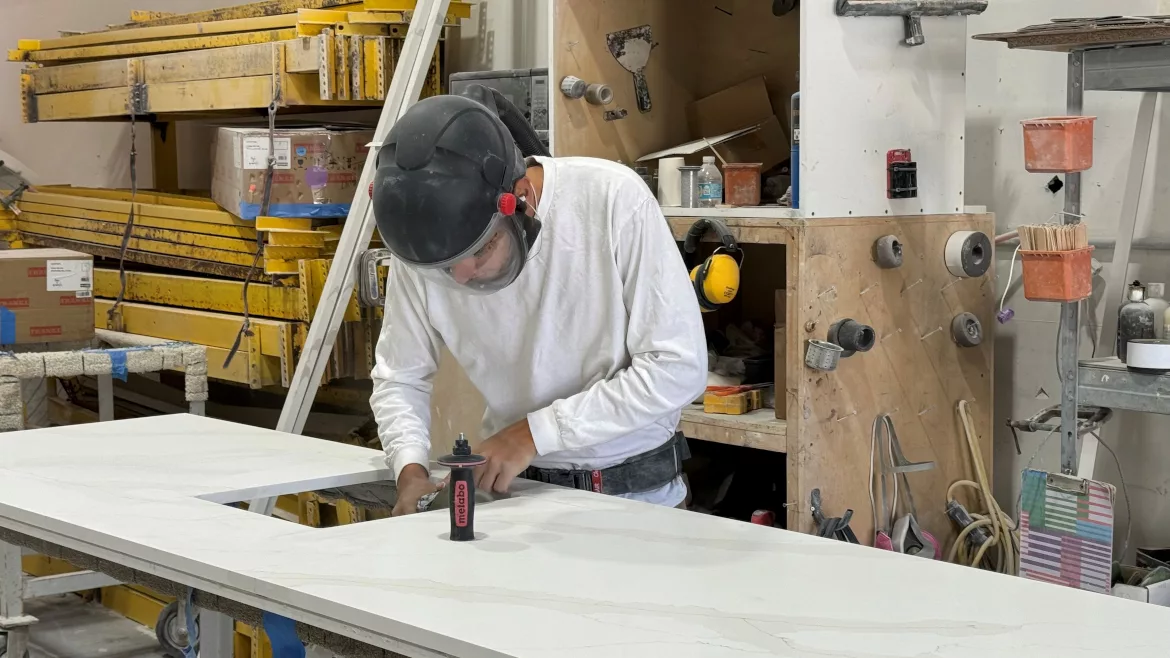
- California's SB 20 (the STOP Act) passed but was stripped of its licensure provisions, complicating safety training and compliance efforts in fabrication shops. In the meantime, silicosis-related lawsuits are expanding beyond California into other jurisdictions.
- The current business climate is marked by uncertainty, with tariff policy creating ongoing challenges for stone importers and distributors.
- Growing demand for full-slab showers and oversized stone floors in luxury homes as well as softened demand for quartz amidst silicosis concerns have created opportunities for natural stone fabricators.
The natural stone industry is grappling with a surge in silicosis-related lawsuits, stalled licensure efforts in California and persistent tariff uncertainty, industry leaders said on Monday, March 30th during the annual State of the Stone Industry panel discussion at Coverings 2026.
The panel, moderated by Jim Hieb, CEO of the Natural Stone Institute (NSI), featured four industry figures and members of the NSI executive committee, representing different segments of the stone supply chain: Evan Cohen, president and CEO of Quality Marble and Granite in Ontario, CA, and immediate past NSI president; Josh Levinson, CEO of Artistic Tile, based in Secaucus, NJ; Jeff Erickson, founder of Cutting Edge Countertops in Perrysburg, OH, and current NSI president; and Sam Arcot of Rugo Stone, a fabrication and installation firm in the Washington, DC, area, and NSI board secretary.
Silicosis Cases and Lawsuits Mount
The silicosis crisis dominated the opening portion of the discussion, with panelists urging fabricators, distributors and other industry stakeholders to take immediate action rather than wait for the issue to reach them directly. Cohen said his company, a small distributor that sells natural stone slabs, has received 64 lawsuits to date. "It's going to get to you at some point in some way," Cohen said. "Don't wait for it to come to you. Get ahead of it now."
More than 400 silicosis-related lawsuits have been filed nationally, Levinson said, with cases expanding beyond California into other jurisdictions. The lawsuits have also broadened in scope, evolving from claims focused solely on silica exposure to include allegations about metals, pigments and other components in engineered stone products, according to Levinson.
"We don't have a slab warehouse in California, and we've been named in lawsuits," Levinson said. He urged distributors to ensure proper documentation, warning labels and safety data sheets accompany all shipments.
More than 500 silicosis cases have now been documented in California, Hieb said.
Of the first 100 documented silicosis cases in California, only 13% of affected workers were covered by workers' compensation or a company insurance program, Hieb added.
An audience member asked what percentage of the lawsuits involve quartz products versus natural stone. Cohen said his company has been named in numerous lawsuits. The lawsuits typically cite both engineered quartz and natural stone, he said, though the claims clearly point to engineered quartz as the primary factor.
Plaintiffs' attorneys are naming any distributor within proximity of a fabrication shop, regardless of whether that distributor actually supplied material to the shop in question, Hieb said.
Levinson cautioned attendees to review their insurance policies carefully. "A lot of people have insurance, but they might have a silica exclusion," he said.
California Licensure Stalls, New Efforts Emerge
California's SB 20, which the industry supported as a vehicle for fabricator licensure, passed but was stripped of its licensure provisions, according to Cohen. Under the original proposal, distributors would have been required to sell slab material only to licensed fabricators who had completed safety training.
"Any distributor I've spoken to, we've all been willing to say, let's sell only to licensed fabricators to try to prevent it getting in the wrong hands," Cohen said. "Unfortunately, that got stripped out of it."
A new bill has been introduced in the California Assembly to revive the licensure effort, Hieb said. Erickson added that ISFA is also developing an industry-led safety credential program.
Hieb outlined several obstacles that complicated the legislative process. Trade unions generally supported licensure because of their existing training and compliance infrastructure, he said. However, disagreements arose over which government agency would administer the program, how it would be funded and concerns about creating a public registry of fabricators that could be used for immigration enforcement purposes.
"We had members of the state legislature saying, 'I don't want a public list, because that's just going to give ICE a list of fabricators to go raid,'" Hieb said.
He proposed a three-part funding model: a nominal licensure fee for fabricators, fines for distributors caught selling to unlicensed shops and an assessment on slab material sales.
A separate piece of federal legislation has also been introduced that would provide some relief to sellers of stone slabs, Hieb said. He encouraged attendees to contact their congressional representatives in support of the bill.
"Just because you're [wet-cutting] doesn't mean that you're okay."
– Jeff Erickson
Arcot said that on a grassroots level, any industry member can help advance the legislation. "Anybody can help out," he said. "Send a letter, invite the representative to come in to see your facility to see how a properly developed facility is supposed to operate."
Erickson urged fabricators to prioritize compliance regardless of the legislative outcome. "Just because you're wet doesn't mean that you're okay," Erickson said, referring to wet-cutting practices. He said his shop conducts regular air monitoring and has found elevated readings even in areas that appeared clean, prompting additional engineering controls.
Tariffs and Market Uncertainty
Panelists described the current business climate as marked by uncertainty, with tariff policy creating ongoing challenges for importers and distributors. Cohen addressed what he called misinformation circulating in the industry about tariff refunds.
"There's nothing that's been handed out yet,” he said. “Nobody's getting any money back at this point. They're still trying to figure out how it's going to work."
Levinson noted that approximately $160 billion in tariffs have been collected and said the government is reportedly developing a system to process refunds, though the timeline remains unclear. He recommended that importers consult a Customs attorney to evaluate their options.
"The cost of just filing a lawsuit as a placeholder relative to the potential recovery of the cash that we paid is, to me, a no-brainer," Levinson said.
Cohen said his company filed a lawsuit against the government for approximately $10,000 as a protective measure to keep its Customs entries open for potential refund claims.
An audience member asked where industry members should turn for reliable information on tariff developments. Cohen said he relies on multiple sources, including the NSI, Stone World and freight forwarders.
Arcot, speaking from the perspective of a commercial installer who bids on projects years in advance, emphasized the importance of detailed written proposals with clear inclusions and exclusions. "When you sign a commercial contract with a general contractor, the deal is done," Arcot said. "But if you have some language in your proposal saying specifically what you carried and what you didn't carry, that at least creates a baseline."
He described a recent situation in which a contractor requested a price reduction after emergency tariffs were lowered. After reviewing the full cost picture, including increases in other tariffs and freight, Arcot's team determined the overall cost had actually risen slightly.
When Hieb asked the audience about their business performance relative to the prior year, responses were mixed across up, flat and down categories.
Natural Stone Opportunities
The panel struck an optimistic tone when discussing market opportunities for natural stone. Levinson said fabricators who are not working with marbles and other difficult-to-fabricate materials are missing opportunities at the high-end of the market. He pointed to growing demand for full-slab showers and oversized stone floors in luxury homes.
"A lot of the shops that are doing this are the smaller shops, a lot of hand work," Levinson said. "You don't have to have a huge production shop to be able to do that type of work."
Cohen said quartzite continues to surge in popularity, with Brazil seeing significant increases in quartzite exports. He added that tariffs on Indian stone and some Brazilian granites had created bottlenecks, but recent policy shifts were reopening those channels.
Cohen also cited statistics showing that quartz imports declined in 2025 while natural stone imports increased, suggesting a possible market shift driven by silicosis concerns. "There may be some sign of seeing less people using it or more hesitation because of what's going on — more people turning towards stone," Cohen said.
Arcot highlighted natural stone's durability and versatility in commercial applications, noting that architects are specifying more limestones for exterior projects. He said natural stone can be finished and textured to meet specific aesthetic and performance requirements in ways that engineered materials cannot replicate.
"We restore churches that are over 150 years old," Arcot said. "We are able to refurbish, repurpose the marble that was once installed all these years ago. That cannot happen with artificial materials."
Erickson, whose business serves the mid-market through retail channels, said he observes that when he speaks directly with consumers and advocates for natural stone, they are often persuaded.
"When I talk to somebody directly, more times than not, I can convert them to natural stone," Erickson said. He noted, however, that sampling remains an obstacle, as it is easier for consumers to take home a sample of engineered stone than natural stone.
Hieb announced that the NSI is expanding its online natural stone catalog, currently limited to North American stones, to include materials from around the world. He also said NSI is partnering with Centrorochas, a Brazilian stone association, to develop a new continuing education course for architects and designers focused on quartzite and other Brazilian materials.
Looking for a reprint of this article?
From high-res PDFs to custom plaques, order your copy today!

Jason Kamery is the Managing Editor and Group Digital Editor of Stone World. With more than a decade of experience covering the stone and countertop industry, he has conducted hundreds of interviews with fabricators, manufacturers, and industry leaders, and hosts the Stone World. podcast. He reports from events worldwide, including TISE, Coverings, and Marmomac, and his coverage extends to worker safety and silicosis, trade policy and tariffs, and fabrication technology. Kamery has also served as a speaker and panel moderator at The International Surface Event (TISE). He graduated from Purdue University with a B.A. in Mass Communication.
email: kameryj@bnpmedia.com | office: (248) 833-7356