Soapstone Contributes to Theatricality of Dining Experience
COTE Vegas is the fourth of the Michelin-starred brand of Korean steakhouses, featuring the natural stone as a main component of its interior design
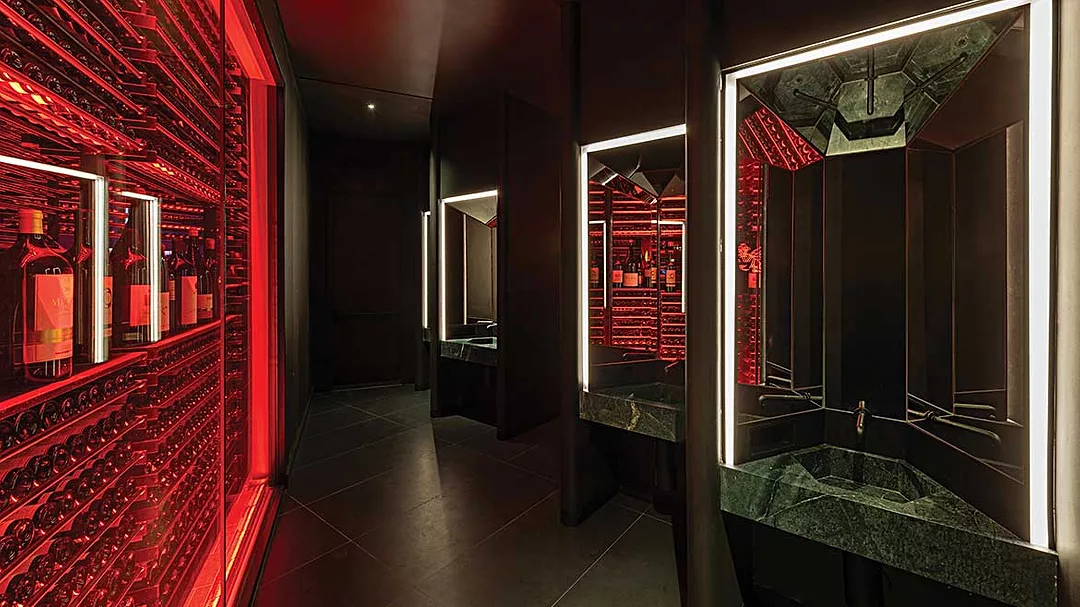
Crafted from honed Rainforest Green soapstone, each vanity in the restrooms features mitered integrated sinks.
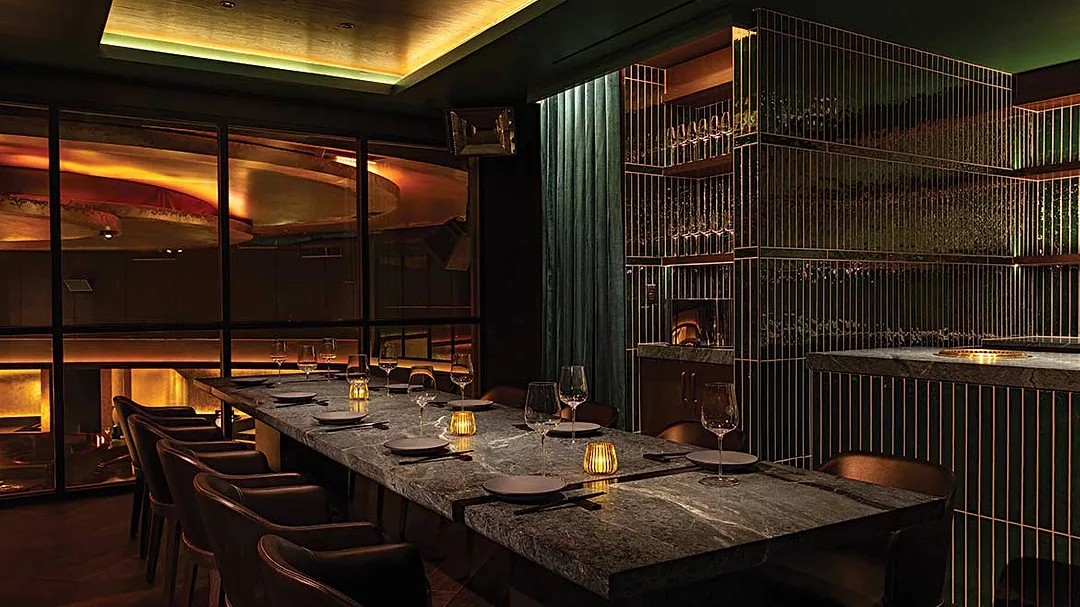
“We love the fact that the soapstone is aged and oiled, giving it a robust, lived-in feel -- warm and grounded, not overly pristine or precious,” said Zuger.
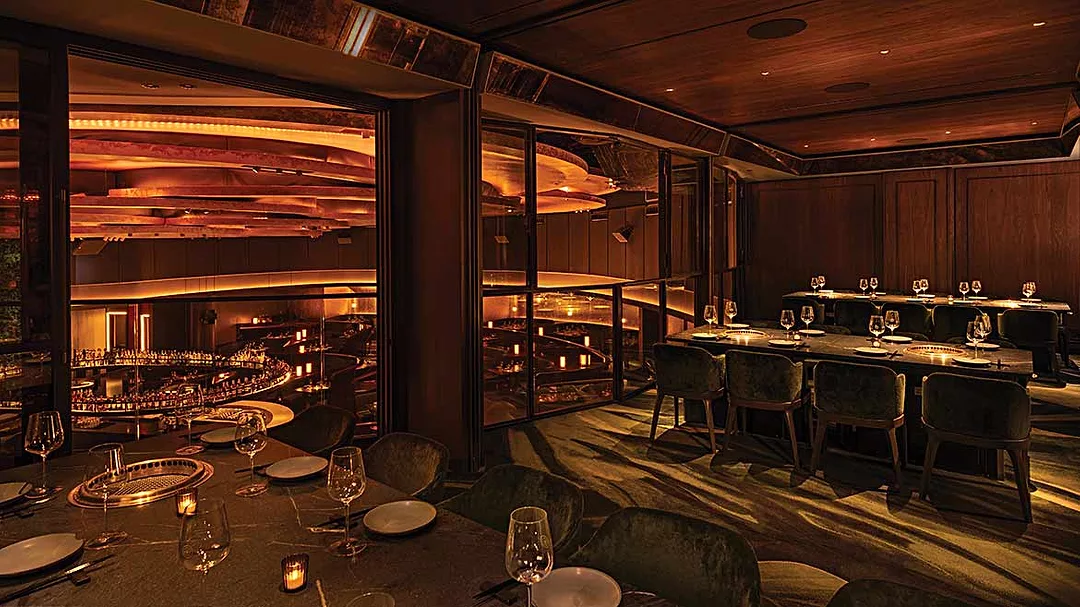
The dining tables feature a 30mm radius reverse bullnose on the underside.
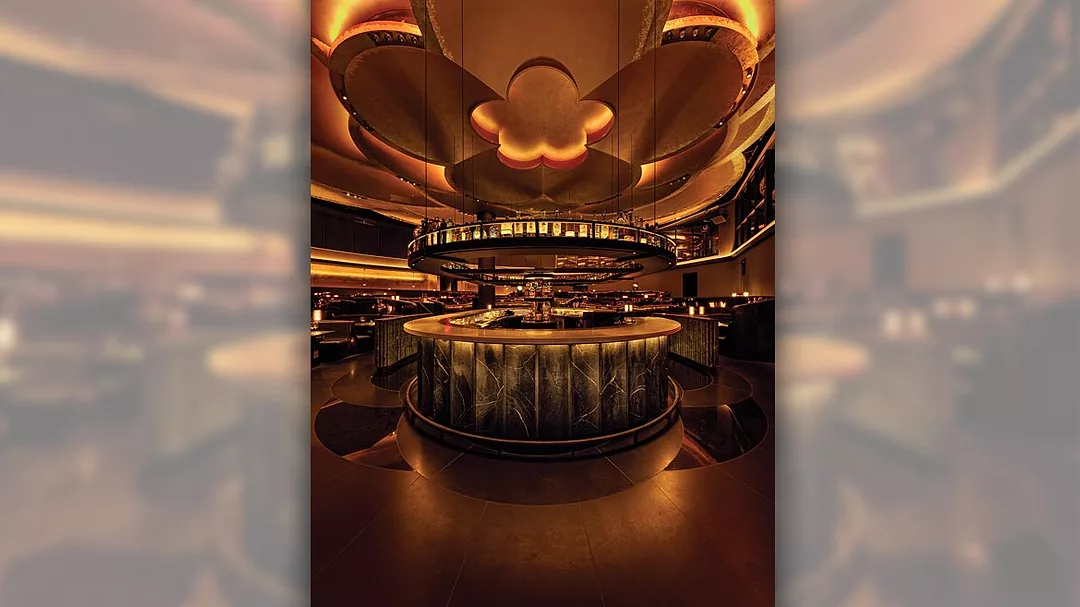
The main bar consists of 13 inches wide x 2 ¾ inches deep x 42 inches tall concave large-format granite tiles. Dimensions were rigorously mocked up to confirm tight joints and precise fit, according to the architect.
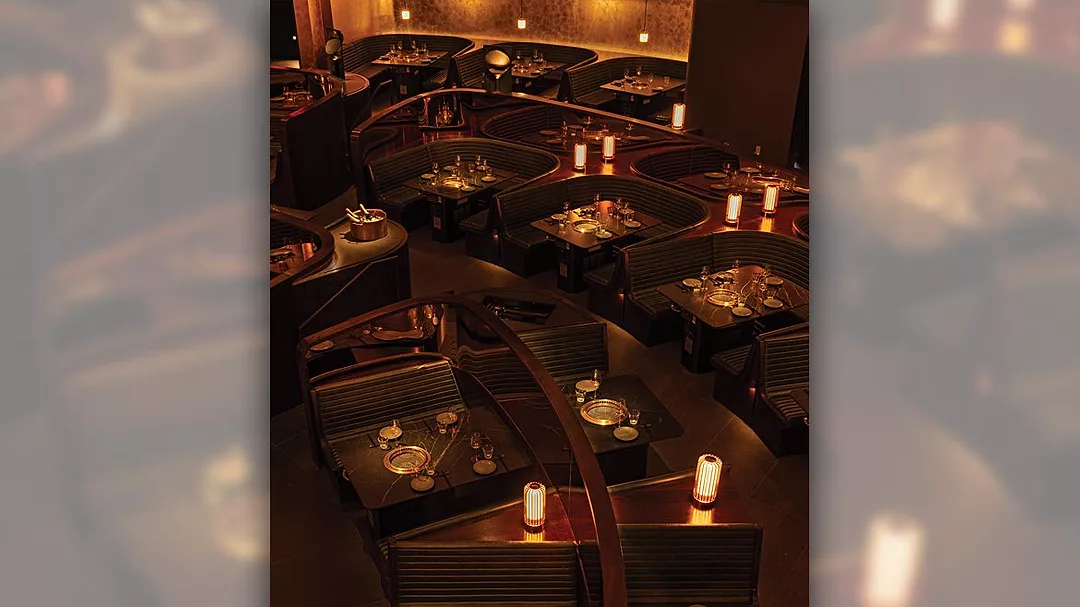
“Inspired by COTE’s flower emblem, we created a journey into the heart of the dining room that gradually opens and reveals itself like petals of a flower,” said Brad Zuger, partner, Rockwell Group.
COTE Vegas is the fourth of its kind to open under the direction of Seoul-born restaurateur Simon Kim of Gracious Hospitality Management. The concept originated in June 2017, when Kim rose to the top of the culinary world with COTE Flatiron in New York City, which was not only recognized for being New York City’s first Korean steakhouse, but also the world’s only Michelin-starred Korean tabletop grill restaurant. In addition to New York, NY, and Las Vegas, NV, there are locations in Miami, FL, and Singapore. While the atmosphere of each subtly differs to reflect its host city, there is one common thread that weaves throughout each restaurant’s interior design — the use of soapstone.
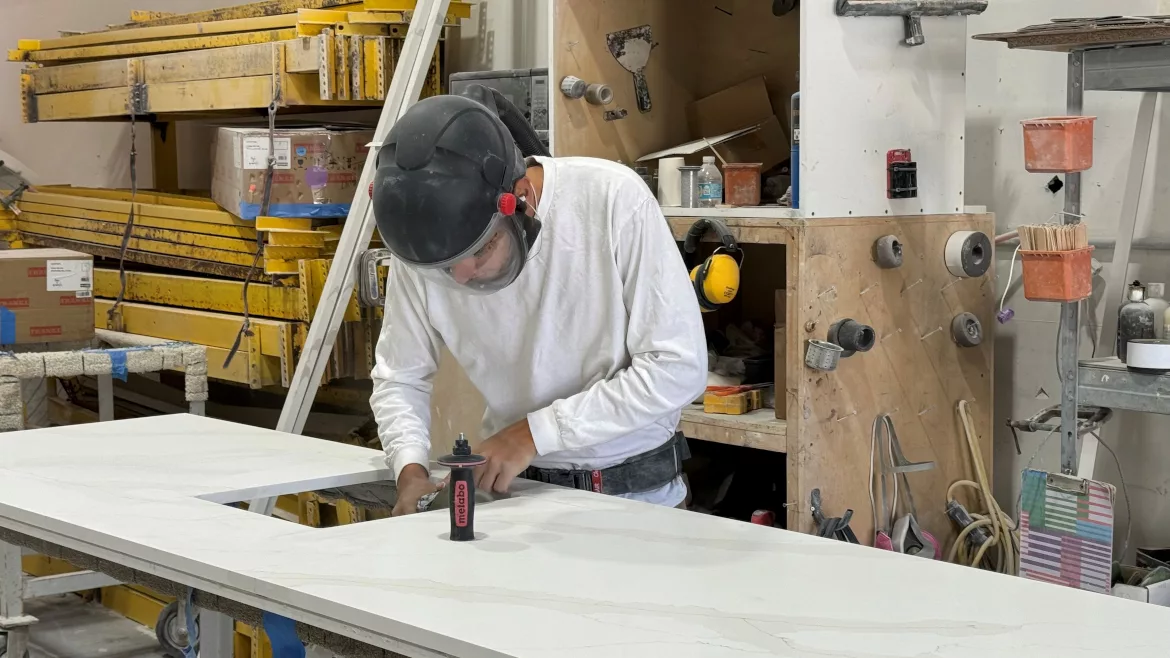
Roger Teixeira of M. Teixeira Soapstone in Glen Rock, NJ, explained how he first was introduced to Kim in New York City through the project’s contractor, Skyland Construction. Teixeira is an importer of soapstone and he also runs a stone fabrication business.
“We met during the building of his first COTE Restaurant in the Flatiron District,” said Teixeira. “He loved the work we did, and he loves soapstone. He has included it in all his restaurants since. We are currently working on his sixth project, 550 Madison Ave.”
The Design of COTE Las Vegas
For the design of COTE Las Vegas, Kim worked with the Rockwell Group of New York, NY. On the ground floor (Front of House), the area spans 7,000 square feet, while the mezzanine (Front of House) covers 2,900 square feet.
“The goal for COTE Las Vegas was to allude to the language and atmosphere of its predecessors but to take an entirely new and unprecedented approach to the theatricality of dining,” explained Brad Zuger, partner, Rockwell Group. “Inspired by COTE’s flower emblem, we created a journey into the heart of the dining room that gradually opens and reveals itself like petals of a flower. This runway-like experience — perfect for seeing and being seen — is akin to passing through a number of thresholds before entering a grand theater, with the showstopper standing bar as the main event. Clusters of tiered banquettes sit under a glowing flower ceiling installation. The mezzanine-level DJ and PDRs have a skybox feel and float over the dining room. The evening unfolds with lighting activations created by the LAB at Rockwell Group, music and the special culinary performances at the tableside grills.”
While the design team was not too familiar with soapstone, they soon learned about its wonderful characteristics and benefits, according to Zuger. “It made sense to us that there would be a throughline in materiality from the other COTE locations,” he said. “If guests had been to other locations, the soapstone would feel familiar at the touch level, while the overall environment in Las Vegas is still curated to reflect the local context. We love the fact that the soapstone is aged and oiled, giving it a robust, lived-in feel — warm and grounded, not overly pristine or precious.”
In addition to employing soapstone in COTE Vegas’ interior design, Kim also stressed several other requests. “Durability, local inventory and budget were key challenges raised by the client,” said Zuger. “We wanted the flooring to ‘disappear,’ so the focus stayed on the theatrical seating and the gold ceiling — encouraging guests to look around and up. For that reason, we selected large-format black granite for the ground floor. Because the bar is the center of the restaurant, we wanted the stonework to acknowledge it without pulling too much attention. We developed a pattern that alternates polished and leather finishes, subtly integrating the COTE flower logo at the center.
“We used Bianco Rhino in a honed finish for the central bar top; it was hand selected in Las Vegas in collaboration with the Venetian and the restaurant owner,” Zuger continued. “It is a timeless white stone that has light sage accents.”
The Inherent Qualities of Soapstone
The architect explained that other than COQODAQ, another of Kim’s New York restaurants that blends Korean and American flavors to deliver high-quality, sustainably sourced fried chicken, they had not worked much with soapstone prior to COTE Vegas. “During the material exploration phase with our supplier, we understood that the material looks drastically different with various finishes and techniques,” he said. “An oiled finish will deepen the color, creating a patina. A honed finish would change color if it encountered water, so that prevented us from specifying a honed finish at wet area applications. Soapstone’s softness also makes it easy to carve from the block, so we made some large-scale three-dimensional tile and sinks throughout.”
“During the material exploration phase with our supplier, we understood that the material looks drastically different with various finishes and techniques.”
As the supplier and fabricator, Teixeira was in constant communication with the design team. “I must say, a lot of the education Rockwell received about soapstone was probably from Simon himself,” he said. “We did work very closely with them exchanging samples with different textures and finishes; also performing lab tests to make sure it met all their expectations and specifications.
“Durability, texture and the color palettes were very important for each different application,” Teixeira went on to say. “For instance, all the restaurant dining tables are done in the world's best-selling soapstone, Stormy Black, in a custom leathered finish treated with a color enhancer by Tenax. This gives the soapstone that deep black color and enhances the lighter veins. On the drink rail facades, they wanted something with a greener color, so they selected a very rare soapstone, called Maldives, also mined in the same region.”
The Stone Fabrication Process
Zuger was excited to share several of the intricate stone details. “We made some amazing large-scale fluted stone tiles for the bar die and drink rail die walls,” he said. “The drink rail is 3 inches wide x 1 ½ inches deep x 36 inches tall convex tiles. We made sure there was no cutting on site and worked out the radius to fit nicely around the curve.” Zuger went on to say that the main bar consists of 13 inches wide x 2 ¾ inches deep x 42 inches tall concave large-format granite tiles. “Dimensions were rigorously mocked up to confirm tight joints and precise fit,” he said.
The dining tables feature a 30mm radius reverse bullnose on the underside. “Something not so obvious, but thoughtful when you grab your hand along the edge,” he said. “We didn’t want over-the-top detailing. Something that felt simple but caring felt right for this project.”
The design team worked closely with Teixeira to achieve the details that were sought after. “The main bar die was originally designed in Nero Portoro fluted slabs, 2 inches thick and 48 inches tall,” he said. “Due to the highly custom nature of these pieces, the original supplier was unable to meet the required schedule and Rockwell asked if we could provide the material in soapstone instead. We accepted the challenge; however, because of the wide radius required for the 13-inch-wide fluted pieces, fabrication would normally require a custom diamond “mega bit” to be manufactured in Italy, which would not arrive in time.”
To keep the project on schedule, Teixeira had to improvise. “I personally flew from Brazil with a 75-pound soapstone sample in my carry-on luggage to present for review and approval prior to proceeding,” he said.
For the Rainforest Green soapstone drink rails, the millwork facades are clad in soapstone cylinders with a ¼-inch reveal at the top. Teixeira shared a fun fact. “We produced 150 cylinders for two drink rails,” he said. “Due to a misunderstanding during ordering, only half the cylinders arrived initially — just three weeks before the grand opening. We managed to produce, package and airfreight the additional 75 cylinders from Brazil to Las Vegas in under two weeks, ensuring the project opened flawlessly and on time.”
Teixeira went on to explain that he and his team fabricated and supplied all the restaurant’s dining tables — each custom-engineered to integrate with Shinpo Smokeless Grills. “These were far from standard ‘cut and eased-edge tops’,” he said. “Each table features an inverted demi-bullnose edge, meticulously milled using Nicolai diamond router bits personally hand-carried to our partners’ factory in Brazil by Camila, my wife. The grill cut-outs include precision recessed milling under the tops (50mm x 15mm) to perfectly accommodate the grill units. The tables are finished in leathered Stormy Black soapstone.”
Crafted from honed Rainforest Green soapstone, each vanity in the restrooms features mitered integrated sinks and mitered integrated napkin holders — elevating the design beyond standard vanity construction, according to Teixeira. “Three highly customized handwash stations, also in honed Rainforest Green soapstone, were fabricated with mitered hexagonal integrated sinks — a striking and original design feature.”
For the restaurant’s main doors, the fabricator supplied custom soapstone push plates with a linear saw-blade finish and the restaurant’s logo CNC-engraved. “It is a subtle but powerful design detail,” he said.
Overcoming Challenges
“As with any construction project — especially one of this caliber — challenges can arise,” Teixeira went on to say. “How those challenges are addressed is what defines us as professionals. One example involved the dining room tables, which were designed with a very custom inverted demi-bullnose edge. After installation, Simon shared that the edges felt slightly sharper than expected and could impact the guest experience. At that point, the restaurant had already begun soft-opening events and staff training. We immediately sent a team from our San Francisco shop to rework the edges by hand, on site. Due to the active schedule at the restaurant, the work had to be completed after hours, often late at night. Despite the constraints, the adjustments were completed successfully and to satisfaction.”
For the Rockwell team, one of the most challenging and exciting aspects of the project was seamlessly integrating technology into the storytelling aspect of our design. “We did this in tandem with our LAB at Rockwell Group,” said Zuger. “We wanted to blur the boundary between fine dining and a DJ’s favorite spot. We designed a bespoke, dynamic lighting installation and overlay to complement the architectural team’s design and allow the COTE team or DJ to shift the mood of the evening at the appropriate rhythm for any crowd. First, we created a theatrical lighting rig that can refract and project COTE's branding as a light-based animation. Then we layered in sound reactivity so that the lighting and its rhythms and colors always accurately reflect the vibe of a moment. This system allows the flower emblem on the dining room ceiling to feel as though it’s a dynamic element.”
COTE Vegas opened its doors in The Venetian Resort in October 2025. It is the first West Coast location of the Michelin-starred COTE Korean Steakhouse. Recently, the project was recognized in the Stone Design category of the Coverings Installation & Design Awards, which were presented at Coverings 2026 at the Las Vegas Convention Center in Las Vegas, NV.
Looking for a reprint of this article?
From high-res PDFs to custom plaques, order your copy today!