Stone Industry Professionals Instructed to Master the Fundamentals Before Chasing AI Tools
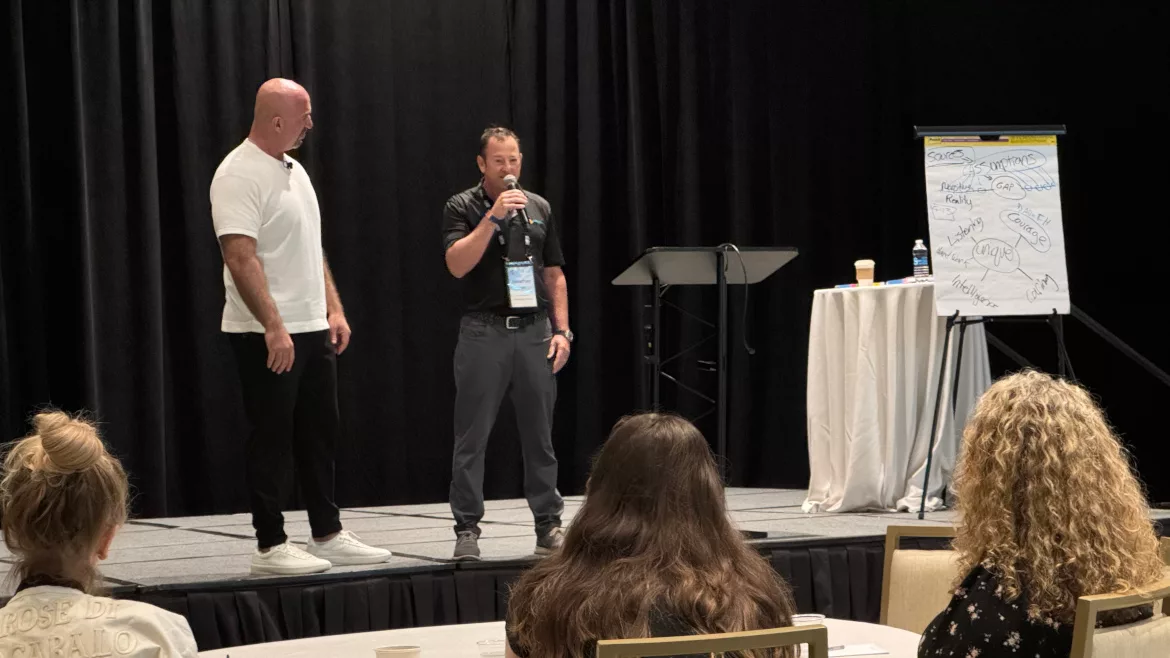
Leadership and neuroscience expert René Rodriguez urged stone industry professionals to embrace a systematic approach to sales during StoneBiz on the Beach, a two-day workshop held in Puerto Rico this past fall and organized by the Stone Fabricator’s Alliance (SFA). He warned that emotional self-regulation and consistent prospecting matter more than the latest technology.
Rodriguez, a Wall Street Journal best-selling author and keynote speaker who has spent more than 27 years researching behavioral neuroscience, delivered his signature presentation on influence and sales methodology to fabricators and industry suppliers who were in attendance. “Sales is the highest paying hard work there is, and the lowest paying easy work," said Rodriguez, drawing from lessons he learned at age 18 when he began selling cookware door-to-door after his college basketball career ended unexpectedly.
From Basketball Dreams to Sales Success
Rodriguez opened his presentation by sharing his personal journey, describing how he spent 15 years pursuing basketball only to be cut from his college team after an injury. The experience, he said, taught him an invaluable lesson about control.
"I spent my whole life chasing basketball and the approval of a coach who could decide if I play or not," said Rodriguez. "But in sales, you make a sale, you never get cut. The level of control when you can go out there and sell a product, an idea or a service is better than money, because they can take your money, but they can never take the skill."
At 19, Rodriguez ranked fifth in sales among representatives across the U.S., Canada and Mexico, earning a trip to New York City for the company's top performers. The experience crystallized his commitment to sales as a profession.
The Courage Scale: Managing Energy in Sales
Central to Rodriguez's teaching is what he calls the "Courage Scale," based on the work of psychiatrist Dr. David Hawkins. The framework assigns energy levels to different emotional states -- from shame and guilt at the bottom to peace and enlightenment at the top.
Rodriguez explained that a threshold at 200 on the scale separates "taking" emotions like fear, grief and apathy from "giving" states like courage, willingness and acceptance. He urged attendees to remain aware of their emotional state and develop techniques to stay above the line.
"One outburst from a leader in a thousand-person organization permeates emotionally throughout the organization within 15 minutes," said Rodriguez, citing Harvard research. "The number one task of a leader is emotional self-regulation."
For sales professionals, understanding this emotional dynamic provides a competitive advantage. Rodriguez noted that most customers enter the buying process below the line, experiencing fear about expenses, uncertainty about outcomes and stress about major purchases.
"Do you think your competitors have any clue of this idea? You could be the one that's above the line and understands that," he told attendees.
The Six Money-Making Activities
Rodriguez presented what he described as the only six activities that generate revenue in sales: prospecting, setting appointments, presenting value, gaining commitment to close, delivering on promises through aftercare and asking for referrals.
"Anything you do outside of these six is a complete and total waste of time," said Rodriguez. He emphasized that only the first activity, prospecting through phone calls and outreach, is directly controllable by the salesperson. Everything else depends on customer response.
Using what he calls "sales math," Rodriguez demonstrated how tracking conversion rates at each stage creates predictable revenue. In his model, talking to 25 people generates five leads, which produce 2.5 presentations, resulting in 1.5 contracts and ultimately one sale.
"If my average deal is $3,000, that means every conversation is worth $120," said Rodriguez. "Those activities carry inherent value, even when they feel fruitless."
Competing on Value, Not Price
During a question-and-answer session, a fabricator raised the challenge of competing against lower-cost providers in an industry with little regulation. Rodriguez responded with a framework for justifying premium pricing.
He displayed an image showing poorly executed countertop work with the caption "There's always someone willing to do it cheaper" and advised fabricators to build a library of similar examples to share with prospects.
"We made a decision 20 years ago when we started our company," said Rodriguez, suggesting a script for fabricators. "We knew it would be a lot easier to explain price one time here today than have to apologize for poor service and bad quality forever."
Rodriguez emphasized that differentiation, the ability to sell products or services without lowering prices, comes primarily through service, relationships and trust rather than the physical product itself.
"A piece of chicken with no story ends up on a dollar menu," said Rodriguez. "A piece of chicken with a story costs more for the experience. You have to be able to tell the story."
AI as a Marketing Multiplier
Rodriguez briefly addressed artificial intelligence, revealing that he now uses AI tools to produce more than 40 videos daily across social media platforms. He credited the technology with helping him grow his following to more than one million on Instagram and TikTok after 13 years of minimal traction.
"I used to have to hire AI operators and strategists, and now we have it for free with ChatGPT," said Rodriguez, promising to share his formulas with attendees.
However, he cautioned that mastering fundamental sales skills remains essential. "You need to be good at it now, so that when AI comes along, you're just as good as that," said Rodriguez. "You need to get in the game."
Procrastination: A Self-Regulation Problem
In the afternoon session, Rodriguez turned to procrastination, which he identified as the primary obstacle preventing sales professionals from executing proven strategies.
"Procrastination is not a time management problem," said Rodriguez. "It is a self-regulation problem. Procrastination is actually a cure. It cures fear, self-doubt and even the dislike of work. But it's curing the wrong thing."
He led attendees through an exercise replacing the word "time" with "life" in common phrases, transforming statements like "stop wasting my time" into "stop wasting my life" to illustrate the true cost of poor time management.
Using a ruler to represent an 80-year lifespan, Rodriguez calculated how much time remains after accounting for sleep, work, television and social media. The visual demonstration showed attendees their remaining discretionary time measured just a few inches.
"I stopped scrolling six months ago because I was living at 45 hours a month scrolling social media," said Rodriguez. "When I stopped scrolling, I started two businesses, started creating products, had more energy, slept better and was in the gym all the time."
Looking Ahead
Rodriguez concluded by encouraging attendees to focus on controllable activities and consistent execution rather than external market conditions. "There are only two ways to make more money," said Rodriguez. "Either do the activity more often or improve the conversion ratio between activities through better quality presentations."
For stone industry professionals seeking to implement Rodriguez's methodology, resources including his book "Amplify Your Influence" and the AMPLIFII training program are available through his website.
Looking for a reprint of this article?
From high-res PDFs to custom plaques, order your copy today!