Sales Expert René Rodriguez Delivers Masterclass on Revenue Generation
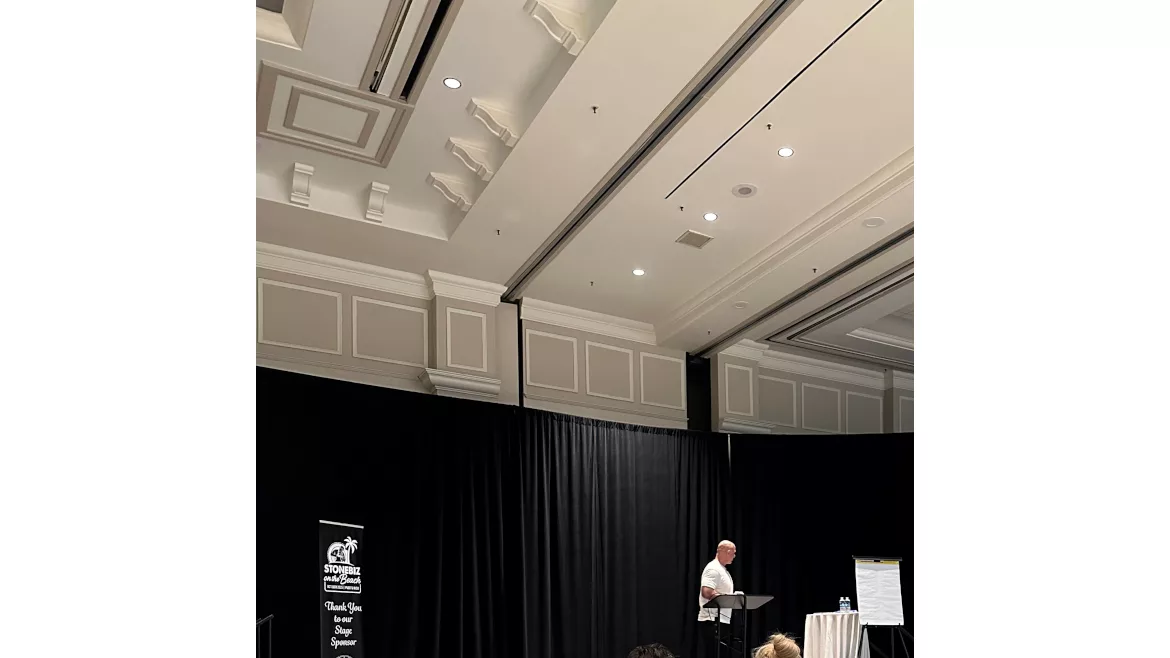
René Rodriguez, a veteran sales trainer with over 30 years of experience, delivered a comprehensive presentation on sales methodology and overcoming procrastination at StoneBiz on the Beach, a recent stone industry event in Puerto Rico organized by the Stone Fabricator’s Alliance (SFA), emphasizing that sales success depends more on consistent activity than innate talent.
Rodriguez, who began his career at 18 selling cookware door-to-door and rose to rank fifth in sales across the U.S., Canada and Mexico by age 19, outlined what he called the "six money-making activities" that form the foundation of any successful sales operation.
"There are only six ways that you make money in sales," Rodriguez told attendees. "And anything you do outside of these six is a complete and total waste of time."
Those activities, he explained, are prospecting, setting appointments, presenting value, gaining commitment to close, delivering on promises through aftercare and asking for referrals, which feeds back into the prospecting phase to create what he described as a "perpetual sales cycle."
The Law of Averages
Central to the presentation was the concept of predictable revenue through mathematical consistency. Rodriguez introduced an inverted funnel model suggesting that for every sale, a salesperson typically needs 1.5 contracts, 2.5 presentations, five qualified leads and conversations with approximately 25 prospects.
"If my average deal is $3,000, that means every conversation is worth $120," said Rodriguez, breaking down the value inherent in each step of the sales process. "Those unsexy activities like talking to somebody and presenting, feel fruitless and difficult. But those are the ways we get to the revenue."
He emphasized that the only element salespeople can directly control is the initial conversation. Everything else flows from that foundation.
Quality Over Price
The presentation addressed a challenge familiar to many stone fabricators: competing against lower-cost providers. One attendee raised the issue of customers taking their expert consultation to cheaper competitors.
"There's always somebody willing to do it cheaper," Rodriguez acknowledged, displaying a slide with that exact message. He advised fabricators to develop compelling narratives around quality and craftsmanship rather than competing on price alone.
"We made a decision 20 years ago when we started our company," he demonstrated as an example script. "We knew it would be a lot easier to explain price one time here today than have to apologize for poor service and bad quality forever."
Rodriguez encouraged attendees to show visual examples of substandard work from competitors and to remind customers that the only person who pays when quality is compromised is the customer themselves.
Emotional Intelligence in Sales
Rodriguez introduced the emotional consciousness scale developed by Dr. David Hawkins, a psychiatrist who studied different emotional states and their effects on energy and performance. The scale ranges from shame and guilt at the bottom to courage, reason and peace at higher levels.
"Most of your customers are below the line when they're buying something," he noted. "They're in the middle of a project. Expenses are higher than normal. They don't know what it's going to look like."
He advised sales professionals to recognize when they themselves fall below a productive emotional threshold and develop techniques to regain composure before engaging with customers.
Harvard research cited during the presentation indicated that emotional outbursts from leaders can permeate through a thousand-person organization within 15 minutes, underscoring the importance of emotional self-regulation.
Procrastination as Self-Regulation
Rodriguez, who has been addressing procrastination in his presentations since 2006, argued that procrastination is commonly misunderstood.
"Procrastination is not a time management problem," said Rodriguez. "It is a self-regulation problem. Procrastination is actually a cure. It cures fear, self-doubt and even the dislike of work. But it's curing the wrong thing."
To illustrate the finite nature of time, he led attendees through an exercise replacing the word "time" with "life" in their personal statements about time management challenges.
"Stop wasting my time" becomes "Stop wasting my life," Rodriguez demonstrated. "When we change that word, it becomes painful. It becomes real."
Looking Forward
Rodriguez announced plans to share Artificial Intelligence (AI) tools and marketing formulas that he credited with helping grow his social media presence to over a million followers across platforms. He emphasized that these resources would be provided free to attendees.
"Once I give it to you for free, next year what I want to share with you is probably irrelevant," he acknowledged. "And probably some AI tool will do it for you automatically. But you need to be good at it now, so when that comes, you can be just as good at that."
Looking for a reprint of this article?
From high-res PDFs to custom plaques, order your copy today!