Indiana Limestone Provides Strength and Tranquility
With traits of timeless beauty, warmth and durability, the natural stone was the ideal choice for the new administration building at a historic cemetery in Portland, OR
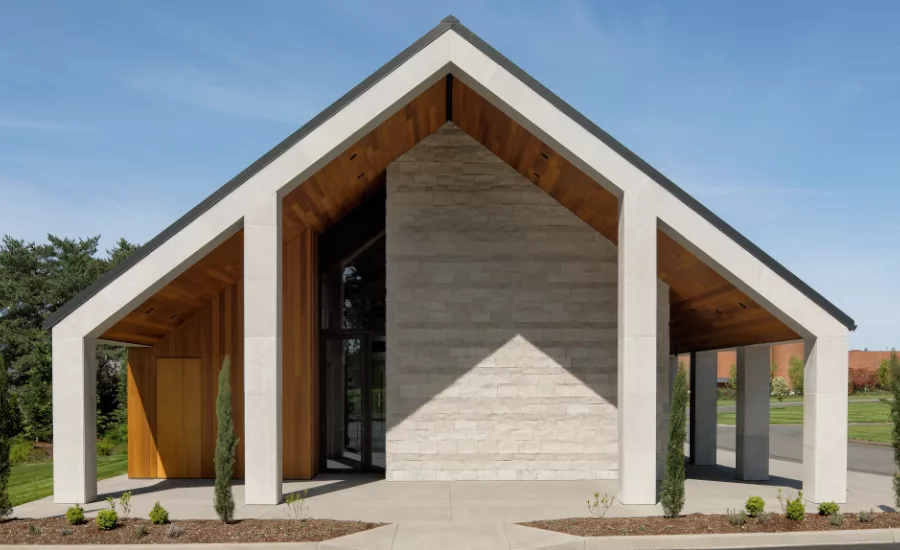
Indiana limestone is a prominent component of the design for Cedar + Stone office building in Portland, OR, designed by Giulietti Schouten Weber Architects.
Photo by Jeremy Bittermann
The administration building for a historic cemetery in Portland, OR, was in desperate need of a renovation. The staff and stewards of the property sought a new structure constructed of durable, yet warm materials that would be welcoming to visitors. As a result, they worked with the team from Giulietti Schouten Weber Architects on the design of the Cedar + Stone office building – featuring Indiana limestone throughout its exterior and interior design.
“The clients were very specific during initial programming meetings,” said Timothy Schouten, AIA, principal at Giulietti Schouten Weber Architects. “They wanted a permanent building to last for centuries, and a building with a timeless design and matching timeless materials. They were specific on wanting a beautiful design that was restrained, modern, yet modest in size.”
The new building not only was designed to accommodate administrative tasks, but also to provide spaces for gathering with families, board meetings, merchandise display, and quiet reflection. Schouten explained that natural stone was always at the forefront during the material selection process for the nearly 4,400-square-foot building.
“We knew from the start that natural stone, specifically limestone, would be our first choice for stone cladding,” said the architect. “Its warmth, availability, time-tested durability, and beautiful finishes matched our vision for a fresh take on an over-looked building type. In the end, it was the perfect match and the clients loved the detailing both inside and outside.”
The design team researched a number of stone options for cladding before making a final decision. “Highest on the priority list was the permanence of the stone, availability,y and location, and most importantly, the beauty of the stone,” said Schouten. “Indiana limestone was the easy choice.”
According to the design team, the architectural vision centers on “a striking yet understated gabled structure, featuring a simple shed dormer that introduces east-facing clerestory windows, flooding the lobby and office areas with natural light and creating an inviting atmosphere. Emphasizing resilience and longevity, the colonnade is clad in smooth limestone, echoing the existing mausoleum structures on-site, while the building's body is split between rough-cut limestone and warm cedar tongue-and-groove siding.”
Numerous sizes of Vanderbilt Classic and Vanderbilt Berkshire thin veneer – supplied by Indiana Limestone Co. of Bloomington, IN – were employed for the project. For a standard large ashlar pattern of split-face veneer the sizes included: 4 x 16, 8 x 20, and 10 x 16 inches. Larger smooth-finished panels on the fascias, columns, and soffits average 40 x 20 inches and smaller.
The masons from Rael, Inc. provided a full-scale mock-up showing details at the building corners and column corners for the design team and clients to review. “Multiple meetings took place with the stonemason and Gridworx, [who was the company that provided the stone hanging system], to finalize attachment and finish details,” said Schouten. “The large limestone slabs were attached to exterior soffits by steel ties and anchors. Gridworx provided attachment details and critical shop drawings. With heavy slabs hung overhead, this was the most challenging of the details.”
The architect went on to talk about the timeless quality of natural stone, and that the team loved that they could use the same limestone with two different finishes -- smooth limestone finish on the outside columns, fascia, and soffits, while using a rougher face stone for accent walls. “It felt like the perfect fit and material for this project,” he said. “It’s a building to last 200 or more years -- limestone cladding, zinc roof, bronze windows. The limestone shines and feels as permanent as the foundation it rests on. It will look beautiful long after all of us are gone!”
Schouten also shared a comment from one of the clients, David Dunahugh, a board member of the Crescent Grove Cemetery Association who recently passed away: “We are very proud of the building that you and your firm designed for us. It reflects the quality we project in all the areas of service we provide. Our previous office building fell short of delivering that image we as a Board thought was so important. We wanted to project an image of ageless design with quality materials and sophisticated detailing. We think that we succeeded in delivering exactly that. The collaboration between architect, contractor, and client was seamless and productive. We should all be proud of the building we created.”
Looking for a reprint of this article?
From high-res PDFs to custom plaques, order your copy today!