Dust Removal: What Fabricators Need to Know
Need to Know
- All respirable dusts — not just silica — have the potential to cause harm, particularly in environments where multiple materials and processes are involved.
- The focus to ban quartz is at best a temporary band-aid answer in the broader context of all of the dust-producing materials and processes involved in stone fabrication.
- To effectively manage the safety hazards of respirable dust, fabricators must implement a comprehensive dust control strategy.
In the world of occupational health and safety, “dust” is certainly earning its lion’s share of attention, and rightfully so. Given the myriad of materials which our fabrication shops process every day, there exists a hierarchy of hazard potential within each one. Whether it is sawdust, granite dust, normal everyday dust, dust from porcelain, ceramic, marbles and other natural stones, laminates, vinyl, plastics, and of course, the “red elephant,” crystalline silica dust, all of these are hazards to our health in one way or another. The reality is that any respirable dust, regardless of its origin and composition, has the potential to harm the body when inhaled. Fabricators must adopt a comprehensive approach to dust control that addresses all particulate hazards — not just those associated with crystalline silica.
Most focus today is on respirable crystalline silica (RCS). Silica dust has largely been attributed to dry-cutting or grinding masonry, engineered stone, granite and quartz. Silica respiration has been well-documented as a serious health hazard that can lead to silicosis, lung cancer and other respiratory diseases. However, focusing exclusively on silica can create a dangerous blind spot.
Unlike larger particles that may be trapped in the nose or throat and largely expelled, respirable dust can remain in the lungs for very long periods of time. Once these respirable dust particles (typically <10 microns in size) penetrate and settle deep into the lungs, the lungs will be damaged to some extent — typically via scarring and inflammation. When it comes to the “sharp edges” of micro crystalline silica, these edges micro-abrade lung tissue which then automatically activates the body’s immune response. The body “thinks” it’s helping to fix the damage by creating scarring. Over time, however, this scarring is what causes respiratory ailments ranging from wheezing and coughing to extreme difficulty in breathing, and in its extreme, death by “self-suffocation.”
I want to be perfectly clear that the objective of this article is to broaden the consciousness of fabrication shops to fully embody and embrace the general “dust hazard.” Sound basic? Well, maybe not quite so. With the focus today largely being on quartz and regional pressures to ban the product because of its latent danger, it seems the vast majority of what is written about focuses on just quartz. Truth be told, the quartz product itself is not the problem, how it is handled and managed is; aka, the “behavior.”
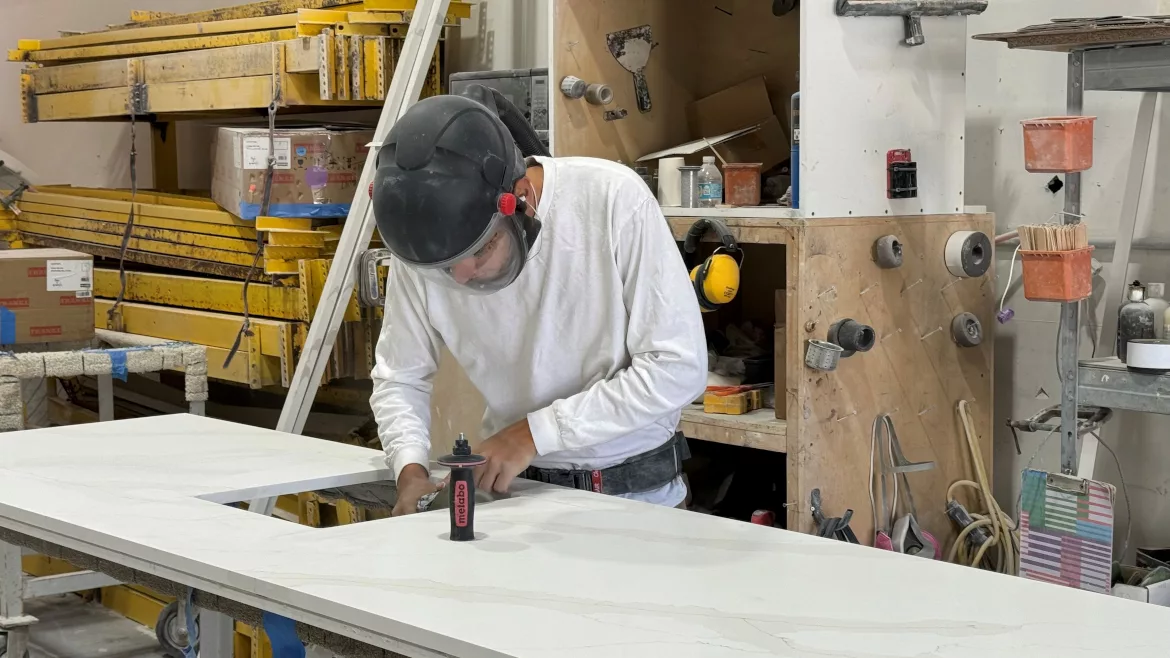
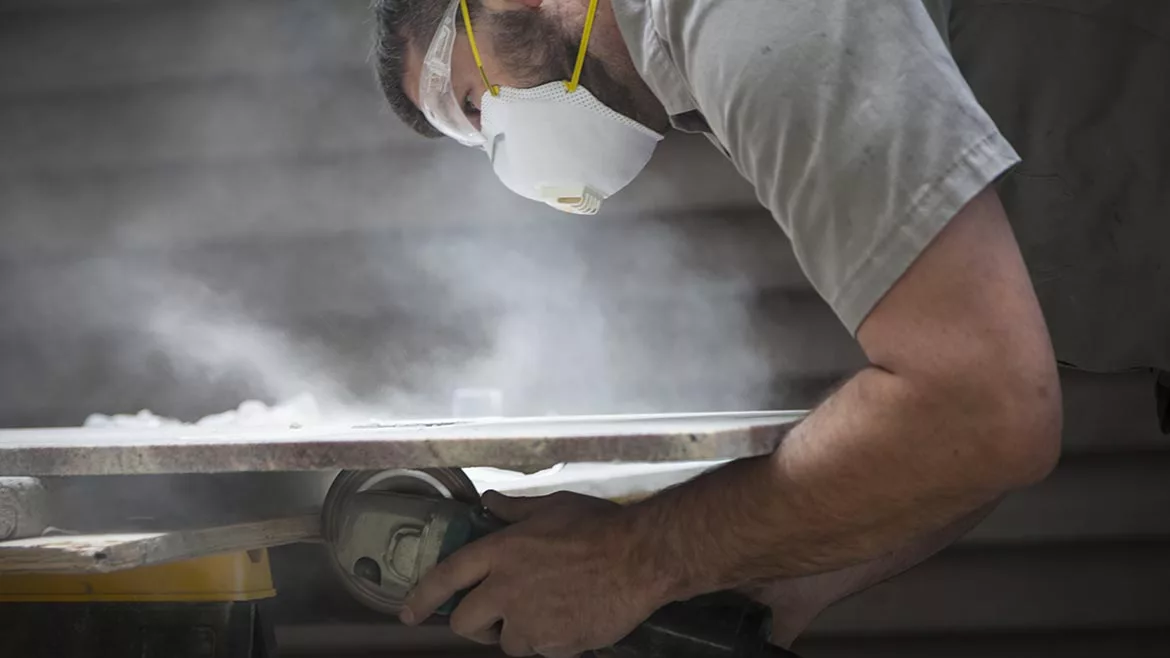
Drilling this down: In a countertop fabrication shop, dust is generated from many products at nearly every stage of handling — grinding, cutting, edging, polishing, drilling and even during clean-up activities like sweeping or blowing debris. Most larger fabricators today are rather diversified and offer a much broader portfolio of products and services. What does this mean? It is rather common for shops to cut wood (saw dust); using, grinding, sharpening tools (metal dust); cutting, sanding/polishing and routing resins within engineered stone, laminates and solid surfaces; cutting plastics and essentially any other materials. All of these activities create dust of various sizes and potency that should not enter anyone’s body,
Follow the Dust
One critical issue is that different types of dust can have different toxicological effects, which largely stem from their inhalation. Wood dust, for example, has been linked to respiratory irritation, asthma and even certain types of nasal cancer with prolonged respiration. Metal dust has been linked to chronic lung disease. Plastics, vinyl and other polymeric/synthetic materials may release fine particles and chemical residues that irritate the respiratory system or introduce additional toxic risks. It has also been shown that materials considered relatively “inert” can create some degree of health affect when respirated in sufficient quantities over time. (See Figure 1.1)
Bringing It All Together
As I mentioned, today’s fabrication shops are typically converting multiple materials. A somewhat “under-the-radar” problem is the cumulative effect of mixed dust exposure. It is believed that the combined exposures could interact in ways that amplify health risks, making it difficult to attribute symptoms to a single material. This complexity underscores the need for a holistic approach to dust control rather than a narrow focus on one hazard.
While ignorance “may be” bliss, it is also extremely dangerous. The overabundance of caution focused on the creation of respirable silica is justifiable, however, what sense does it make to focus on one culprit when the fabrication environment potentially breeds so many? The focus to ban quartz is at best a temporary band-aid answer; what then remains behind are numerous other crystalline silica containing materials along with many other sources of other types of dust. All just mentioned that remains will likely affect the workers eventually and rear as general health problems, disease and loss of vital function.
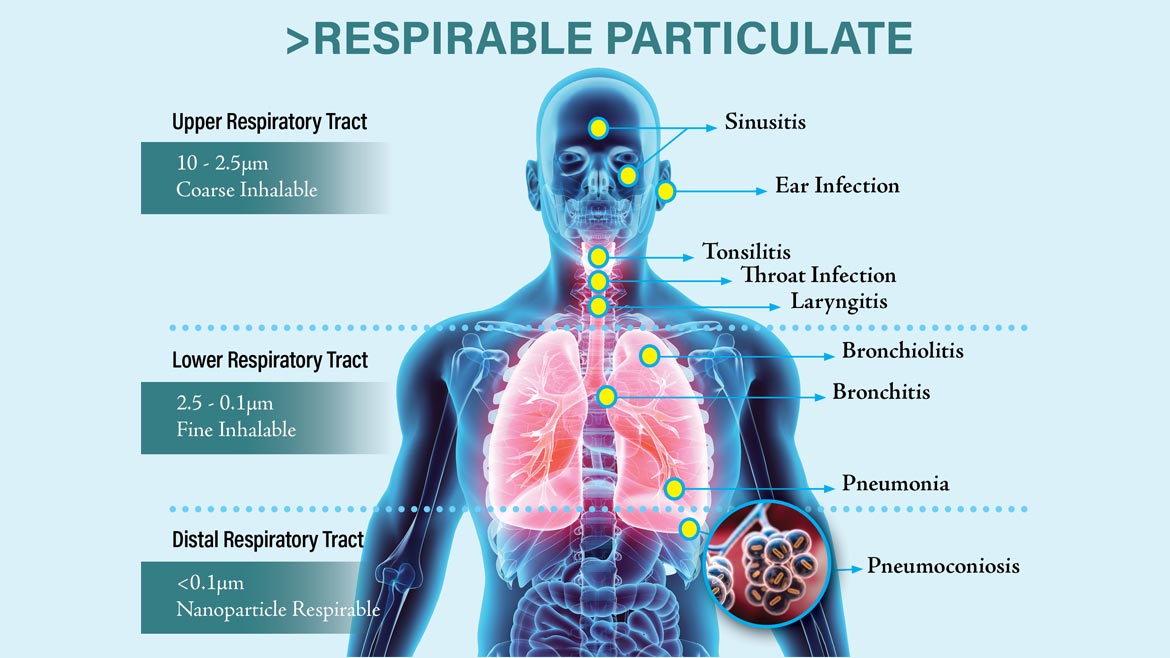
Figure 1 (Click to enlarge)
Image Credit: yodiyim / iStock / Getty Images Plus via Getty Images; peterschreiber.media / iStock / Getty Images Plus via Getty Images
For any fabrication shop to consider themselves a “sustainable” business entity, they really should focus on the “behavior” first – i.e., All Dust Mitigation. If they focus on quartz and respirable silica, it is tantamount to kicking the can down the road until the next problem/product invariably rises to the top of the culprit list. It is not if, it is when. The health risks associated with the fabrication of quartzite and its release of RCS is rarely addressed and yet, quartzite has a higher percentage of crystalline silica in its composition.
By targeting the product versus the behavior, you are essentially playing whack-a-mole. Yes, engineered stone, by demand and installed volume, is the biggest culprit and understandably under the primary microscope. However, banning quartz has the potential to also do much more harm to livelihoods than the disease itself, (given the number of manufacturers, distributors and fabricators that rely on its demand) to then be left with other silica containing products and other dust creations which will eventually cause disease and death? I truly struggle to see this logic.
I suggest to effectively manage the entirety of the “dust” risk, fabricators must implement a comprehensive dust control strategy. Engineering controls are the most effective means of reducing airborne dust. These largely include wet cutting and polishing, local exhaust ventilation systems and HEPA filtration systems used in vacuums and dust collectors to ensure that fine particles are not recirculated into the air.
When it comes to maintenance and cleaning, common sense controls play a critical role. Dry sweeping and the use of air for cleaning should be eliminated as much as possible as these methods can reintroduce settled dust into the air. Wet cleaning methods using HEPA-filtered vacuums, for example, are far wiser and safer.
Personal Protective Equipment (PPE) is another very important — albeit “insufficient as alone” important layer in the dust defense. If N95 masks were highly recommended for Covid-19, I would have to think using these would also be a large help. I do not pretend to be a PPE expert; however, there are countless suppliers of quality equipment that when properly fitted and used consistently should have the positive efficacy we are seeking.
All the other administrative aspects of risk mitigation remain perfectly applicable to the entire dust conundrum including: Worker education and training programs around all sources and risks of dust and dust sources; accountability, including auditing, monitoring and continuous improvement; air quality testing; regular maintenance; and feedback from workers. These culminate into positive actionable items whose consistent and collective deployment can have profound benefits to the health of the workers and the corporate culture.
Essentially, the fabricator’s goal should be to create a culture of safety that treats dust control as a universal threat rather than a material-specific concern. By recognizing that any respirable dust can pose a risk, fabricators can avoid the pitfalls of selective safety practices and build a more robust approach to worker protection.
Crystalline silica remains the current foremost hazard in countertop fabrication, and yet, realistically, it is only part of a much broader issue. All respirable dusts have the potential to cause harm, particularly in environments where multiple materials and processes are involved. Ironically, there is inherent risk in fabricators who focus solely on silica; they will be overlooking other significant risks whose effect can rear at any point in time. A larger and broader, more comprehensive holistic approach is what is needed.
In my opinion, as a multi-decade veteran of the industry, a fabricator must adopt the overall dust control paradigm as part of their social responsibility and sustainability strategy. By hedging against all dust concerns, not just silica, the industry can move toward safer and more sustainable operations. In the end, the behavior is what governs the risk. We can preserve the livelihoods of tens of thousands of workers and businesses across the U.S. alone if we focus on the overall problem versus focusing on one culprit.
Looking for a reprint of this article?
From high-res PDFs to custom plaques, order your copy today!