Why Your Stone Shop Needs a Sales & Marketing System (and How to Build One)
Infrastructure for building a marketing strategy that works for your fabrication business
Need to Know
- A successful sales and marketing strategy for stone fabricators requires a documented system – not individual tactics that result in unpredictable growth.
- A complete system for fabrication businesses has five essential components: Lead generation, lead capture, CRM and process management, follow-up automation, and measurement and optimization.
- Building an entire marketing system does not have to happen overnight. Stone shops should address their biggest revenue leak first.
Most stone fabricators approach marketing like they are throwing darts in the dark. They spend money on Google Ads, update their website, post on social media, and hope something sticks. Then they wonder why growth is unpredictable.
Here is the truth: marketing is not about individual tactics. It is about building a system -- a framework that connects every touchpoint from the first time someone discovers your business to the moment they sign a contract. Without this infrastructure, you are not running a marketing strategy. You are just reacting.
What a Sales and Marketing System Actually Is
Think about your fabrication process. You do not just "make countertops." You have a documented system:
- Material arrives and gets inspected
- Slabs are digitized and entered into your ERP
- Templates are created with precise measurements
- Cutting follows exact specifications
- Quality control checks every piece
- Installation happens on schedule
- Final inspection ensures perfection
Every step is documented. Every handoff is clear. Everyone knows their role. Now compare that to how most stone shops handle leads.
A call comes in. Someone answers (or does not). Maybe they take notes. Maybe they enter it somewhere. Maybe they follow up. Maybe they do not. There is no system. No accountability. No way to know where things break down. That is the gap. And it is costing you jobs.
The Five Components Every System Needs
A complete sales and marketing system has five essential components. Miss anyone and leads fall through the cracks.
1. Lead Generation Architecture
This is how you attract potential customers. Google Ads, SEO, social media, referrals -- these are channels. But without architecture, they are just noise. Your lead generation architecture answers:
- Which channels bring qualified leads vs. tire kickers?
- What is your cost per lead by source?
- Which campaigns drive actual jobs, not just inquiries?
- How do you track attribution from first touch to closed deal?
Most shops cannot answer these questions. They know their monthly ad spend, but they have no idea which dollars drive revenue.
2. Lead Capture Systems
Someone visits your website. They are interested. What happens next?
Most fabricators lose 95%+ of website visitors because they only capture the 5% who fill out a form or call. The other 95%? Gone forever.
Your lead capture system should include:
- Phone call tracking with unique numbers for each campaign
- Form submissions tied to specific pages and sources
- Chat functionality for immediate response
- Lead identification technology to capture visitor information even when they do not convert
- After-hours capture so you do not lose the 20% of leads that come outside business hours
3. CRM and Process Management
This is where most fabrication businesses completely fall apart. You need a CRM that is actually built for sales and marketing -- not your ERP's basic module that was designed for job tracking. HubSpot, Pipedrive or similar platforms built for attribution and pipeline management.
Your stone shop's CRM should:
- Log every inquiry (not just quotes)
- Track deal stages from inquiry → appointment → quote → job
- Assign ownership and accountability
- Integrate with your existing tools (website, call tracking, ERP)
- Provide visibility into where deals get stuck
One shop we worked with discovered 78% of calls that discussed scheduling never actually booked an appointment. That is not a lead quality problem. That is a process problem that only became visible with proper CRM tracking.
4. Follow-Up Automation
Speed and consistency matter more than you think. Fabrication shops that respond to leads within 15 minutes convert at dramatically higher rates than those that take hours or days. But most fabricators are asking busy sales reps or front desk staff to handle follow-up between everything else they are doing.
Your follow-up system needs:
- Automated initial response (email or text confirming you received their inquiry)
- Triggered sequences based on lead type (residential vs. commercial, new construction vs. remodel)
- Reminders for your team to follow up at specific intervals
- Re-engagement campaigns for leads that went cold
One client increased their inquiry-to-appointment conversion rate from 45% to 73% simply by implementing a dedicated response coordinator and automated follow-up sequences.
5. Measurement and Optimization
If you cannot measure it, you cannot improve it. Your measurement system needs to answer:
- What is your cost per lead by channel?
- What is your conversion rate from inquiry to appointment?
- What is your conversion rate from appointment to quote?
- What is your close rate from quote to job?
- What is your average job value by lead source?
- How long is your sales cycle?
- Which team members have the highest close rates?
Most shops track "total leads" and "total revenue" and call it a day. The shops that are scaling profitably? They know these numbers cold.
How Systems Prevent Revenue Leaks
Let us look at a real example. A Midwest fabrication shop came to us spending about $8,000 monthly on marketing. They were getting leads. The phone was ringing. But growth had plateaued.
When we implemented a complete system and analyzed their data, here is what we found:
- 78% of calls discussing appointments never actually scheduled one (422 missed opportunities annually)
- Only 3.8% of calls captured email addresses (meaning 96% of leads had no follow-up capability)
- 19% of calls came after hours with no capture system
- Their highest-converting lead source was getting the least budget
- Their lowest-converting source was eating 40% of their ad spend
None of these problems were visible without the system in place to measure them. After implementing the full infrastructure:
- Appointment-setting rate increased to 68%
- Email capture rate jumped to 71%
- After-hours leads got automated response and next-day follow-up
- Budget was reallocated to high-performing channels
- Cost per lead dropped 28%
- Close rate improved from 34% to 43%
- Revenue from marketing channels increased 47% year-over-year
Same team. Same talent. Better system.
The Marketing System in Action
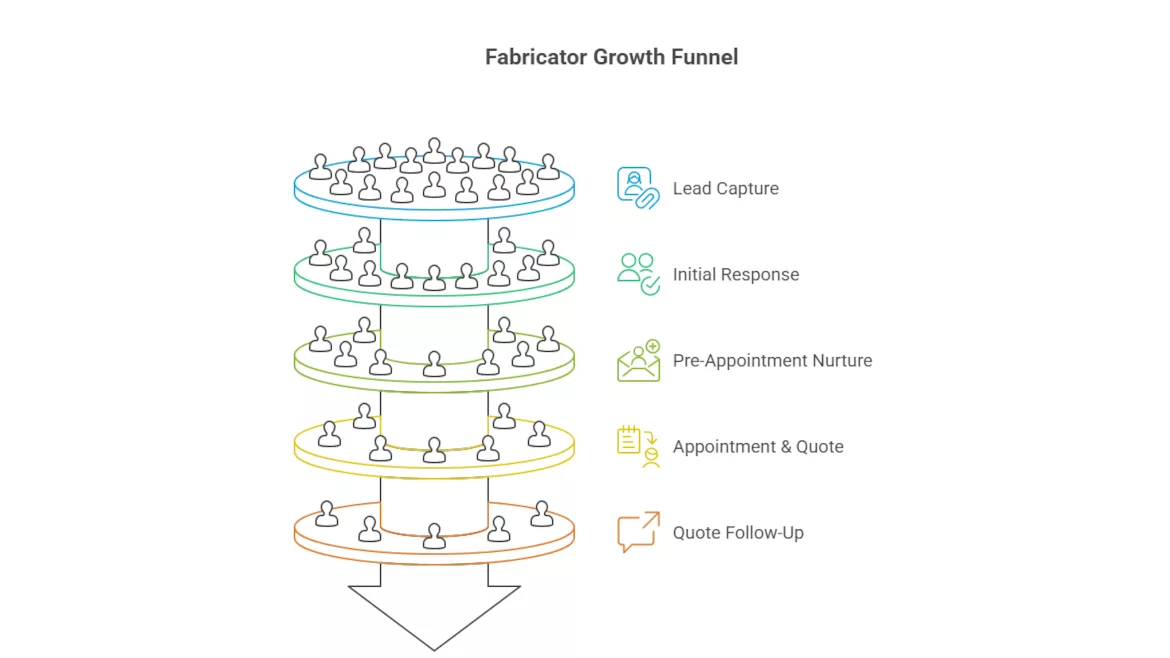
Here is what the complete system looks like for a stone fabricator getting serious about predictable growth:
Day 1: Lead Generation
- Google Ads running with unique tracking numbers for each campaign
- SEO-optimized website with clear calls-to-action
- Retargeting ads following up with site visitors
- Google Local Service Ads capturing high-intent searches
- Referral tracking for word-of-mouth business
Hour 1: Lead Capture
- Call comes in, automatically recorded and transcribed
- Call tracking identifies exact campaign source
- If after hours, automated text response: "Thanks for calling. We will reach out first thing tomorrow."
- Form submission triggers immediate auto-reply email
- Lead syncs automatically to CRM with all source data
Day 1: Initial Response
- Dedicated response coordinator (not juggling other duties) calls within 15 minutes
- Uses proven script to qualify lead and book appointment
- Captures all contact information including email for follow-up
- Schedules appointment in shared calendar
- Deal moves to "Appointment Scheduled" stage in CRM
Days 2-7: Pre-Appointment Nurture
- Automated email sequence: Company background, portfolio, what to expect
- Reminder texts 24 hours before appointment
- Sales rep reviews lead source and previous interactions before visit
Week 1: Appointment & Quote
- Appointment conducted with documented process
- Quote created and sent within 24 hours
- Deal moves to "Quote Sent" stage
- Automated follow-up sequence begins
Week 2-4: Quote Follow-Up
- Three automated touchpoints if no response
- Sales representative makes personal follow-up calls at predetermined intervals
- Re-engagement offers if lead goes cold
- Lost deals marked with reason in CRM for analysis
Ongoing: Measurement
- Weekly pipeline review showing all deals by stage
- Monthly marketing performance report by channel
- Quarterly attribution analysis showing which sources drive highest-value jobs
- Annual review of close rates, sales cycle length and customer acquisition costs
Why Most Stone Shops Do Not Have Systems
If systems work this well, why does not every fabricator have one? Three reasons:
1. "We're too busy."
This is the trap. You are too busy reacting to implement the systems that would give you time back. Meanwhile, you are losing 30 to 40% of potential revenue to process gaps you cannot see.
2. "We don't have the expertise."
Fair. Most fabricators are experts at fabrication, not marketing systems. But that is why you partner with people who specialize in this. You would not hire a plumber to program your CNC. Do not try to build marketing infrastructure without expertise either.
3. "We can't afford it."
This is backwards thinking. You cannot afford NOT to have systems. Every lead you lose to poor follow-up costs you $8,000 to $15,000 in revenue. Every dollar spent on channels that do not convert is money down the drain. The system pays for itself by stopping the bleeding.
Start With Your Biggest Leak
You do not have to build the entire system overnight. Start with your biggest revenue leak. For most shops, it is one of these:
- Lead Capture: You are losing 95% of website visitors and 20% of after-hours calls.
- Follow-Up: Qualified leads are slipping through because follow-up is inconsistent.
- Attribution: You do not know which marketing channels actually drive jobs, so you are spreading budget ineffectively.
- Process Visibility: You cannot see where deals get stuck, so you cannot fix bottlenecks. Pick one. Fix it. Measure the impact. Then move to the next.
The Bottom Line
Growing takes planning, not guessing. Every successful fabrication shop has systems for production, quality control and installation. The shops that are scaling profitably? They have equally robust systems for sales and marketing. Stop treating marketing like a series of random tactics and start treating it like the infrastructure it should be. Your revenue depends on it.
Need help building a sales and marketing system for your shop? Visit miliamarketing.com to learn how we help stone fabricators turn marketing chaos into predictable growth.
Looking for a reprint of this article?
From high-res PDFs to custom plaques, order your copy today!