Minimize Silica Risk: Maintain a Clean Water Recycling System
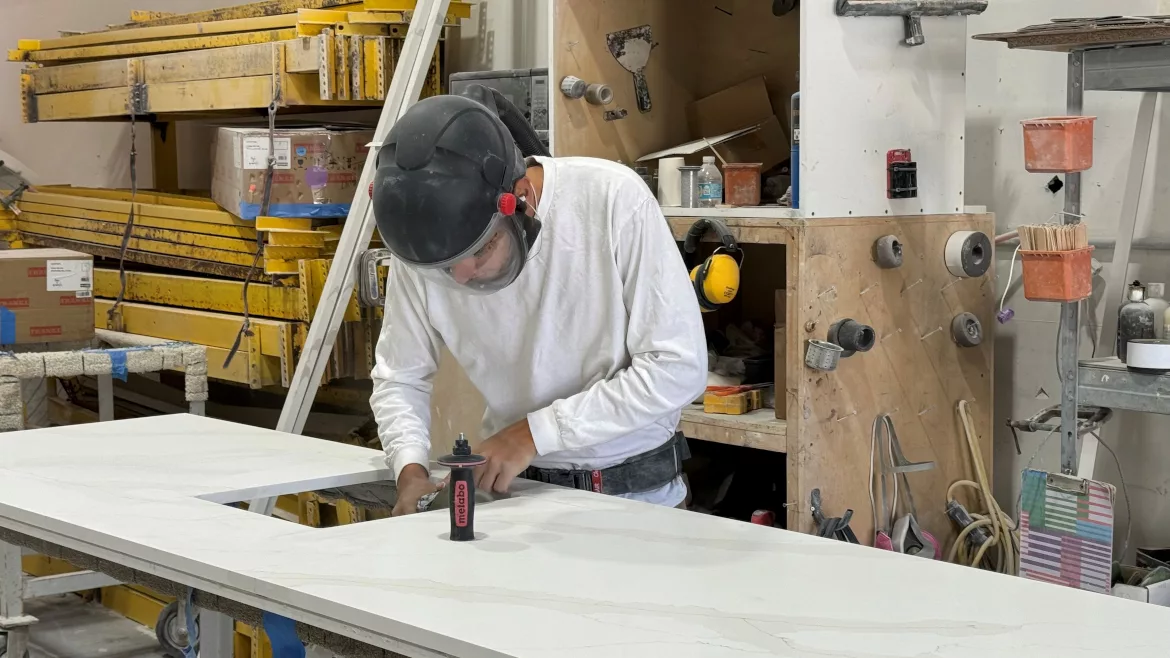
Water quality in stone fabrication facilities has evolved from an afterthought to a critical production tool, with dirty recycled water now identified as a contributing factor to elevated respirable silica levels in shops, according to a wastewater equipment manufacturer.
Joe Meyer, founder of Full Circle Water, addressed fabricators during a recent webinar, outlining how water system performance directly affects worker safety, equipment longevity and production efficiency.
"If the water's very dirty, it's going to carry silica back into the shop, and when it dries, you're going to have respirable silica levels," said Meyer. "Water quality of that recycled water directly affects the silica levels in the shop."
Meyer cited testing conducted at a fabrication facility where silica levels were found to be highest in carpet areas near shop entrances, as workers tracked wet slurry on their shoes into office spaces where it dried and became airborne.
Signs of Water System Problems
Meyer outlined several indicators that a water system may be underperforming, including visibly cloudy or turbid water, frequent pump seal failures, accelerated tool wear, clogged hand polisher nozzles and trenches that fill rapidly with mud. "If you're seeing equipment or tooling costs or maintenance costs escalating, that's usually a water system problem," said Meyer. "A lot of times, it may not be the pump itself, but it's the water the pump is pumping."
Production slowdowns during peak demand periods can also signal water system limitations, Meyer noted. Undersized plumbing manifolds may cause pressure drops when multiple machines operate simultaneously, triggering alarms and forcing operators to manage which equipment runs and when.
Silica Compliance Concerns Growing
Meyer warned that regulatory enforcement around silica compliance is spreading rapidly across the country, with local agencies and OSHA groups learning from each other's enforcement efforts. "What happens is these local agencies and OSHA groups that are working on silica compliance all throughout the U.S. learn from each other now," said Meyer. "When one state targets an industry, it spreads very quickly throughout the U.S."
Recent testing at one facility using silica monitoring devices found that while overall levels remained below the 50 threshold, the highest readings occurred in areas where forklifts traveled throughout the day, stirring up settled dust.
Modern Systems Reduce Labor Requirements
Contemporary water treatment equipment has evolved to minimize operator intervention, Meyer said. Where older systems often required a dedicated employee for management, newer designs aim for three to five minutes of daily attention with emergencies occurring only every three to eight months.
"Modern systems now reduce labor where the old systems created more labor and required more labor," said Meyer.
Key features in current equipment include automated sludge removal through filter presses or bag systems, pit mixers that keep solids suspended for more effective treatment, remote monitoring capabilities and warning messages sent via email or text.
Meyer recommended that fabricators look for scalable designs that can grow with shop capacity and compatibility with emerging chemical additives.
Treatment Technologies
Two primary treatment technologies dominate the market, Meyer explained. Filter presses use mechanical cloth filtration to separate solids from water, producing very clean results but requiring periodic cleaning cycles that can interrupt production.
Settling systems use chemistry to accelerate particle separation. Liquid additives remain the most common and least expensive option but require careful calibration. Overfeeding liquid chemistry can cause it to work against itself, Meyer noted, comparing the effect to reversed magnets.
Dry chemical additives represent a newer development in the industry. While more expensive to operate, they offer greater tolerance for dosing variations.
"If we overfeed the dry chemistry, it just cleans the water better," said Meyer. "You don't have the same struggle you have with liquid, where if you overfeed, your water quality goes to hell."
Controlling Bacteria and Odor
Meyer addressed concerns about bacteria growth and odor in water systems, recommending a combination approach using biocides and low levels of bromine rather than chlorine, which can damage steel equipment.
"Chlorine is used but not recommended by most manufacturers because it's very aggressive on steel," said Meyer. "Bromine is a little softer, but it's still an oxidizing agent."
Non-oxidizing biocides, which must be registered in each state where they are used, cost approximately $300 to $400 annually for a typical shop and are dosed weekly, preferably on Fridays to provide a bacterial kill before the weekend shutdown.
For pH management, Meyer recommended targeting 7.5, noting that most untreated shop water runs between 8.2 and 8.3. Higher pH levels cause more scaling and can be uncomfortable for workers using hand polishing equipment, while lower pH is more aggressive on equipment.
Recommendations for Struggling Systems
Meyer encouraged fabricators experiencing water quality issues to first contact their equipment manufacturers for training or consultation before considering replacement.
"A lot of times, an existing water system is capable,” he said. “It's just not running the way it should be. It's not being used properly or something needs adjusting."
For systems that cannot be optimized through adjustment, add-on equipment may offer a middle path between continued struggles and full replacement, which can exceed $100,000 for larger facilities.
Looking for a reprint of this article?
From high-res PDFs to custom plaques, order your copy today!

Jason Kamery is the Managing Editor and Group Digital Editor of Stone World. With more than a decade of experience covering the stone and countertop industry, he has conducted hundreds of interviews with fabricators, manufacturers, and industry leaders, and hosts the Stone World. podcast. He reports from events worldwide, including TISE, Coverings, and Marmomac, and his coverage extends to worker safety and silicosis, trade policy and tariffs, and fabrication technology. Kamery has also served as a speaker and panel moderator at The International Surface Event (TISE). He graduated from Purdue University with a B.A. in Mass Communication.
email: kameryj@bnpmedia.com | office: (248) 833-7356