Stone World logo
search
cart
facebook twitter linkedin youtube
  • Sign In
  • Create Account
  • Sign Out
  • My Account
Stone World logo
  • NEWS
  • PRODUCTS
    • Machinery
    • Digital Technology
    • Tooling & Accessories
  • MATERIALS
    • Alternative Surfaces
    • Stone
    • Tile
    • Imports & Exports Data
  • FABRICATORS
    • Fabricator How-to
    • Fabricator Case Studies
    • Fabricator of the Year
  • A&D
    • Installation & Technical Tips
    • Outdoor Design
    • Interior Design
    • Hospitality | Commercial Design
    • Mosaics & Decorative Tile
    • Kitchen & Bath
    • Residential
    • Renovation | Restoration
  • MEDIA
    • Videos
    • Podcasts
    • EBOOK
  • EVENTS
    • STONE INDUSTRY EDUCATION
    • Industry Calendar
  • MORE
    • NEWSLETTERS
    • WOMEN SPOTLIGHT
    • MARKET RESEARCH
    • STONE WORLD STORE
  • DIRECTORY
    • TRADE ASSOCIATIONS
    • Stone Suppliers
    • GET LISTED
  • EMAG
    • eMagazines
    • Archives
    • Contact
    • Advertise
  • SIGN UP!
Installation & Technical TipsTile

One-Sided Thin Set is Not a Thing: How to Ensure a Proper Bond
By Scott Carothers
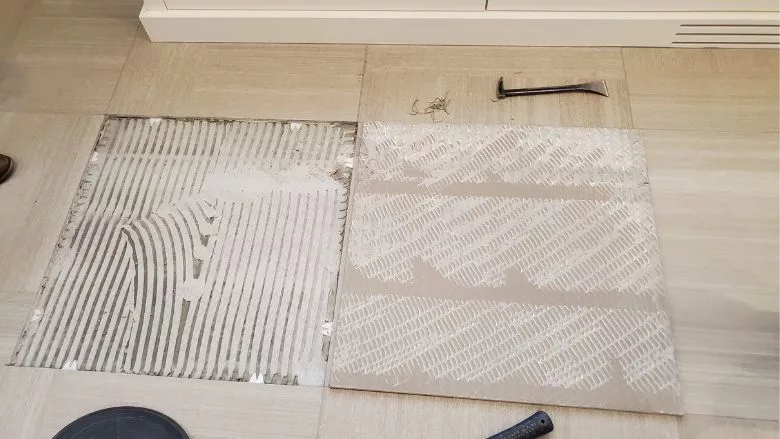
CTEF Tile Tip Improper Thin-Set application.

The thin-set mortar was not troweled properly, and the mortar was skinned over, which didn’t allow the proper bond to the back of the tile. Notice that the lippage control devices provided a flat transition from tile to tile but did nothing to enhance the mortar bond to the tile. Photo: Scott Carothers.  

March 3, 2025

Dry-set (thin-set) mortars are designed primarily to bond to the substrate and the back of the tile. Manufacturers work creatively to develop mortars that are easy to mix and place, along with the ability to provide a tenacious bond. However, they do not make one-sided mortars, meaning they only bond to the tile or substrate. If the mortar bonds only to the substrate, the problem may often be due to site conditions. 

Case in point: recently, an inquiry asked why the residential tile was loose and breaking. It was a four-year-old installation of large format plank tile on concrete using the direct bond method as found in the Tile Council of North America (TCNA) Handbook method F113, “On-Ground Concrete with Ceramic Tile.” The tile sounded hollow, the grout joints were cracked and crumbling, and numerous pieces of tile were broken.  

When the loose tiles were removed, the thin set was well bonded to the substrate with standing trowel notches that were not collapsed. Unfortunately, the thin set mortar was not transferred to the back of the tile. The question was, why didn’t the mortar bond to the tile? The answer could be attributed to one or more possibilities.  

  • If the concrete substrate was dry and porous when the thin set was applied, the moisture in the thin set would be drawn into the dry concrete causing the top surface of the thin set to dry prematurely. This situation can easily be corrected by dampening the substrate with water. 

  • Secondly, the thin set would rapidly lose moisture if the site was not climatized (windows and doors installed) with the HVAC system operational, wind or drafts blew across the thin set, or the HVAC system was operational, allowing air movement across the floor. 

  • Thirdly, if the installer spread a large area of mortar, but did not install the tile quickly, normally fifteen to twenty minutes, the thin set would again lose moisture too rapidly. This last point is reinforced by the ANSI A108.5-2.2.2 which states in part, “Tile shall not be applied to skinned-over mortar.” 

All three of these scenarios can cause what is commonly known as skinning. When the moisture leaves the mortar prematurely, the top surface of the spread mortar develops a film or skin that will not allow the mortar to transfer or bond to the back of the tile. In essence, the skin is a bond breaker to proper mortar transfer. To determine if the spread mortar is still bondable, place a finger into the mortar. If it transfers to your finger, you are good to go. If your finger comes up dry, the mortar is past its useful life. At this point, the mortar may be able to be re-troweled to expose the fresh mortar or if not, it should be removed and spread with fresh mortar. As the installation proceeds, the installer should occasionally check the condition of the thin-set mortar to be sure it will function correctly.   

The unhappy conclusion to the above inquiry is that the tile installation has failed and the tile industry gets another black eye. The tile and mortar must be removed, the substrate prepped as needed and new tile installed.


This article was originally posted on www.floortrendsmag.com.

KEYWORDS: ctef education and training installation products mortar

Share This Story

Looking for a reprint of this article?
From high-res PDFs to custom plaques, order your copy today!


Scott carothers 2025

Scott Carothers is the Academic Director of the Ceramic Tile Education Foundation (CTEF) headquartered in Mt. Juliet, Tennessee (Nashville area). In 2007, he was hired and tasked with creating the Certified Tile Installer (CTI) program, and in 2012, he was part of the team that created the Advanced Certifications for Tile Installers (ACT) program.

For eighteen years, he has been providing training and education to others in the tile industry. Carothers has been involved in the ceramic tile industry for over 44 years and was the owner of a successful retail store and installation firm prior to coming to CTEF.

Carothers served as President and Chairman of the Board of the National Tile Contractors Association (NTCA), Chairman of the NTCA Technical Committee, named the NTCA Tile Person of the Year in 2005, and received the NTCA Ring of Honor in 2013. He is a voting member of the American National Standards Institute (ANSI), the Tile Council of North America (TCNA) Handbook, and NTCA Technical Committees.

Scott has authored over 185 articles in tile industry print magazines including Floor Covering Installer, Tile, TileLetter, and eMagazine/Newsletter publications such as Floor Trends & Installation and TIleLetter along with covering numerous topics on the CTEF Blog, thereby sharing his knowledge and installation experience with his readers. Additionally, he recently retired from being a presenter and trainer for the NTCA Workshop and Regional Training programs and the NTCA Technical Hotline.

He may be contacted at scott@tilecareer.com or 864-222-2131.

Recommended Content

JOIN TODAY
to unlock your recommendations.

Already have an account? Sign In

  • customer doing research online

    3 Reasons Why Quick Response Time Results in a Successful Fabrication Shop

    Your fabrication shop can have the best website. The best...
    Fabricator How-to
    By: Anthony Milia
  • Silica

    Renewed National Attention Ignites Over Silicosis Epidemic

    A major investigative report published on March 12, 2026...
    Industry Insights
    By: Jason Kamery
  • shipping containers

    U.S. Countertop Material Imports: February 2026

    U.S. countertop material imports collapsed in February...
    Stone
    By: Jason Kamery
Manage My Account
  • eMagazine
  • Newsletters
  • Online Registration
  • Manage My Preferences
  • Subscription Customer Service

More Videos

Popular Stories

artificial intelligence

5 Amazing AI Tools and Ideas That Every Stone Countertop Shop Can Implement

shipping containers

U.S. Countertop Material Imports: February 2026

Save Quartz Jobs Coalition Logo

ITC Moves Towards New Quartz Import Tariffs

Fabricator Focus

From profiles to roundtable discussions, Q&As to best business practices, we're turning a focus on topics and challenges impacting fabricators.

AI Talk Is Everywhere -- Where Does a Countertop Fabricator Begin?

Fabricators Discuss Pros and Cons of Chip Repair

How to Grow a Countertop Fabrication Shop

Events

June 25, 2026

North Carolina Stone Summit

You’ve probably heard a lot lately about how to calculate the profit for each job you produce. You likely have production benchmarks based on square footage since it’s the most common production metric in the industry. Come learn how focusing on these metrics can hurt your profitability and what to do about it.

July 16, 2026

Washington Stone Summit

Join us for "Taking Your Organization to the Next Level," a session dedicated to transforming your business practices. Discover strategies for setting clear agendas, encouraging participation, and driving actionable outcomes. Learn how to foster collaboration and communication, ensuring that every meeting enhances productivity and contributes to your business goals.

View All Submit An Event

Poll

Tariffs and Quartz Imports

If high tariffs are placed on U.S. quartz imports, how will this affect your business?
View Results Poll Archive

Products

Restoration & Maintenance Technical Module

Restoration & Maintenance Technical Module

See More Products
	
3 Reasons Why Quick Response Time Results in a Successful Fabrication Shop

Related Articles

  • Schluter Peel-and-Stick uncoupling membrane on bathroom floor with a tub.

    How to Ensure a Mess-Free Tile Installation

    See More
  • tile trowels

    How to Ensure You Have the Right Tile Trowel for the Job

    See More
  • marble shower with iron oxide discoloration

    Marble Tile in Showers: A Cautionary Tale

    See More

Related Products

See More Products
  • image10.jpg

    Viewing Stones of North America A Contemporary Perspective

  • Premium Quarry Posters (set of 6)

  • Quarry Posters - Set of 12

See More Products

Events

View AllSubmit An Event
  • June 25, 2026

    North Carolina Stone Summit

    You’ve probably heard a lot lately about how to calculate the profit for each job you produce. You likely have production benchmarks based on square footage since it’s the most common production metric in the industry. Come learn how focusing on these metrics can hurt your profitability and what to do about it.
View AllSubmit An Event

Related Directories

  • A. Lacroix Granit

    Today, our 14 granite quarries use cutting-edge extraction techniques to maximize productivity and minimize waste. Our 225,000 sq. ft. plant features the latest in modern technology, including 5-axis numerical-control machines capable of producing the most beautifully shaped stone and complex stone parts on the market. We also use lean manufacturing processes at both our plant and our quarries. And that makes a big difference for our customers!
  • Nikolaus Bagnara S.p.A.

    Bagnara is an international leader in the production, distribution, and processing of stone materials that ensures the availability of almost a thousand natural stones of superior quality, from block to slab until processed product.
  • Pedrini S.p.A.

    We innovate, we test, we strive to improve. Always with passion. For 60 years we have been designing machines and systems to bring out the beauty of natural stone. We build and adapt each plant to the growing needs of our customers, implementing new technologies that focus on increasing the production capacity while respecting the environment. Because for Pedrini smart solutions can only stem from our deeply technological soul, developing a new concept of manufacturing, more flexible, more efficient, more connected and more sustainable. Since 1962, from generation to generation, we have been your reliable partner for natural stone processing.
×

Our Newsletters are a rock solid source of industry insights!

Stay in the know on the international stone and tile industry trends.

JOIN TODAY!
  • RESOURCES
    • Advertise
    • Contact Us
    • Directories
    • Store
    • Want More
  • SIGN UP TODAY
    • Create Account
    • eMagazine
    • Newsletter
    • Customer Service
    • Manage Preferences
  • SERVICES
    • Marketing Services
    • Reprints
    • Market Research
    • List Rental
    • Survey/Respondent Access
  • STAY CONNECTED
    • LinkedIn
    • Facebook
    • YouTube
    • X (Twitter)
  • PRIVACY
    • PRIVACY POLICY
    • TERMS & CONDITIONS
    • DO NOT SELL MY PERSONAL INFORMATION
    • PRIVACY REQUEST
    • ACCESSIBILITY

Copyright ©2026. All Rights Reserved BNP Media, Inc. and BNP Media II, LLC.

Design, CMS, Hosting & Web Development :: ePublishing