Maximizing Efficiency in a Fabrication Shop
During a session held at the tise Learning Lab during StonExpo, an industry expert led a discussion on best business practices to run a productive and lucrative fabrication operation
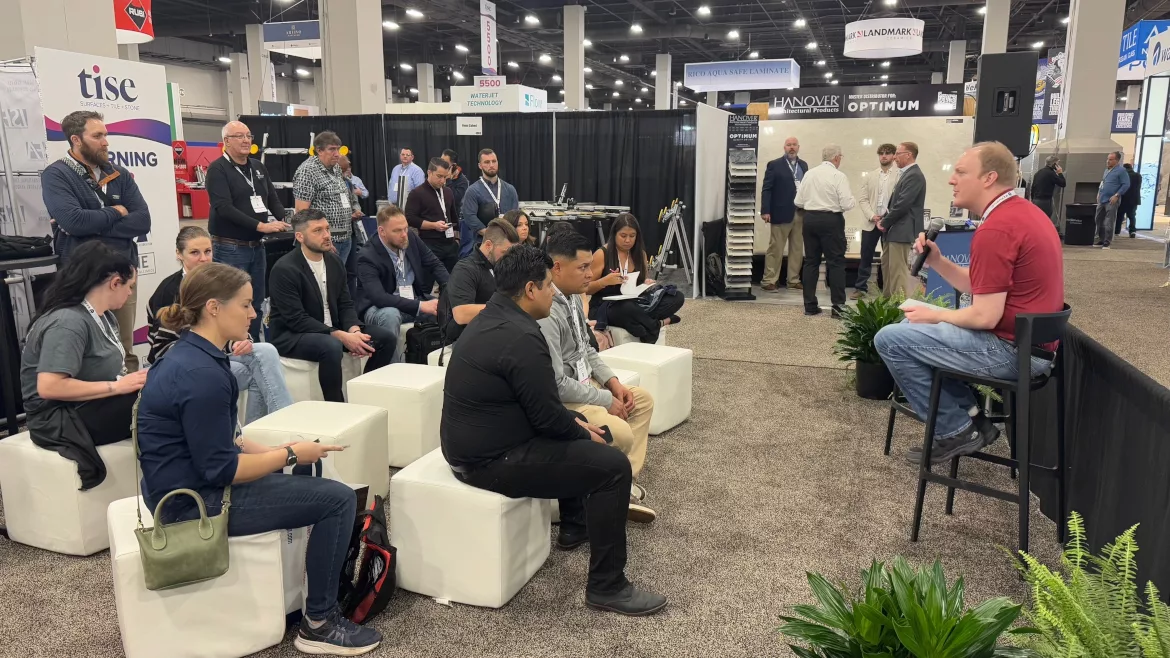
Photo by Jennifer Richinelli
In the bustling world of fabrication shops, where time and money dictate success, Mark Phelps, coaching and business development for Synchronous Solutions, stood before an eager group at an educational session during The International Surface Event (tise) held last month in Las Vegas, NV, ready to dive deep into the world of efficiency. His session was titled "Shop Efficiency," but his lessons were universal, applicable to any business keen on optimizing their operations for profitability.
"Welcome, everybody. We'll start right on time because that's the efficient thing to do," said Phelps, setting the tone for a session packed with insights on how to streamline business processes. His approach was not about cutting corners, but about enhancing the core function of any business. "What's the core function of business? Making money," he said, echoing the sentiment of the room.
During the discussion, Phelps introduced the concept of throughput, the metric he emphasized as the true measure of value. "Throughput is the measure of value in your business," he explained, detailing how one should calculate it by subtracting total variable expenses from sales price. Phelps pushed forward, discussing how to maximize this value.
"We're not talking about efficiency for efficiency's sake, but efficiency for money-making sake," he clarified, ensuring everyone understood that the goal was not just to be busy but to be profitable.
He then detailed how to measure efficiency through productivity scores, which involved comparing throughput with operational expenses. "The way we measure that we're efficient from that perspective is through productivity scores," said Phelps, breaking down the complexities into digestible insights.
The conversation turned to practical steps, with Phelps asking the audience for their input on starting points for efficiency. "Step one is to map your flows," someone suggested, to which Phelps nodded approvingly. He elaborated on mapping processes by content, sequence, timing and expected outcomes -- illustrating how each element could either lead to profit or waste.
Throughout the session, Phelps didn't shy away from the realities of business operations. He talked about constraints, the bottlenecks in business, and how understanding and exploiting these could lead to significant gains.
"We want to set our schedule to whatever your lowest constraint is, and that becomes what limits the potential of our plant at that current stage," he said, urging everyone to focus on the weakest link rather than overall efficiency.
As the discussion neared its end, Phelps left the audience with a powerful message on the importance of continuous improvement and discipline. "Don't let what you do today become a constraint on what you're trying to do tomorrow," he said, emphasizing the need for ongoing reassessment and adaptation in business practices.
The session concluded with Phelps painting a vision of what efficient business operations could lead to: quicker lead times, fewer callbacks, higher productivity scores, and ultimately, greater profitability. "Boring is profitable," he concluded, suggesting that a business running smoothly, predictably and without chaos was, in fact, on the right track to success.
Looking for a reprint of this article?
From high-res PDFs to custom plaques, order your copy today!

Jason Kamery is the Managing Editor and Group Digital Editor of Stone World. With more than a decade of experience covering the stone and countertop industry, he has conducted hundreds of interviews with fabricators, manufacturers, and industry leaders, and hosts the Stone World. podcast. He reports from events worldwide, including TISE, Coverings, and Marmomac, and his coverage extends to worker safety and silicosis, trade policy and tariffs, and fabrication technology. Kamery has also served as a speaker and panel moderator at The International Surface Event (TISE). He graduated from Purdue University with a B.A. in Mass Communication.
email: kameryj@bnpmedia.com | office: (248) 833-7356