Harmoniously joining old and new
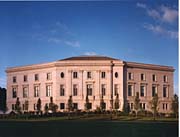
When Severance Hall opened its doors in 1931 as the permanent home for The Cleveland Orchestra, the building was viewed among the most modern, state-of-the-art concert facilities in the U.S. And with an exterior facade comprised entirely of limestone and sandstone -- as well as a significant amount of stone used throughout its interior design -- the structure's architecture was a fitting match to its reputation. A recent interior restoration and addition to Severance Hall challenged the design team to uphold the landmark building's integrity as a first-class performance facility as well as to maintain its aesthetic beauty.
Originally designed by the Cleveland, OH-based firm of Walker & Weeks, construction on Severance Hall began in December 1929 and was completed by early 1931. Intended to serve as the permanent home for The Cleveland Orchestra, the new facility was a gift from John Long Severance and his wife, Elisabeth. Severance, whose father had served as treasurer of Rockefeller's Standard Oil, was then president of the orchestra's board of trustees. Until then, the orchestra, which was founded in 1918, performed in auditoriums and theaters throughout Cleveland and on tour.
Not long after the Severances announced their initial donation of $1 million, Elisabeth Severance died unexpectedly. Her husband then dedicated his energies and finances toward the new concert hall as a memorial to his wife. In the end, Severance gave nearly three times his initial pledge towards the building's design and construction. The overall cost of the hall was approximately $7 million, with funding generated by Severance, other benefactors and the public.
The site chosen for Severance Hall is in the heart of Cleveland's University Circle area, situated on the city's east side and home to many major cultural, medical and educational institutions, including the Cleveland Museum of Art, the Cleveland Institute of Music and what is today Case Western Reserve University. For the design, the finest materials of the time were selected to create its grandeur appearance. The Georgian-style exterior was chosen to harmonize with the classical architecture of the Cleveland Museum of Art and with the graceful gardens and pond in front of the museum. Ohio sandstone was used for the terrace and base of the building, while the upper portions consist of Indiana limestone.
Renovating a landmark
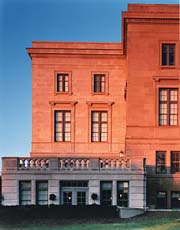
According to Project Architect Craig Williams of David M. Schwarz / Architectural Services, Inc., a cleaning of the exterior limestone and sandstone was completed a year prior to the start of the renovation project. “The year before we did our project, there was some reworking of exterior terraces because the stone was in really bad shape,†said Williams. “It was not in our project budget to replace or resurface the sandstone. At some point they will probably have to do it. There was some rusting steel lintels, which were taken care of with an actual capital budget before the project started.â€The $36.7 million renovation project involved constructing a five-story addition to the back of the building, along with restoration and renovation throughout existing public spaces, according to Williams. For the exterior, 16,000 cubic feet of Select Buff limestone -- quarried by Victor Oolitic in Bloomington, IN -- was used. The pieces were fabricated by Dixie Cut Stone and Marble, Inc. of Bridgeport, MI.
“The limestone is not quite taken from the same quarry,†he said, explaining that the original quarry has been shut down. “The original limestone is Select Buff from the Empire quarry, and the new stone is Select Buff from the Victor Oolitic quarry.â€
The architect continued to explain that the texture of the limestone on the existing building had been compromised by improper cleaning, which was done during the 1950s.
“We debated about sandblasting the [new] Select Buff, but decided that would be somewhat criminal,†he said. “In terms of the limestone, we matched the coursing and sizes as the pieces on the original building, which were approximately 12 to 16 inches high [and] the lengths varied. The original building's limestone was much thicker. We used 3-inch-thick panels except where we did the molding casing.
“In terms of the exterior stonework, it was actually pretty simple,†continued Williams. “We had good drawings; we knew what we wanted to do; and the client was willing to pay for the right stone. We didn't have to use variegated, gray or standard limestone.â€
One of the more challenging aspects of the 39,000-square-foot addition was creating the appropriate facade, according to the architect. “The back of the [original] building, where the addition is, was definitely 'just the back,'†he said. “There were loading doors, and it faced a parking lot. Over time, [Case Western] University put in an underground parking garage and plaza. We wanted to create a new plaza facade, but because it was backstage to the [original] building, there was no appropriate reason to put an entry there. We had to figure out the right type of entry.â€
Williams explained that the building is a very odd seven-sided structure. As a result, some thought was required before deciding how to develop the face of the addition. Among the interesting architectural details of the structure are the “Severance Order†capitals with inverted treble clefts that can be seen at the top of the pilasters, according to the architect, who added that they took their clues from standard 1920s neoclassical ionic capitals.
“In many ways, some people in interpretation think that we didn't do enough to distinguish the addition from the original,†said Williams. “We wanted it to be an appropriate addition to the original building that would really stand the test of time. It would have been ridiculous to make a statement. As far as we were concerned, for it to be seamless was a goal. It was designed so that the astute person can pick up on the differences.â€
Interior stonework
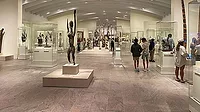
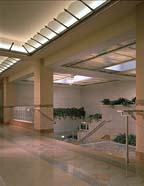
Inside, the design goals included creating an interior for the addition that matched that of the original building as well as restoring areas of existing stonework. “The interior took a little more design creativity than the exterior of the building,†said Williams. “The bulk of the public spaces in the original building used three different types of Spanish marble -- Rojo Alicante, Rojo Coralito and a pink stone that on the original drawings the architect called Alicante Claire. It was a real struggle to find stone that matched that one. In the end, we were successful after two trips to Spain.â€For the addition, two galleries were created on either side of the Patron Lobby. “We used the same palette of stones that the original architect used, but changed the detailing a little to show something new and different,†said the architect. “There are rooms, including the new Smith Lobby, that have both new and old stone, and you can't tell them apart.â€
All of the interior stonework was quarried and fabricated by Levantina of Novelda, Spain, and supplied and installed by The Cleveland Marble Mosaic Co. According to Williams, Cleveland Marble assisted in the preliminary search to match the pink stone and pointed them in the direction of Levantina. “We met with someone there who said that he knew exactly that type of stone this is,†said the architect. “The quarry was closed decades ago, but Crema Valencia -- a common yellow Spanish stone -- every once in a while will hit a pinkish seam. They had one block in their yard, and then they took us for a drive out to the quarries, and we saw a seam of pink that they thought they could work. They called a month later and said that they cut open the block and it wasn't consistent throughout, but they could get enough pink out of it. We named it Rosa Valencia.â€
The columns and baseboard are made from Rojo Alicante, the pink stone was used for the wainscot panels, and Rojo Coralito was employed for the chair rail and some casings. “There's a subtle change between Rojo Alicante and Rojo Coralito,†said Williams. “That was the original architect's intent, and we carried that through.â€
End box:
Severance Hall, Cleveland, OH
Owner: Musical Arts Association, Cleveland, OHOriginal Architect: Walker & Weeks, Cleveland, OH
Architect-of-Record: GSI Architects, Cleveland, OH
Design Architect: David Schwarz / Architectural Services, Washington, DC
General Contractor: Panzica Construction Co., Cleveland, OH
Stone Quarrier: Victor Oolitic, Bloomington, IN (limestone); Levantina, Novelda, Spain (marble)
Exterior Stone Fabricator: Dixie Cut Stone and Marble, Inc., Bridgeport, MI
Exterior Stone Installer: Foti
Interior Stone Supplier / Installer: The Cleveland Marble Mosaic Co., Cleveland, OH
Looking for a reprint of this article?
From high-res PDFs to custom plaques, order your copy today!