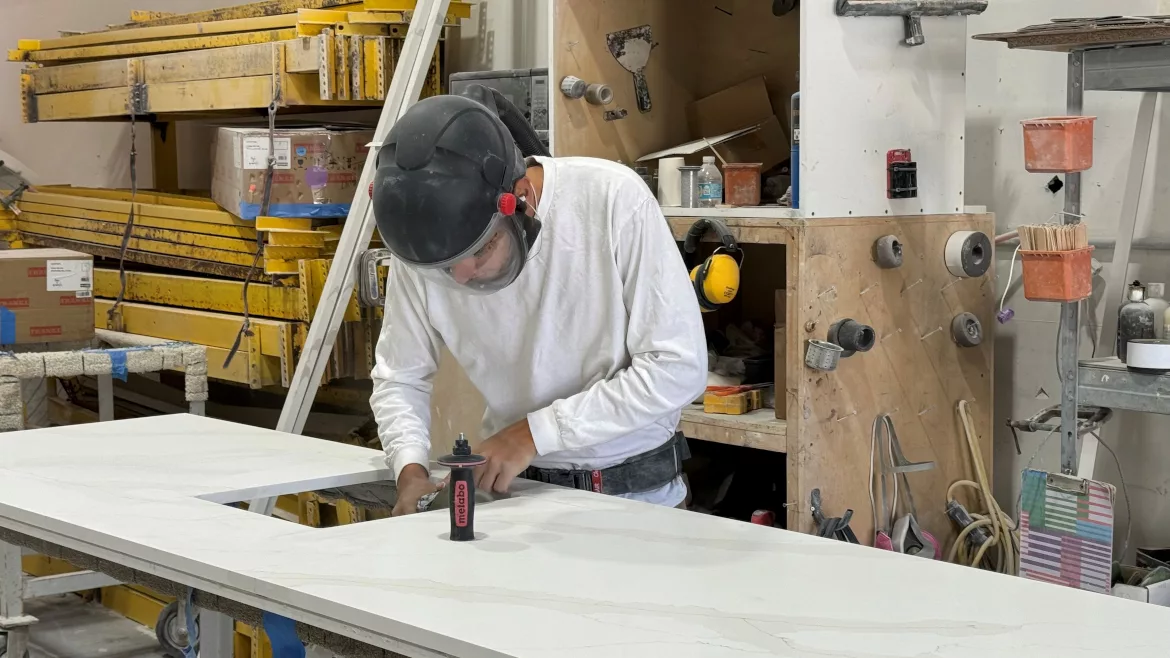
A Fabricator's Guide to Cutting Porcelain and Sintered Stone
Porcelain and sintered stone slabs rank among the most misunderstood materials in the countertop industry, but fabricators who learn to work with them are opening a revenue stream that is not going anywhere.
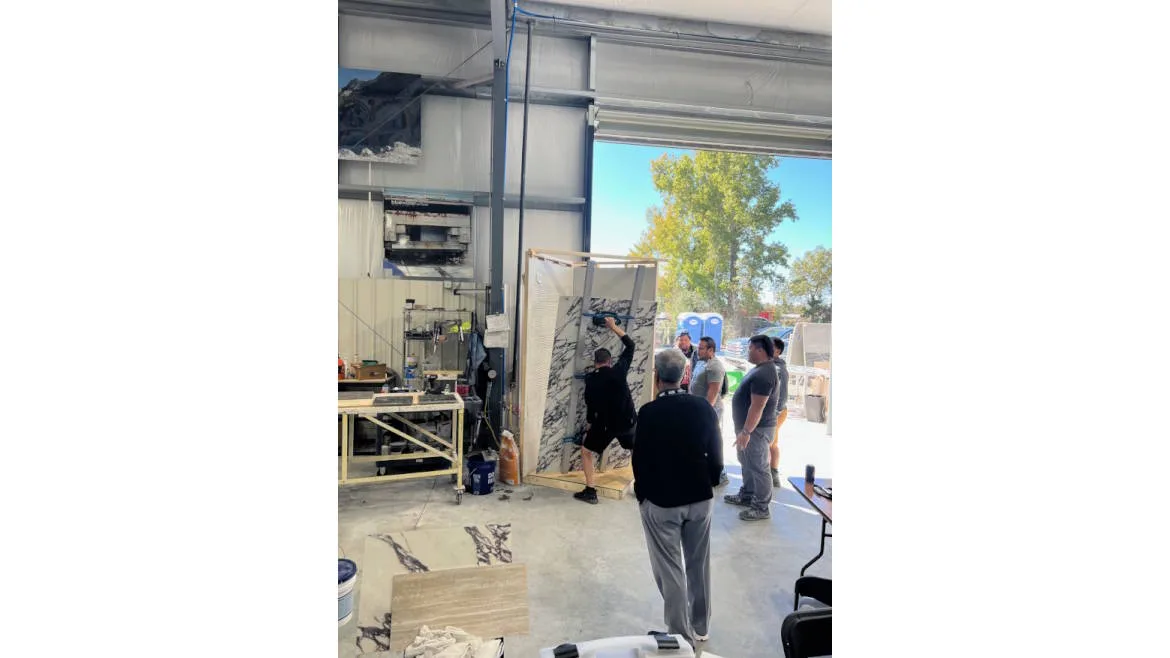
Porcelain and sintered stone slabs rank among the most misunderstood materials in the countertop industry, but fabricators who learn to work with them are opening a revenue stream that is not going anywhere. That was the message from Mitchell Kennedy, founder of Precision Diamante in Albuquerque, NM, during a recent episode of the Stone World podcast, where he walked through what these materials are, how to cut them, why homeowners keep asking for them and how to keep them in one piece on the way to the jobsite.
Kennedy came to the industry after the U.S. Army, where he served in the infantry beginning at age 17. After being discharged at about 21, he bounced through a few jobs before landing a position at Emser Tile, one of the largest privately held tile companies in the country and later worked for Arizona Tile. Both gave him a deep education in porcelain, including its manufacturing process and how it compares to natural stone. Later on he was recruited by GranQuartz where he sold diamond tools to fabricators in New Mexico. After that, never looked back.
"I love porcelain, stone, tools, anything that has to do with this industry — installing, handling, fabrication, all of it," said Kennedy.
Understanding the Composition of the Materials
Part of the confusion starts with the names. Fabricators hear porcelain and sintered stone used interchangeably, but the two are not identical, explained Kennedy. Porcelain is created from clay, silicas, feldspar and other natural materials, then fired in a kiln at temperatures above 2,000 degrees Fahrenheit. The result is a non-porous slab. Sintered stone is still a porcelain-type material, but it mimics the way granite and marble form geologically by combining heat with pressure. That pressure fuses the material and creates something on its own.
"They look similar, and a lot of people will cut them and not even know they're cutting different materials," said Kennedy.
The category is not new. Kennedy was importing porcelain slabs nearly 20 years ago, though those early panels were a quarter-inch-thick and used only for cladding. Hospital walls were a common application because the antimicrobial surface could be cleaned with anything, but the color options ran to basic blues, yellows, greens and oranges. The shift came when factories scaled up to produce large-format porcelain for floors and walls, moving from 12-x-24 and 24-x-48 inch tile to the full-size panels fabricators see today.
The Tooling Question
Many fabricators are nervous about cutting porcelain, and one of the most common questions is whether different brands require different tooling. According to Kennedy, the answer is yes.
Big-name brands such as Laminam and Atlas Plan have invested heavily in their processes, and that quality shows up in the slab, explained Kennedy. “The denser a material is, the harder it is to cut. That leads to a trap. A cheaper, mass-produced porcelain that was not fired as hot will be softer and more brittle, which makes it easier to cut.
"Somebody might say, ‘Oh, wow, this blade works really great,’ or ‘I like working with this material because it cuts so easy,’" Kennedy went on to say. "From an installation side and a load-bearing side, it's actually the opposite."
In other words, the harder material that gives a fabricator more trouble at the saw is usually the stronger more durable product. Either way, the work calls for specialty diamond tooling and a glass-like approach where everything is tight and precise.
Kennedy also pointed to the difference between through-body and double-loaded porcelain. The pattern on top of a slab is applied through an inkjet process, similar to a printer laying down a marble-look design. A through-body porcelain has a body, or bisque, that closely color matches the top surface. A double-loaded slab carries the vein halfway into the material. Those distinctions matter at the mitered edge, where porcelain is far less forgiving than granite.
"Mitering granite, we can throw a bunch of adhesives in; we can color match the adhesive," said Kennedy. "Porcelain is just not that way. It is completely unforgiving."
That reality favors shops with higher-end machinery such as waterjets and miter saws. Traditional hand fabricators face a steeper climb, though Kennedy noted that fabricators with a tile background often have an edge because they are comfortable scoring and snap cutting the material, which creates a tension line and cracks it cleanly.
Relief Cuts and Best Practices
The early worries about relief cuts and sink cutouts still hold true, Kennedy said, in large part because a brand will never advertise that its porcelain is the cheaper option. That puts the burden on fabricators to set a single standard and apply it to every slab to mitigate risk.
For a sink cutout, Kennedy recommends a thin-wall core bit or a vacuum brazed or electroplated bit that puts the diamonds in immediate contact with the surface, to core every corner. The goal is to cut hole to hole so that any tension or thermal crack follows to the next hole rather than running into the slab.
Most slab manufacturers want fabricators to cut in a clockwise direction around the outside of the slab, relieving roughly an inch of material as they go. Kennedy said the method came out of trial and error, with fabricators who cut the top and bottom first, then the sides, still ending up with cracks.
Vibration is another culprit. A brittle material on a concrete table that is not perfectly level can crack as the blade makes each kerf cut. Kennedy suggested laying down foam or a rubber horse mat and shimming the sides if there is any bow in the slab. Many of these techniques, he noted, were first developed during the early years of quartz and will live on in the porcelain world because qualities and densities vary so much from one manufacturer to the next.
Why Homeowners Keep Asking
If all of that sounds intimidating, Kennedy is the first to acknowledge it. But he argues the demand is real and growing, and it is being driven from the top down by homeowners who see the material on HGTV, on social media and through influencers.
He used his own market as a cautionary tale. New Mexico tends to resist trends, he said, which means it is the last place to adopt a look and the last place to let it go. The popularity, though, is grounded in fact, not just fashion.
Natural stone installed outdoors can discolor, fade or dull over time, and many homeowners do not realize that most slabs today are resin-filled to address natural fissures, according to Kennedy. Porcelain holds up.
"You can put it outside and it's going to look the same in 10 years as it does today," said Kennedy.
That makes it a natural fit for markets such as Arizona and California, where outdoor kitchens, pools and barbecues are common, and for the growing number of homes built with large collapsing door systems that blur the line between the living room and the backyard. Because porcelain does not absorb water, it will not crack in a winter freeze the way a saturated stone might.
A new Revenue Stream
For fabricators willing to learn the material, Kennedy framed it as an opportunity rather than a headache, precisely because so many shops are still resisting it. He encouraged fabricators to partner with their local tool supplier and tap into online fabrication communities to get up to speed.
The applications extend well beyond the kitchen. A fabricator can install porcelain on shower walls and be in and out in a single day, where a tile installer would need to build a bed, set the tile, then return to grout. Kennedy also pointed to integrated induction cooking surfaces, built-in charging and panels that double as touchscreens as features that set the material apart.
The upsell potential is significant. A fabricator who is already in a home for a kitchen can offer to handle a shower, an outdoor entertainment area or a grill surround with leftover material.
"It won't replace granite; it won't replace quartz or quartzite," said Kennedy. "This is just another item, another revenue stream for the design community and fabricators."
Handling the Fragility
Cracking the cutting code is only half the job. Getting the slab to the site and installed in one piece is the other half, and Kennedy said it is where most shops get burned.
The glass analogy applies here too. Many manufacturers now require foam board, often a peel-and-stick product on the bottom of the slab, to keep a warranty valid. Beyond protecting the slab, the foam gives a more rigid surface that helps absorb accidental taps and provides another substrate for adhering the mitered edge.
Before that backing goes on, handling matters. Kennedy recommends clamps made specifically for thin panels, which are slightly wider than a standard slab clamp and give more bite so the slab flexes less in the air. He is a firm believer in installation A-frames that collapse and use bars to hold the material, and in handling systems from companies such as Grabo and Omni Cubed, which offer American-made products with multiple aluminum bars running horizontally and vertically to create a rigid surface. For book-matched fireplaces and similar work, he pointed to suction-based systems such as the SmartLift.
What he warns against is the homemade approach that worked fine with granite.
"That deflection is real," said Kennedy. "If you pick up a big piece and turn it horizontally, it could snap on you very easily."
His advice is to invest in quality installation carts and kits, and to pay extra attention in the shop, where he sees most accidents happen.
For fabricators sizing up the category, Kennedy's bottom line is simple. The material is here permanently, the demand is real and the shops that master it now will be the ones naming their price later.
Looking for a reprint of this article?
From high-res PDFs to custom plaques, order your copy today!

Jason Kamery is the Managing Editor and Group Digital Editor of Stone World. With more than a decade of experience covering the stone and countertop industry, he has conducted hundreds of interviews with fabricators, manufacturers, and industry leaders, and hosts the Stone World. podcast. He reports from events worldwide, including TISE, Coverings, and Marmomac, and his coverage extends to worker safety and silicosis, trade policy and tariffs, and fabrication technology. Kamery has also served as a speaker and panel moderator at The International Surface Event (TISE). He graduated from Purdue University with a B.A. in Mass Communication.
email: kameryj@bnpmedia.com | office: (248) 833-7356