Quartz vs. Quartzite: Key Differences Every Stone Professional Must Know
How structural composition drives fabrication risk, performance, and long-term durability
Quartz and quartzite. The names are close enough that the terms get used interchangeably across showrooms, spec sheets, and design consultations. It's an understandable confusion, but it creates real problems, because these two materials behave nothing alike. Understanding what separates them at the structural level helps everyone in the chain, from specifier to fabricator to end user, make better decisions and avoid preventable failures.
In this article, we'll break down what distinguishes these materials at the structural level, why those differences matter for fabrication and field performance, and how those distinctions can inform more productive conversations, conversions & (hopefully), less complaints.
The Fundamental Distinction
Let's establish the baseline: Quartzite is a natural metamorphic stone. Engineered quartz is a manufactured composite.
Quartzite forms when quartz-rich sandstone undergoes metamorphism. Heat and pressure cause individual quartz grains to recrystallize and fuse at their boundaries, creating an interlocking crystalline matrix. Think of it like welding: the grains don't just press together, they bond. This structure distributes mechanical stress across the entire fused network rather than through individual grains, which is why quartzite exhibits exceptional hardness and abrasion resistance.
Engineered quartz takes a different path entirely. Ground quartz aggregate (the same mineral but crushed) gets combined with polymer resins and pigments, then compacted under vacuum with vibration and pressure. The quartz particles provide hardness, but the resin binder defines slab behavior. This is where critical differences emerge.
Why This Matters in Your Showroom
When a homeowner says they want "quartz because it doesn't need sealing," they're talking about engineered quartz, a functionally non-porous composite. When an architect specs "quartzite for its natural beauty and durability," they're talking about metamorphic stone that may indeed require sealing depending on it’s specificity.
The problem is that these conversations often happen with the terms used interchangeably. A customer researches "quartzite" online, sees images of dramatic veining, and arrives at your showroom asking for it by name. But their actual priority is low maintenance, which points toward engineered quartz. Or an interior designer specs "quartz" for a sun-drenched kitchen because they love a particular slab's movement, not realizing that UV exposure will degrade the polymer binder over time.
Your role as the fabricator is often to be the last line of defense against specifications that will fail. That requires understanding not just what these materials are, but why they behave differently.
Heat Response: Where the Binder Shows Its Limits
Quartzite maintains thermal stability under common residential and commercial heat conditions. The silica matrix remains structurally unchanged under short-duration contact with cookware. Thermal shock can occur along unsupported spans with abrupt temperature gradients, but that's an installation consideration, not a material weakness.
Engineered quartz tells a different story. Every polymer resin has a softening point where it begins to lose rigidity. Sustained or concentrated heat can deform the binder network, producing color shifts, gloss changes, or localized cracking. These alterations occur within the polymer structure itself, and here's the critical point for restoration professionals: you cannot refinish your way out of heat damage on engineered quartz. The resin is integrated throughout the slab. Surface abrasion won't reach the altered polymer below.
UV Exposure: The Outdoor Question
Quartzite is stable under ultraviolet radiation at building timescales. Silica doesn't degrade under sunlight. Some mineral inclusions influence colorfastness, but properly selected quartzite handles exterior and high-UV applications without structural concerns.
The polymer binder in engineered quartz undergoes photo-oxidation under UV exposure. UV energy breaks carbon bonds in the resin matrix and shifts the color-producing molecules in the pigments, resulting in yellowing, fading, or dulling. The quartz particles themselves are completely UV-stable, it's the resin that fails. This reaction progresses even with indirect sunlight and explains why most manufacturers explicitly exclude UV exposure from warranty coverage. If a customer wants material near large windows or for outdoor applications, this distinction matters enormously.
Chemical Interactions: Different Vulnerabilities
True quartzite, (when it's actually quartzite), and not a mislabeled marble or dolomite, resists acids and alkalinity because silica is chemically inert to most household substances. If a stone sold as quartzite etches when exposed to lemon juice or vinegar, you're not looking at maintenance failure. You're looking at misclassification. That stone contains carbonate minerals and behaves more like marble regardless of what the distributor identification.
Engineered quartz has different vulnerabilities. High-pH cleaners can weaken the chemical bonds holding the resin together. Certain solvents destabilize binder components. Oxidizers alter the color-producing molecules in both pigment and binder. These reactions aren't absorption events; the material isn't porous in the traditional sense. They're chemical interactions between cleaning agents and polymer components. And because they alter the binder at depth, stone restoration methods can't correct them. The underlying polymer remains changed.
This distinction matters for callbacks. When engineered quartz shows surface degradation, the instinct may be to treat it like stone damage. It isn't. The physics are simply different.
The Misclassification Problem
Here's where fabricators often inherit problems they didn't create: the stone market is flooded with materials labeled "quartzite" that aren't quartzite at all.
Dolomitic marble, calc-silicate stones, and mica-rich schists frequently appear in quartzite categories because they share visual characteristics: dramatic veining, crystalline appearance, and interesting movement. But these materials differ substantially in acid response, abrasion resistance, and fabrication behavior. A stone that looks like Super White quartzite but contains significant calcite will etch like marble. A slab with beautiful mica inclusions may exhibit directional weakness along cleavage planes.
Meanwhile, engineered quartz is sometimes marketed as "natural quartz surfaces," which leads customers to assume it behaves like geological quartzite. The confusion flows in both directions.
A Practical Diagnostic Approach
Visual inspection alone cannot reliably distinguish these materials. Grain translucency, veining patterns, and coloration overlap across quartzite, marble, granite, and engineered products. A more systematic approach improves accuracy at the point of sale or specification.
Scratch testing provides preliminary indication of silica dominance. True quartzite typically registers near 7 on the Mohs scale.
Acid testing identifies carbonate or dolomite content. A drop of diluted hydrochloric acid on an inconspicuous area will fizz on calcite-bearing stones. If a "quartzite" reacts to acid, it's been misclassified.
Magnified visual assessment distinguishes crystalline interlock from resin-bound aggregates. Under magnification, engineered quartz shows discrete particles suspended in binder; quartzite shows fused grain boundaries.
Directional or UV lighting can reveal resin pooling and particulate distribution characteristics of engineered composites.
This protocol doesn't replace petrographic analysis for contested situations, but it provides practical accuracy for everyday specification decisions.
Fabrication Considerations
The structural differences between these materials translate directly to shop floor requirements.
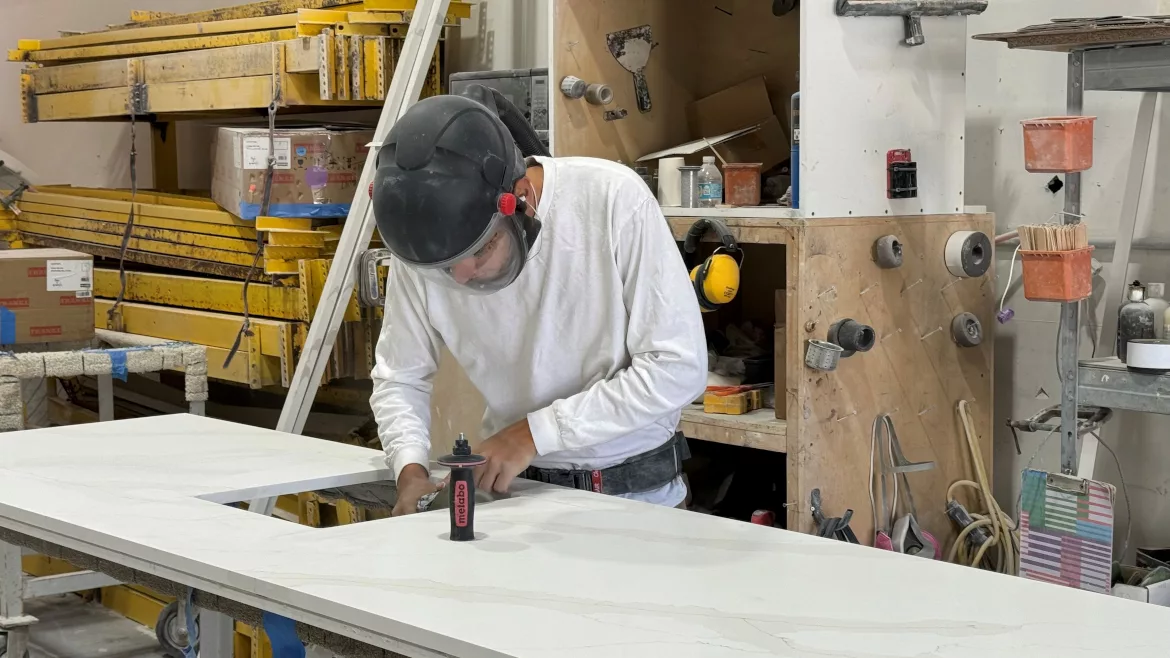
Quartzite demands significant tooling resources. Blade wear is substantial. Veining direction influences fracture patterns and requires planned cutting paths. Inclusions like mica create edge fragility that must be anticipated. Water and cooling management are critical. Fabrication costs reflect these realities.
Engineered quartz fabrication centers on heat management. Friction during cutting and polishing can soften or deform the resin binder, producing smearing, surface distortion, or color variation. Seam areas require careful adhesive color matching because resin content influences translucency differently across colors and brands. Darker colors and resin-rich formulations are particularly heat-sensitive.
Incorrect fabrication produces predictable failures, sometimes immediately visible, sometimes emerging weeks after installation. Knowing which failure modes to watch for depends on knowing which material you're working with.
Matching Material to Application
Neither material is universally "better." Each has applications where it excels and environments where it will struggle.
Quartzite is appropriate for applications involving high thermal condition, significant UV exposure, heavy abrasion, or aggressive cleaning chemistry. Exterior installations, areas near cooking surfaces with direct heat contact, commercial spaces with intense traffic: these environments align with quartzite's structural strengths. Mineral composition should be confirmed for stones with marble-like veining, since visual appearance doesn't predict silica content.
Engineered quartz excels in interior environments with controlled temperatures, predictable cleaning chemistry, and limited UV exposure. It offers uniform patterning, consistent fabrication behavior, and excellent stain resistance within its design parameters. Bathrooms, interior kitchen surfaces where trivets are used consistently, commercial spaces away from windows: these applications leverage engineered quartz's strengths without exposing its limitations.
The key is honest conversation about how the space will be used, not assumptions based on what a material is "supposed" to handle.
Having Better Conversations
When a customer conflates these terms, resist the urge to simply correct them. Instead, ask what's driving their material choice. Are they prioritizing aesthetics? Low maintenance? Heat resistance? Budget? The answer often reveals that they need different information than they think they need.
A homeowner who loves the dramatic veining of natural stone but prioritizes "no sealing, no fuss" may be better served by engineered quartz in a pattern that mimics natural movement, as long as they understand the heat and UV limitations. A designer who specs engineered quartz for a sun-drenched space because they liked a slab's appearance needs to understand why that application will fail before fabrication begins.
The Bottom Line
Quartz and quartzite share a mineral name, but that's where the similarity ends. Quartzite derives from geological transformation and silica crystallinity. Engineered quartz derives its behavior from polymer chemistry and aggregate distribution. One is stone. One is composite. They fail differently, fabricate differently, and belong in different applications.
Misclassification, whether from distributors mislabeling stone, customers conflating terms, or specifiers not understanding the distinction, creates problems that land on fabricators' doorsteps. Technical clarity in material identification isn't academic. It's how we prevent fabrication difficulty, field failures, and warranty claims that shouldn't exist.
The more precisely we can identify what we're working with and communicate those distinctions to customers and specifiers, the better outcomes we create across the entire chain, from quarry to kitchen.
Looking for a reprint of this article?
From high-res PDFs to custom plaques, order your copy today!