Burlington Stone Welcomes Local Historical Society
KIRKBY-IN-FURNESS, UNITED KINGDOM (UK) -- More than 40 members of Cartmel Peninsula Local History Society descended into the heart of England’s largest slate quarry -- Kirkby Slate Quarry in South Cumbria -- for an exclusive behind-the-scenes tour hosted by Burlington Stone. The visit offered a rare glimpse into the geological and industrial processes behind Burlington Blue Grey slate, one of Cumbria’s most iconic natural materials.
The quarry, operated by Burlington Stone for more than 180 years, lies within the ancient rocks of the Borrowdale Volcanic Group, formed over 300 million years ago during a period of intense geological activity. The slate produced here is a metamorphic rock, created when layers of mudstone and volcanic ash were compressed and heated over millions of years beneath the Cumbrian fells.
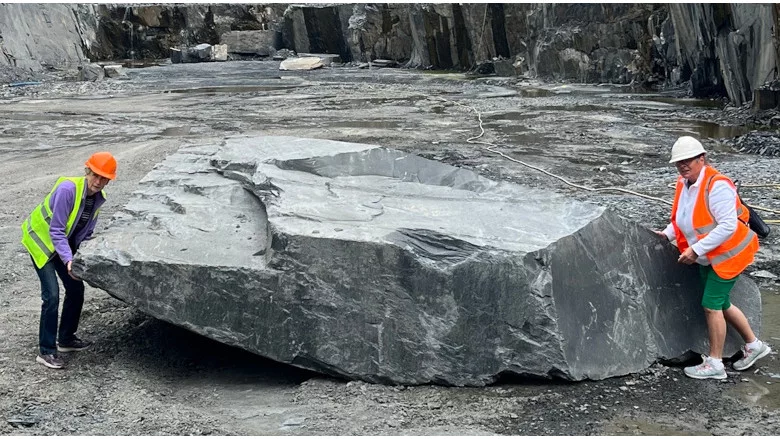
Travelling in specialist vehicles, members were transported deep into the working quarry, where Deputy Quarry Manager Thomas Rotherham explained the formation of the slate and demonstrated how the stone is extracted. Visitors were shown how large blocks, or “clogs” -- each weighing several tons -- are carefully removed from the rockface using expert techniques passed down through generations, before being transported to the surface where they are sawn and processed for use in a wide range of architectural, landscaping and building applications.
The group then returned to the quarry head, where Roofing Supervisor Christian Peterson provided a tour of Burlington’s processing facilities where members witnessed first-hand the traditional craft of riving -- a centuries-old technique that splits the slate along its natural grain using only a chisel and hammer. This process is used to create Kirkby Blue roofing slates, renowned for their durability and aesthetic beauty. The slates are then dressed and finished, ensuring the quality expected for use in heritage buildings and prestige projects across the UK and beyond.
The history of slate quarrying in Kirkby dates back to at least the 17th century, but it was in the 19th century that Burlington Stone became a household name, supplying stone for grand Victorian buildings, railway stations and country estates. Today, Burlington’s slate is widely specified all over the world for roofs, walls, floors, cladding and public spaces -- recognized for its strength, longevity and natural elegance.
Rose Clark, the Society member who organized the trip, thanked Burlington Stone for its warm hospitality and the time invested in showcasing the quarry and its story. “The visit was both highly informative and quite spectacular,” she said. “We were given privileged access to areas not normally open to the public and came away with a far greater appreciation of the natural and human history that shapes this iconic Cumbrian material. It’s a real eye-opener to witness the craft, skill and geological wonder behind the slate we see on roofs, walls and footpaths all over the Lake District.”
Looking for a reprint of this article?
From high-res PDFs to custom plaques, order your copy today!