Helpful Tips Necessary for Running a Successful Fabrication Business
Several experienced fabricators took part in a Fabricator Forum on the stage of the Natural Stone Theater during The International Surface Event (tise)
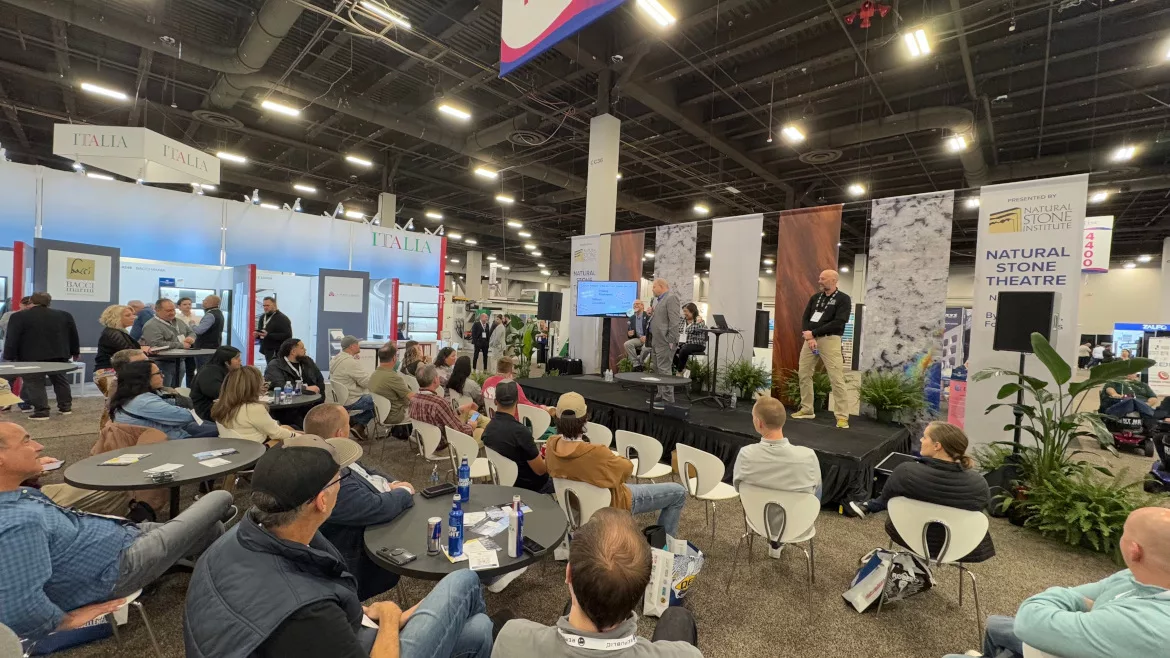
Photo by Jennifer Richinelli
Industry Veterans shared issues and solutions at a Fabricator Forum during The International Surface Show, which was held at the Mandalay Bay Convention Center in Las Vegas, NV, at the end of January 2025. Topics ranged from exit strategies to automation and OSHA visits, as well as everything in between. The discussion was led by Mark Meriaux, technical manager at the Natural Stone Institute (NSI). The panelists included:
- Laura Grandlienard of ROCKin’teriors in Raleigh, NC
- Buddy Ontra of Ontra Stone Concepts in Bridgeport, CT
- Tim Zeng of Zeng Granite Inc. in Lincoln, NE
The following is a summary of the discussion.
Planning an Exit Strategy
A fabricator in the audience explained that in the last five years, his company is looking for an exit strategy, which requires a lot of processing. He asked, “What can you share about the different software systems and automation tools that are being used in the industry successfully?”
Grandlienard responded, “I understand where you're coming from because we have been there too. We initially tried out new templates, thinking they were perfect, but then made a dedicated effort to go digital. Today, we are completely paperless, with everything on the cloud. There are excellent software programs available that can really help. We ended up choosing Park’s software for our shop, and it has worked wonders. It seemed like a monumental task at first, but once you're on the path, it becomes much easier. The industry has evolved so much with software, machinery and digital automation.”
Meriaux asked Zeng if he had anything to add in terms of operations or planning. “It all depends on what you want your shop to become -- especially in terms of growth,” he said. “Going digital is like getting a taste of candy -- once you have it, you'll want more. But there are challenges, especially when it comes to employees. They might resist change, and you will need to consider whether you hire new talent or train your existing team.”
Ontra stressed it is important to talk to others in the industry. “Even if we don’t have all the answers, we can guide you in the right direction,” he said. “It is also important to start thinking about your exit strategy now, set your goals and plan for the future of your shop when you are ready to move on. I am going through this process right now, and while it can feel overwhelming, it is worth it in the long run.
“It is all about finding the right people and learning from others -- especially from those who have been there before,” Ontra went on to say. “There are plenty of companies out there, and talking to different fabricators of all shapes and sizes can provide valuable insight. Do not be afraid to ask about what worked and, more importantly, what did not.”
Meriaux told the crowd that the Natural Stone Institute (NSI) is always happy to answer any questions. “[Also], I know Tim is actively involved with the Stone Fabricators Alliance (SFA), which offers a lot of valuable education,” he said. “And, of course, Laura is also a member of International Surface Fabricators Association (ISFA), which focuses on manufactured materials. There are various associations that offer different kinds of resources, including business-focused, technical support and safety standards.
“As we go through the conversation, remember there are plenty of opportunities to network and learn from one another,” Meriaux went on to say. “Industry groups are a great resource to help you figure out your next steps.”
Employee Retention and Training
Always a point of discussion among fabricators is employees. “One of the challenges fabricators often face is employee retention and training,” said Meriaux. “Many fabricators have employees who are not traditionally educated or skilled in business management. So, how do you transition your staff to adapt to new systems?”
“We cross-train our team to ensure redundancy and flexibility,” said Grandlienard. “For example, if one person is out sick, there is always someone else trained to step in and fill their role. This approach has been in place for about 10 years and has proven successful. We started with basic equipment, and now we have CNC machines. When our main operator was not available, we all pitched in, and everyone stepped up to learn and help. Training is key, and it is important to make employees feel valued by offering them opportunities for growth. It is not about having a college degree. It is about giving them the skills they need to succeed.”
Zeng agreed. “That is exactly it,” he said. “We also focus on redundancy with machinery and employees. However, as you scale up, it can be more challenging to maintain this balance. For example, with 18 employees, it can be difficult to provide specialized training for each role. We also try to ensure that everyone knows how to perform different tasks, like both fabrication and installation. This way, if something goes wrong, there is someone else who can step in.
“As for training on new systems like CNC machines, it is definitely a challenge,” Zeng went on to say. “People who are used to hand fabrication might initially resist, but they may also embrace the change once they understand its benefits. I know many shops, including mine, have had to invest in systems CNC machines to stay competitive.”
Grandlienard explained she had a similar experience. “It is all about pushing boundaries,” she said. “When we first started using larger formats like marble or quartz, our team was not familiar with the specific tools required. But through trial and error, and with input from the network, we learned and improved.”
“One other thing that has worked well for us is reaching out to competitors and industry colleagues for help,” said Ontra. “For example, I reached out to a fabricator in New Jersey and asked if my templator could shadow their team for a few days to learn how to use CNC equipment. Sharing knowledge has been invaluable in improving our practices.”
Grandlienard agreed. “The network of fabricators is incredibly supportive, even across state lines,” she said. “Whether it is discussing challenges with large formats or sourcing materials for a unique project, you can always count on the network to offer help.”
“Networking is vital,” said Ontra. “I once had a project where an architect wanted a custom sculpted water feature for a high-end home, but the larger fabricators I reached out to were too backed up. So, I turned to a fabricator in Washington state. With their expertise and the material I sourced, we were able to complete the project, which ultimately ended up in Manhattan. It was a perfect example of how collaboration and networking in the industry can lead to success.”
“And I’d also like to share something personal,” said Grandlienard. “A year ago, I lost my brother, who was a key part of the business. It was devastating, not just personally, but for the shop too. He was the one who led the fabrication team. But because we had cross-trained everyone, the rest of the team stepped up, and we were able to keep moving forward.”
“That’s a powerful story, Laura,” said Zeng. “It is a reminder that things can change suddenly, and it is crucial to prepare your business for the unexpected. One of the most important lessons I’ve learned is that you need to have systems in place -- whether that is for operations, employee training or even insurance. You need to ensure that your employees and equipment are protected.”
“Absolutely,” said Grandlienard. “As hard as it was, we were able to weather the storm because we had the right processes and systems in place. It also helped that the industry came together to offer support. I received calls from fabricator owners offering help, and that is something I will always be grateful for.”
Zeng agreed Grandlienard shared a great point. “We all need to be proactive in protecting our businesses,” he said. “Don’t wait for something catastrophic to happen -- take the necessary steps to ensure your business is prepared.”
“And that goes beyond just insurance,” said Grandlienard. “Whether it is workers’ compensation or flood insurance, you need to make sure you are covered for all the unexpected challenges that can arise.”
“Exactly,” said Zeng. “And on the topic of worker safety, do not forget about silica testing. It is a growing concern in the industry, and your shop could be visited by OSHA at any time. We have been proactive in testing our silica levels and making improvements to our processes. Last year, we got a test result that was much higher than expected, but by implementing better systems and getting advice from a fellow fabricator, we were able to reduce our levels and stay within the safe range.”
Grandlienard told the audience it is a reminder that fabricators all need to stay on top of regulations and safety standards. “Voluntary inspections and proactive measures can help keep your shop in compliance,” she said.
“Absolutely,” said Zeng. “And if you have not done a voluntary inspection, I highly recommend it. It is free. It is state-sponsored. And it can save you from major headaches in the future.”
Looking for a reprint of this article?
From high-res PDFs to custom plaques, order your copy today!