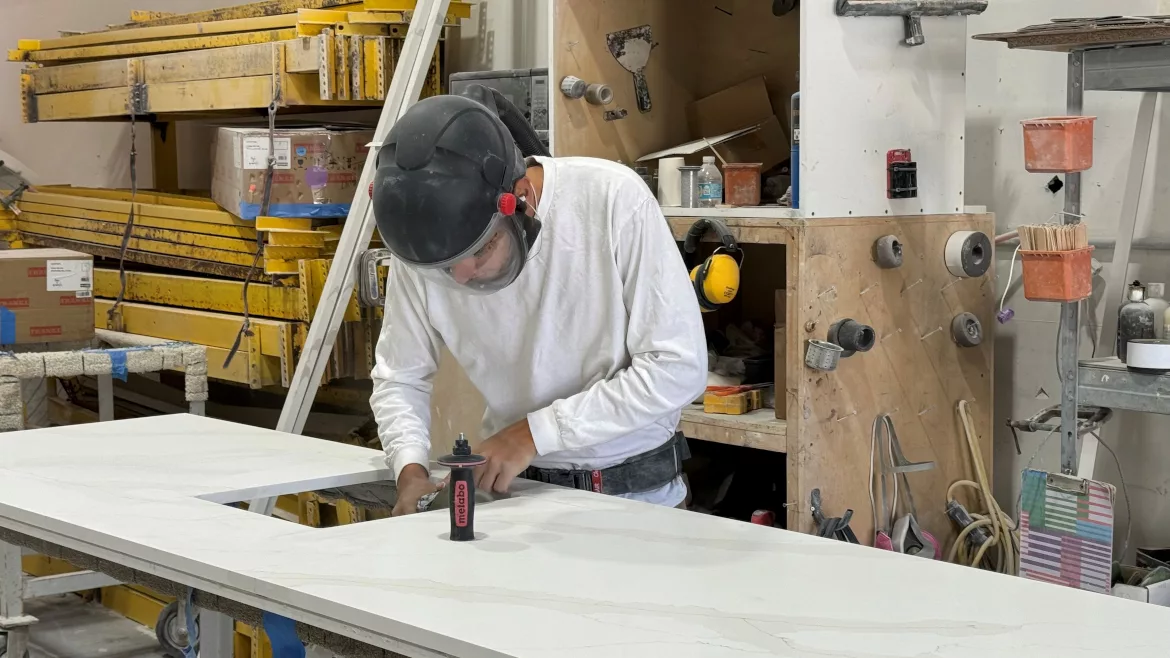
Building your shop through automation and digital software
Recently, Stone World and the Natural Stone Institute held a virtual Stone Summit to discuss ways for fabricators to investigate products that are new to their process, including tooling equipment and digital software, as well as methods to develop focused questions that will help ensure the product or machine they review will perform as anticipated and provide the expected results

Technology continues to advance and play an important role in many of our daily lives. For fabricators in the stone business, each year there are more digital and automated products introduced to the marketplace, which can contribute to a shop’s overall efficiency and production. But understandably, some fabricators might be hesitant of new technology for a range of reasons, including not fully understanding it to know what products would best suit their business. Moreover, they might have concerns about cost or how their staff will respond to the change.
To address this subject, Stone World, along with the Natural Stone Institute, presented a two-part virtual workshop on Thursday, December 10, 2020, which was sponsored by Triton Stone Group, one of the largest importers of natural stone and other building products headquartered in New Orleans, LA. The Stone Summit, moderated by Tony Malisani of Malisani Inc., included speakers of leading machinery and software companies, as an industry veteran who talked about his personal experiences.
“Some things for us to talk about is the concept of changing your company culture,” Malisani told viewers at the start of the morning session. “Changing from one system to another can cause some angst. That’s the typical human reaction to change. It is important as a company to involve as many people as you can. Take time to familiarize your people with the new processes you want to put in place, as well as create measurable goals. Failure comes from lack of communication. For example, say, ‘In three months, we want to be completing our templates digitally.’ That is something measurable.”
Malisani also explained that it is important to put together a transitioning team. “Those people responsible for that makes for a more efficient and probably elegant change,” he said. “Come up with a reasonable timeline for implementation. I think that is important as well.”
Throughout both sessions of the virtual workshop, poll questions were asked. Among the first was: Do you currently use quoting software for your company? Two-thirds of respondents answered “yes.”
This transitioned into Harry Hollander, president and one of the founders and owners of Moraware, speaking about management software. “There are a lot of different individual factors fabricators have [for investing in management software], but overall, it’s growth that is the biggest trigger of wanting to change,” he said. “One trigger we see is when an owner goes from being a craftsperson – the one in the shop -- to being a manager. Now they have to make the rest of the business better.
“Another [trigger] is adding capacity,” Hollander went on to say. “Adding machinery because they have to get more efficient. If you are growing or anticipating growth that is really a reason to start looking at software.”
“If someone calls and wants to implement a process, what is the conversation that goes with that?” Malisani asked Hollander.
“What we have realized over the years is that we can’t ensure their long-time success,” said Hollander. “As much as you want to wave a wand and solve all their problems, you can’t. What we try to clarify when having a conversation with a prospect is understanding what they are doing today, what they want to do and the consequences of not changing.”
“When you go into a business, how do you roll it out?” asked Malisani.
“Like you identified before, change is hard,” said Hollander. “We say let’s break it down into small chunks so you aren’t overwhelming your team. As companies grow, the first challenge they run into is getting the cost to the customer, then a bottleneck in the office and then I think only with skill you have grown to material handling becoming a problem. We like to break it into small pieces so customers of ours are getting value as much as possible.”
Preparing for virtual selling
Todd Vandawater, chief operating officer of Triton Stone Group, explained that to operate in the beginning of the pandemic they prepared to use Zoom to meet with customers virtually, trained their staff on Google Meetings and immediately went to some scheduling programs.
“We told our customers that they can look at slabs in person or you can have a virtual appointment,” said Vandawater. “We got no response. People really wanted to come in and touch and feel those slabs. We did a lot of preparation and worrying for the worse, but really didn’t need to.
Vandawater went on to say that fabricators have set higher standards in recent years about the quality of stone they buy. “Over the past five years, we have seen a huge increase from what fabricators will and will not accept,” he said.
“We certainly have reached a level of sophistication,” said Malisani. “Going forward, do you foresee higher resolution photos being sent to you from your manufacturers/producers or will it come from you?”
“I want to see everything ‘Slabsmith quality,’ but in all honesty, with 200 slabs coming in at a time that is impossible,” said Vandawater. “But we are really trying to do a better job. With the quality of cameras on iPhones and iPads, it helps. It feels like our customers, you the fabricators, don’t really trust the quarry picture. From my perspective, I think the onus is going to continue to be on us.”
The morning session discussion also included JT Hoffmann from Laser Products Industries and Bill Elliott of Northwood Designs, Inc., manufacturer of Slabsmith software. Both provided information that those who have not made the switch to digital should consider.
“There are a lot of fabricator forums that you can follow [to learn about digital templating],” said Hoffmann. He even suggested for those who are still operating a manual shop, but considering digital, to contact a neighborhood fabricator who will be willing to let them observe and share their experience. “I believe now 60% [of fabricators] in the U.S. are using digital templating,” said Hoffman. “The chances are someone in your backyard is using some form of digital. One thing we are pushing for a manual guy is that you might now have a CNC, but let’s go do a job together and you’ll see. One benefit is that you don’t have to know CAD.”
Malisani asked Elliott, “What kind of investment in equipment and space commitment do you have to make when looking at installing Slabsmith?
“To be up and running, it is not an awful amount of money,” said Elliott. “Inventory is becoming more important. Our most successful customers who are making money are photographing material as it arrives.
“An important goal is to reduce touch-time,” Elliott continued. “Reducing handling and touch-time is huge and very important. There’s less risk of injury.”
Automating a shop
The afternoon session of the Stone Summit began with Egon Hinss, national sales manager for Breton, talking about the transition to automation. “Look for employees that can transition with you into automation,” he advised. “Look for guys who have worked in other shops with automation or have a background with it.
“We are in a golden age of automation,” Hinss went on to say. “We have spent the last 30 years developing it. In the beginning, like computers, it was only for the select few, but now that has changed. The programming has become much simpler and easier. You don’t need a degree to operate it -- even a high schooler coming out of school can learn.”
“You have to be a good solid organization going into this so you are a good solid organization coming out of it,” said Malisani. “How does a company come to organize info?”
“If you don’t do it early, it can be very frustrating,” said Hinss. “My advice, start the process earlier. It kind of goes with what you said about having a five-year plan. One step is to start looking and shopping around. Immediately start shopping for your financing. Go to your bank. We can always recommend good people to you. It’s like buying a house.”
“At what point would you say is the jumping off point?” asked Malisani. “What is a very good indicator not only to pursue the process, but to make some good decisions?”
Hinss said that a fabricator should evaluate if they are at capacity? “If you are losing jobs or turning jobs away because you don’t have capacity, that’s an immediate trigger point,” he said. “Labor cost comes into play, but that’s why you want to automate. If you have crazy high labor costs or can’t manage your labor anymore, then it is definitely time to automate. When doing 10 to 15 kitchens a week, that’s when it makes sense to start to think about automation.”
Hinss warned that if you have an existing facility, you have to plan very carefully. “You don’t want to end up in a situation where you say I should have done this differently or put this there,” he said. “Obviously, when going to automation it is best to start with a new facility, but that isn’t always realistic. Use a salesperson as a resource. That’s what we do. We will examine the situation [and offer suggestions].
“There is a lot of machines out there,” said Malisani. “We have sawjets, saws that cut and move – there are more options than we ever had. How does a person select machinery for their situation? Realistically, if you are going to move into automation, what is the life cycle of equipment you are buying now? How fast does technology replace itself?”
“Ogee and bullnose edges are not nearly as popular as they used to be,” said Hinss. “[Therefore], CNC routers are not needed as much. Nowadays, it makes more sense to go with the CNC saw because you need a saw to handle mitering. Moving forward, definitely examine what you are doing more of, and choose something that will accommodate that. You also want to look for equipment that can integrate with software you have.
“You can buy equipment that will last you a minimal of 10 years,” Hinss went on to say. “Keeping your machine clean is something I stress. If you keep a machine dirty than your employees are going to treat it junky.”
Hikmet Pauls of Marjan Stone in San Diego, CA, spoke as a testament to transitioning to automation. “I have been in business since 1987,” he said. “I moved to the U.S. in 1999 and opened my own business in 2005. My background is a civil engineer and contractor. I like the stone industry a lot. I have devoted myself to this kind of business. I am constantly improving my business -- adding machines and attending seminars.
After five or six years of working, Pauls explained that his business started growing. “I first was renting a building, but going to digital I thought that I needed a bigger space and needed to purchase something because rent in California keeps going up and one day I might not be able to afford it.”
Pauls told viewers that he believes having a fully automated shop gives better confidence to builders and contractors. “Go step by step,” he said. “Don’t over jump. I purchased a Robo sawjet and a CNC. I did it within six months. It was not an easy decision. In my opinion, I thought about the worst case scenario. I can sell it and have an asset. Thankfully I didn’t have to do that.”
Looking for a reprint of this article?
From high-res PDFs to custom plaques, order your copy today!