Flagstone veneer contributes to campus design
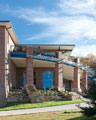
Tennessee flagstone was employed as thin stone veneer for architectural and landscape elements of Enotah Hall, a new residential hall at Young Harris College in Young Harris, GA. The material was supplied by North Georgia Stone of Blairsville, GA.
Nestled in the North Georgia mountains since 1886, Young Harris College has experienced some significant changes in recent months. While the school has been a two-year college since its beginning, it is now in the process of evolving into a four-year institution. With this transformation has come a surge in student attendance - causing a need for more space. As a result, Enotah Hall, a new 200-bed residence dormitory, opened in time for the fall 2009 semester. The new building, which was designed by the Atlanta, GA, office of Lord, Aeck & Sargent not only complemented the campus’s existing architecture, but it has received LEED silver certification from the U.S. Green Building Council. And the use of Tennessee flagstone in a thin stone veneer format for architectural and landscape elements contributed to the overall character of the exterior design.
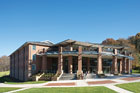
The flagstone was quarried within the specified mile radius to meet LEED certification by the U.S. Green Building Council, which helped the new residence hall achieve LEED silver certification.
And while making the new building sustainable and in regulation of LEED guidelines was important, the design also needed to fit in with the existing architectural context on campus. Additionally, there was a desire for the new residence hall to have a current, progressive and sustainable presence as well. The Lord, Aeck & Sargent design team, which also included Project Manager Jackson Kane, spent a great deal of time studying Young Harris’s architecture and the campus’ connection with the surrounding Appalachian Mountains.
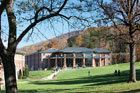
The Tennessee flagstone, which was used for the base of columns, site walls and planters, complements Enotah Hall’s brick exterior as well as existing architecture on campus.
Influenced by existing architecture
“The building needed to fit into a fairly eclectic mix of existing architecture and be a forward-looking, contemporary structure of its place and time,” said Greco. The architect further explained that the majority of the buildings on campus were constructed between the 1950s and 1980s, with the exception of several buildings such as the Susan B. Harris Chapel, which was built in 1892. The chapel sits at the opposite end of campus from Enotah Hall, and is the most iconic, according to Greco.“The Chapel is the oldest and most historically significant building on campus, so we drew from some of its iconic historic elements and created a new common language for Enotah Hall through material usage and scale,” he said. “For example, we picked up on the chapel’s arts motif of arched windows, battered masonry and projecting string course.”
Additionally, the design team was influenced by other campus architecture when selecting exterior building materials. “Enotah uses two tones of red brick - pulling from the color range of the chapel and some of the newer campus buildings,” said the architect. “The site walls, planter walls and amphitheater seating are constructed of Tennessee flagstone - used as an accent in a manner similar to other site retaining and landscape wall features found on campus.”

On average, the Tennessee flagstone pieces were as large as 1 x 2 and 2 x 3 feet with smaller pieces measuring about 1- x 1-foot. Each had a minimal nominal thickness of 2 inches.
An interactive design
The 62,500-square-foot building, which stands three stories high, consists of two 100-bed residential wings connected by a central lobby. “Originally, it was programmed as two separate 100-bed buildings, but we decided that it would be much more dynamic as a single facility with 100-bed wings linked by a connector commons,” said Greco. “It’s a living learning community. There are meeting spaces, music practice rooms and a piano in the lobby. There’s a lot of open space to encourage student interaction. The central bay is thought of as a campus-wide amenity.”Other areas for students to congregate are in study sunrooms that are located at the far ends of the six corridors in the residence wings. The spaces have operable windows that offer dramatic views and provide natural daylighting to the corridors in combination with floor-to-ceiling curtainwall glazing at the opposite ends of the corridors that overlook the main campus quadrangle.
“One of the design goals was to really take strategic advantage of the views,” said Greco. “The building is rotated on the site in such a way that the sunrooms on the corners offer terrific vistas out across the campus recreational spaces and to the mountains beyond.”
Further interaction is encouraged outdoors with an outside amphitheater that is formed by a series of arced flagstone seat walls. “We capitalized on the topography to make the building more interesting,” said the architect. “The cross slope of the site made it possible for us to create an outdoor amphitheater in the courtyard between the building’s residential wings. The amphitheater provides the entire student community with a space for outdoor study, recreation and instruction as well as open-air lectures and performances in the mountain surroundings.”
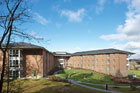
The flagstone veneer was also employed for an outdoor amphitheater that is formed by a series of arced flagstone seat walls. This element provides the entire student community with a space for outdoor study, recreation and instruction as well as open-air lectures and performances in the mountain surrounding.
Selecting local stone
While the majority of Enotah Hall’s exterior is comprised of red brick, Tennessee flagstone veneer provides a nice accent. “The flagstone relates back to the earth,” said Greco. “[Also], it was within the LEED-specified-radius to qualify as a local material.”The architect went on to explain that measures were taken to make sure the flagstone veneer matched the Tennessee flagstone that was already on campus. “Some mock-ups were done, but basically we just tried to match the [existing] walls on the campus as closely as possible,” he said. “That was a good target to go for.”
In total, approximately 2,860 square feet of Tennessee flagstone was used for the new construction. The material was supplied by North Georgia Stone of Blairsville, GA.
On average, the pieces were as large as 1 x 2 and 2 x 3 feet, with smaller pieces measuring about 1- x 1-foot. Each had a minimal nominal thickness of 2 inches.
“We sorted out the larger sizes first, installed them, and then filled in with the smaller pieces,” said Brian Greene, Vice President - Preconstruction of Zebra Construction Company, Inc. in Suwanee, GA, the stone mason for the project. “We installed brick ties to the substrate. We installed a mortar bed on the back-up and a bed of mortar on the back of the stone and secured it into the CMU, making sure we kept the face plumb.”
According to Greene, there were two masons and two laborers on the jobsite. It took a total of 20 days to complete the installation of the flagstone veneer.
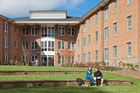
With two masons and two laborers on the jobsite, it took a total of 20 days to complete the installation of the flagstone veneer.
Meeting LEED standards
With an objective to meet LEED silver certification, many steps were taken during design and construction to ensure this target was met. Enotah Hall was constructed with regional and recycled materials, and the building employs generous daylighting and sustainable site strategies. The residential wings are oriented so that windows are within 15 degrees of due south or due north - maximizing daylighting while minimizing late afternoon glare. Additionally, deep roof overhangs help shade the upper terrace, and the two-story porch provides coverage at the building’s west-facing curtainwall openings. And another environmental practice includes rainchains that direct water from the terrace into the flagstone-clad planters at the base of the porch’s masonry columns.“For us, it was great to work with a client that was really committed to sustainability from design through occupancy,” stated Project Manager Jackson Kane. “If you look at where LEED projects are registered, they tend to be located in urban areas. One of the ways this project serves the community at large is by demonstrating sustainable design in the predominately rural North Georgia mountains.”
In total, construction of Enotah Hall on the campus of Young Harris College was completed in approximately 16 months.
Looking for a reprint of this article?
From high-res PDFs to custom plaques, order your copy today!