Williamson Pounders Architects, LLC
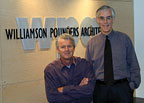
While both men received an undergraduate degree from Rhodes College in 1968, they parted ways after graduation. Pounders headed off to Harvard University, where he received a Master of Architecture from the Graduate School of Design. He then worked in the New York and Boston offices of I.M. Pei and Partners for two years, before settling with Nathan Evans Pounders & Taylor for more than 20 years.
Williamson received a Master of Architecture from the Studio of Louis I. Kahn, Graduate School of Fine Arts at the University of Pennsylvania. He then returned to Memphis, where he was design principal of his own firm. In 1986, the architect took a two-year sabbatical, and went to work for Venturi, Rauch and Scott Brown in Philadelphia.
Williamson Pounders Architects was founded in 1990, and has established itself as one of the South's leading design firms. In addition to the two principals, the staff includes approximately 15 architects and support staff personnel. The firm provides planning, architecture and interior design services to civic, religious, educational, commercial and residential clients throughout the central U.S.
Through the years, WPA has been honored for many of its designs. In 2001, it received several awards for its work on the Metropolitan Inter-Faith Association (MIFA) in Memphis, TN, including: American Institute of Architects, Gulf States Region, Honor Citation; American Institute of Architects, Memphis, Award of Excellence; and American Institute of Architects, Tennessee, Award of Excellence. Additionally, WPA has also received an Award of Excellence in 2001 from the Memphis Chapter of the American Institute of Architects for its restoration of the Cathedral of The Immaculate Conception in Memphis as well as an Award of Excellence in that same year from the Tennessee Chapter of the American Institute of Architects for the Lichterman Nature Center in Memphis.
Recently, Contemporary Stone & Tile Design had the opportunity to speak with the principals of WPA.
CSTD: What first sparked your interest in architecture?
Williamson: One of the things that is very unusual about Louis and me as partners is that we grew up together as kids. Looking back, I shared an interest with Louis in drawing and making things. And although I didn't understand it at the time, that shared interest was one of the things that eventually led me into architecture. We used to be in the same sixth grade class, and would send drawings back and forth to each other, when other kids were passing notes.
Pounders: We mostly drew space capsules. This was the time when the U.S. space program was just getting underway.
Williamson: Later on, we collaborated on science fair projects -- taking photographs of the moon through telescopes and building a scale-model house complete with electric lights. The fact that Louis shared my interest in those types of things made me realize that it was okay -- that it was sort of a cool thing to be interested in making things.
Pounders: Through these episodes -- sketching and drawing and building things -- I thought, "Perhaps I have some talent -- in drawing, that is." This was something I could do well and also enjoy.
Williamson: Later we both went to Rhodes College in Memphis, a liberal arts college. Neither one of us majored in art or architecture, but we continued our interest in those areas. By the time we graduated, I was thinking about architecture as a career possibility -- along with clinical psychology, medicine and a career as a naval officer!
Pounders: After college, I went into architecture school, and Jim went into the navy for a few years, so I was a little bit ahead of him. We worked for different firms and stayed in touch.
CSTD: How has your design style evolved since your beginning days as students?
Pounders: At Rhodes, a liberal arts college, I majored in sociology. So my design style really did not begin to develop until architecture school. I went to Harvard and Jim went to the University of Pennsylvania. I was there trying to understand principles and concepts, and to study what other people have done. I think over the years my design sense has become more focused.
Williamson: I do not see that we have a consistent or recognizable style like, say, Frank Lloyd Wright or Frank Gehry. What Louis and I do grows out of the particularity of each project. (Having said that, it's possible that an outside observer can point to some things that are constant throughout our work that it's hard for us to see since we are so close to what we do.)
Pounders: I think it is interesting that there is not a consistent style in our work. Each project responds to its own specific needs. This was always said about one of my favorite architects, Eero Saarinen, who designed the Gateway Arch in St. Louis, Dulles Airport in Washington, D.C. and the CBS building in New York City. If you look at his body of work, there is great diversity in the projects.
CSTD: So how do you approach a new design?
Williamson: We consciously try to avoid preconceptions about what a new building should look like. Instead we begin by looking very carefully at the building context. We're interested in regionalism, whether it's making buildings that are at home in our part of the South or somewhere else. We're also interested in the smaller context -- what do the buildings next door and across the street look like? Then we try to enhance and strengthen whatever makes that place special or memorable. Context also extends beyond the physical to consideration of the clients' identity. We ask, "Who are they?" "What is their institutional personality?" "What makes this law firm, or church, or community agency different from another?" From these kinds of inquiries the starting points of the design begin to emerge.
Pounders: We try to produce the most responsible, highest quality design that grows out of context.
Williamson: That leads into why we often choose to use stone. It begins with a consideration of context. There are some places where almost everything is made of stone and others where nothing is. In places where it is used, we look at how and why. Is it because there is a quarry nearby? Does the region have a tradition of using a particular variety of stone well? Is there a functional requirement that suggests stone? We design many churches, and often there is a requirement for a baptismal font containing running water, so we specify a non-porous stone like granite rather than limestone.
When we were designing an addition to St. John's Episcopal Church, a historic building in eastern Tennessee, we had to decide how to respond to the grapefruit-size pebbles used for the existing walls -- "river rock" as it is called locally, because the stones were rounded by water. The objective was to make an addition that was compatible with the old building, and it was impossible to imagine it without that same stone. We had to look high and low to find a replacement.
CSTD: Did the new stone come from the original quarry?
Williamson: I don't know if it was exactly the same quarry -- the church is about 100 years old -- but it was located on a dried-up branch of the Nolichucky River in the nearby mountains, just as the original stone was.
And that's another thing about stone. It is a material that suggests a building is going to be around a while. In a society that builds so many transient structures, using materials chosen for initial cost rather than longevity, stone stands out today, perhaps more than it did 100 or 150 years ago when its use was more common.
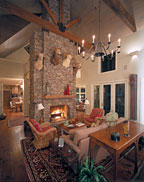
Pounders: In our projects, we have used stone in a variety of ways. We used dry stacked stone on a vacation house on the Little Red River near Heber Springs in central Arkansas. We used it for the foundation of the house, site walls and the fireplaces and chimneys. We've also used random fieldstone for paving surfaces on several projects. Sometimes, when we want a more handcrafted appearance, we use cut stone, which has a more formal character to it. We recently used cut stone from a Tennessee quarry on a residence at Pickwick Lake, a resort area near Memphis. Two large curving fireplaces on separate floors and a double stone chimney became the focus of this lakeside house.
CSTD: Do you often use local fieldstone for your projects?
Pounders: Fieldstone is best expressed as irregular-shaped flat pavers. We have used it on terraces and walks and that sort of thing in a variety of project types. It's a more informal presentation with a random flavor to it.
Williamson: Sometimes we intentionally try to contrast different textures and sizes of stone. One of our projects involved making a place for a large bronze outdoor sculpture at Rhodes College. The sculpture stands on a low seat-height pedestal made of black cut slate -- rather formal and precise looking. On the walking surface around it, we chose a different kind of slate, smaller pavers with a rougher natural cleft finish, in several colors. The contrast between the two helped set the sculpture apart from its surroundings.
CSTD: In your careers, you both have worked briefly for larger firms such as I.M. Pei and Partners in New York and Boston, and Venturi, Raunch and Scott Brown in Philadelphia. What did you learn from your experiences there?
Pounders: My experience at Pei's office was very influential on my career. Most of their designs grew out of a strong geometrical concept. That purity of geometry and design continues to inform my work today. Their East Wing of the National Gallery in Washington, one of their finest projects, was developed from a series of overlapping triangles. The Mellon Center for the Arts at Choate School, a project that I worked on, was conceived as adjacent triangular and circular forms. I was also influenced at Pei's office by the collection of incredibly talented people and how they worked together.
Williamson: Unlike most other young architects during the early '70s, I was trained in a school that had begun to question Modernism. I was a student of Louis Kahn, who was in many ways more of a classicist than a modernist. Then I took a sabbatical in the '80s, and went to work for Venturi, Rauch and Scott Brown in Philadelphia. It's interesting to contrast the two firms. I.M. Pei is the epitome of modernism and purity. Venturi's ideas are quite different. He is an anti-modernist, so instead of geometry, purity and consistency, he was the champion of complexity, ambiguity and impurity. I found myself drawn towards his iconoclastic approach. I continue to carry that thinking with me, and in my preservation work, it has proven very relevant. It's hard to reconcile historic preservation with modernist ideas. The two are always in tension.
CSTD: Do your differing approaches to design ever cause disagreements when working on a project?
Pounders: On every project in our office, one of us is the partner-in-charge of design. While we discuss things with each other and share ideas, we're really working more in parallel rather than in collaboration.
Williamson: We're fairly tolerant of each other's ideas. I'm willing to accept others' views in esthetics as long as they are strong and they work.
CSTD: When did you start Williamson Pounders Architects, P.C.? What made you decide to become partners?
Pounders: About 10 years ago. We were both working with other firms here in Memphis, and we decided to get together. I was working with a firm that I had joined when I graduated from architecture school. I had been with them for over 20 years, and I decided to try something a little different. It just seemed appropriate.
Williamson: I always suspected that it would happen. So when he decided to leave his old firm, it seemed a perfect opportunity for us to try a collaboration.
CSTD: What is the firm's design philosophy?
Williamson: Context and regionalism; design growing out of the particular circumstances of site and program.
Pounders: We love stone and try to use it as often as we can.
CSTD: When you use stone for a project, do you have certain "regular" suppliers who you deal with or do you have to search for a source each time?
Pounders: It depends on the project and location. For the house on Pickwick Lake, the stone came from middle Tennessee. The contractor knew the supplier, so the client drove up to their quarry and brought back a trunk full of samples. We looked at the material and made our decision.
Williamson: We recently did a major restoration of the Cathedral of the Immaculate Conception in Memphis. There was a great deal of existing white marble, used for various altars, railings and fonts. We designed a number of new liturgical items, and it was a natural decision to use that same white marble. We recycled some of the old, and in other cases specified new marble that was visually identical.
Had there been no marble in the Cathedral initially, it might not have occurred to us to use it for the restoration. But by doing so, we connected the new with the old.
CSTD: For the new applications that used recycled marble, what areas of the cathedral did you take it from?
Williamson: There was a marble altar railing, and to bring the building into compliance with modern Roman Catholic liturgical guidelines, the railing had to be removed. Under those same guidelines, a new baptismal font with flowing water, large enough for someone to step into, had to be designed. We took apart the altar railing and incorporated its parts into the new font. Now the new object includes a component of the old architecture. It was an Italian stone, but our supplier was able to find small quantities locally, enough to fill in when we didn't have enough recycled material.
CSTD: I know that you do a lot of historic preservation work -- especially churches, Jim. Are you specializing more in religious architecture now?
Williamson: I seem to be doing a lot of it these days. I discovered one nice thing about having a church as your client: you don't have to convince the owner to do architecture. Churches come to you because they want architecture, not just another ordinary building. It's exciting to work with people who want to do something well -- a building with a large volume, light, high-quality materials and a sense of the mysterious. A place of worship. That's a good match for me.
CSTD: Louis, you have worked on various types of projects through the years. Is there a particular area that you enjoy working on more than others?
Pounders: I've been involved in a number of institutional projects, like the Lichterman Nature Center, which was a project for the city of Memphis. It's a wildlife preserve in an urban environment.
The building is a blending of a very contemporary structure with a historic building. The design was influenced by early national park architecture like the lodges at Yellowstone and Yosemite. We felt that stone was the appropriate material for the project and wanted to use a local stone, something from this part of the country that would give the structure a regional reference. Arkansas fieldstone was chosen for the building.
I'm currently working on a similar project in Tunica, Mississippi. It's a 168-acre wetland park on the Mississippi River. The two projects are similar in their natural settings.
CSTD: You both have been involved with university architecture programs. What advice would you give young architects today?
Williamson: We're probably not as intensively involved as we were, because we are so busy. I taught at Rhodes for the better part of 25 years in a class on theory and design that met twice a week. Finally, it became very difficult to do that and keep up my practice as well. Now we act as visiting critics at schools of architecture where we review student projects.
Pounders: The University of Tennessee School of Architecture in joint venture with the University of Arkansas School of Architecture set up a design studio here in Memphis. That has made it a lot easier for us to be involved.
Williamson: One thing I tell young architects is that the most important skill you can have is the ability to draw -- not drafting, but free-hand drawing. Even though architects are using computers more and more these days, drawing remains an essential skill. It's also a pre-indicator for young persons. For a student who likes to draw, architecture should probably be among the careers given consideration.
The other recommendation is to go the same route Louis and I did -- four-years in a good liberal arts college followed by graduate school in architecture. You don't have to do it that way, of course. There have long been five-year undergraduate architectural programs, and these are okay for young persons who are absolutely convinced they want to be an architect when they are still in high school. But, most students are not in that category and not ready to make that commitment.
Pounders: Also, at a graduate level, students are more dedicated. They know what direction they want to take and work harder at it. It also enhances the educational environment because they are taking it more seriously. They want to be there.
Williamson: A liberal arts background gives you greater educational breadth. The end result is that you not only know architecture, but history, literature, mathematics and science as well. You learn how to communicate -- an extremely valuable skill for an architect. Being able to write and express yourself verbally is absolutely essential, especially if you want your own firm and to be successful.
Looking for a reprint of this article?
From high-res PDFs to custom plaques, order your copy today!