Sustainability discussion with Joe Greco, AIA, LEED Lord, Aeck & Sargent
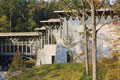
Photos © Jonathan Hillyer/Atlanta
Lord Aeck & Sargent has practiced sustainability in architecture since the early 1990s. Currently, more than half of its institutional projects have a LEED requirement or equivalent. The firm designed the Gwinnett Environmental & Heritage Center (GEHC) - the first “green” county-owned building in Gwinnett County, GA - that opened its doors in the fall of 2006. The facility’s exterior facade consists of approximately 900 tons of salvaged Elberton granite, which was supplied by Sullivan Stone Co. of Conyers, GA.
Lord Aeck & Sargent has practiced sustainability in architecture since the early 1990s. Currently, more than half of its institutional projects have a LEED requirement or equivalent. The firm designed the Gwinnett Environmental & Heritage Center (GEHC) - the first “green” county-owned building in Gwinnett County, GA - that opened its doors in the fall of 2006. The facility’s exterior facade consists of approximately 900 tons of salvaged Elberton granite, which was supplied by Sullivan Stone Co. of Conyers, GA.
Lord, Aeck & Sargent was created in 1989 when two Atlanta, GA-based practices, Aeck Associates, which was founded in 1942, and Lord & Sargent, started in 1983, made the decision to join forces. Since that time, the firm has demonstrated a strong commitment to keeping sustainability at the forefront of its designs. In 2003, the Construction Specifications Institute awarded Lord, Aeck & Sargent its Environmental Sensitivity Award for “showing exceptional devotion to the use of sustainable and environmentally friendly materials, and for striving to create functional, sensitive and healthy buildings for its clients.”
With offices in Atlanta, Ann Arbor, MI, and Chapel Hill, NC, the firm has completed numerous LEED-certified projects - including multiple LEED Platinum-certified projects - and is currently working on many more targeting LEED certification. And to further illustrate its commitment to the environment, Lord, Aeck & Sargent became one of the first architecture firms in the U.S. to adopt The 2030 Challenge - an initiative that calls on the global building sector to immediately reduce energy usage by 50% in new buildings and major renovations in order to avoid hazardous climate change. The ultimate goal of the initiative is the design of carbon-neutral buildings, or buildings that use no fossil-fuel greenhouse gas-emitting energy to operate, by the year 2030.
Recently, Contemporary Stone & Tile Design had the opportunity to discuss some of the firm’s green design philosophy with Lord, Aeck & Sargent’s newly appointed President, Joe Greco, AIA, LEED Accredited Professional: for
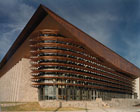
The exterior facade of the Georgia Public Health
Laboratory in Decatur, GA, which won R&D Magazines’s “Laboratory of the
Year Award” in 1998, includes granite remnants from the monument industry.
Greco: We always try to focus on the true sustainability aspects of a project before focusing on specific LEED criteria. Green has been part of our design process since the early 1990s - well before LEED came into existence. Even when doing LEED projects with a specific LEED goal, we try to pay serious attention to the energy side to ensure that there is a payback year after year. Not all LEED points are created equally. We focus on ones that have lasting benefits for the building occupants and those who must pay to operate long term.
Of our institutional projects, currently well over half have a LEED requirement or equivalent. A few institutions require that their buildings meet LEED performance levels, though they do not all go through with the certification. For a lot of colleges and universities - and cities, counties and even some states now - it has become a target - if not a mandate.
CSTD: How is it determined what buildings will be designed to meet LEED standards? Once it is decided to design according to LEED, what initial approach is taken to ensure that those objectives are met?
Greco: We really have embedded sustainability in our design process. For every project, we brainstorm green ideas early on to see what options are feasible for enhancing sustainability. Sometimes we have to shoot down some good ideas early on because of budget, but we usually succeed in finding some sustainable design strategies that can be incorporated at little or no cost and can be shown to have a relatively quick pay-back.
We are very firm believers that you do not try to design a building and then paint it “green” afterwards. We try to make green go to the essence of the design. The focus is beyond LEED. It is on sustainability. But the LEED administration process does take a bit of rigor. It is also important to track it from start to finish, so we typically plan on updating our project LEED scorecard periodically at each design phase, and to make sure the contractor is meeting its points during construction - especially if the contractor has never done a LEED-certified building before. It can be a bit of a learning curve.
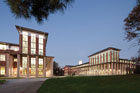
The first building on the Georgia Perimeteer College
Newton Campus - a multi-use academic building, which opened in 2007, is
designed with a strong, durable base of rough-hewn Elberton granite. A second
building, which completes the gateway entrance to the campus, contains an
auditorium, the learning resource center and other student support spaces,
opened last year.
Greco: We actually do use stone a great deal. We have not used tile as exterior cladding very often. We have used locally sourced cut granite on a number of projects that we have done in Georgia. For example, the first building on the Georgia Perimeteer College Newton Campus - a multi-use academic building, which opened in 2007, is designed with a strong, durable base of rough-hewn Elberton granite. A second building, which completes the gateway entrance to the campus, contains an auditorium, the learning resource center and other student support spaces, opened last year.
A lot of what we use is granite scraps from tombstone markers and curbs. It is a distinctive - and regionally unique - material. We used it for the Gwinnett Environmental & Heritage Center (GEHC) in Gwinnett County, GA, [which earned LEED Gold certification]. Another project where we used “scrap” stone was the Georgia Public Health Laboratory [in Waycross, GA]. Even for projects in other areas, we usually consider local stones. We’ve also explored some masonry products with recycled content.
CSTD: How do you go about deciding what materials will be employed for a project?
Greco: A lot of the time, they are chosen for somewhat contextual reasons. Often we find there is a strong precedent for certain materials when designing for a college or university campus. We do try to look for new and innovative materials - often with a green aspect - that can be used at least for portions of a project.
CSTD: Do you find that there are more “green” products on the market now than in the past?
Greco: Absolutely, and I think we will see more and more. We would love to see new and interesting products come out. Of course, when making decisions, we have to balance any potential new benefits with track records for durability. I think that the building materials industry has been working hard to come out with new green products that perform well.
Looking for a reprint of this article?
From high-res PDFs to custom plaques, order your copy today!