Fossil stone enhances high-rise's desert surroundings
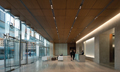
As one of the first new high-rises built in eight years in Phoenix, AZ, the Freeport-McMoRan Center demonstrates great levels of architecture in terms of innovation, research and teamwork - featuring in its lobby, fossilized Jura Marble from the Franken-Schotter quarry in Germany.
photos by Bill Timmerman
photos by Bill Timmerman
As one of the first new high-rises built in eight years in Phoenix, AZ, the Freeport-McMoRan Center demonstrates great levels of architecture in terms of innovation, research and teamwork. Fitted with high-speed elevators, environmentally friendly mechanical systems and strong structural support, it was important for the building to make a bold statement in the lobby - which features Jura Marble from the Franken-Schotter quarry in Germany.
“The choice to use stone in the lobby was intended as an extension of the effort to relate the overall building design to our immediate environment,” said the Design Principal for the project, Mark Roddy of SmithGroup in Phoenix, AZ, which served as the architect. “In order to respond to the desert environment and keep the building cool, a series of design strategies was implemented: shading, an energy efficient curtain wall system and a high performance mechanical system. Each of the design strategies is incorporated throughout the entire building, beginning with the lobby as the main threshold.”
As with most lobbies, a primary goal was to make it as comfortable and inviting as possible, while also connecting to its surrounding climate and environment. “We wanted the lobby to feel cool and inviting as a contrast to the 110-degree summer day,” said Roddy. “It was really important for us to make it a personal connection for the people coming in the lobby. Often you see granite used in a class-A office building, but we felt the stone we selected related more to our natural environment. Our goal was to balance the relationships to both the urban and desert environment.”
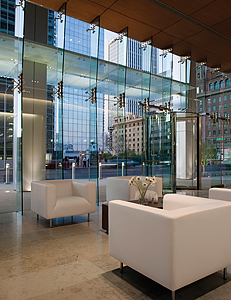
Beige-colored Jura Marble tiles in an 18- x 36- x ¾-inch format were employed for the lobby floor.
The decision to use Jura Marble came in part due to the stone’s organic feel. “The particular [stone] from that region [of Germany] has a lot of fossils, something we were really taken by,” said Roddy. “The fossils were a key design element that led to the selection of this specific stone.”
For the preliminary stone selection phase, the design team had originally been attracted to an Egyptian limestone that was lighter in color. “We soon changed our minds when we visited the factory in Germany,” said the architect. “We picked a gray- and beige-colored stone with fossils, saw the stone in person and looked at the feel of the stone altogether. We clearly realized the Jura Marble from Germany was more appropriate.”
Roddy, along with the contractor and client, traveled to Germany to hand select the stone slabs for the project, paying special attention to the appearance and size of the fossils contained within each slab. “We didn’t think any fossils should be larger than four inches in length or diameter,” said Roddy. “The cut tiles had to contain whole fossils and be held from any cut edge a minimum of one inch. We set criteria with the manufacturer, so they knew our expectations.”
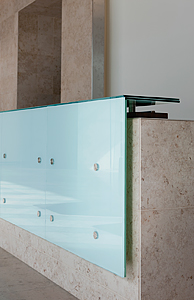
The concierge reception desk is made from gray-colored Jura Marble, as opposed to the beige color found on the floor and walls. “The stone has the same type of texture; one just happens to be beige, while the other is gray,” said Design Principal Mark Roddy of SmithGroup in Phoenix, AZ, which served as the architect for the project. “It made the project more cohesive.”
Beige-colored Jura Marble in an 18- x 36- x ¾ -inch format covers the floor and walls of the lobby. Because the stone had variation in color, the mason did layouts of the floor and wall before installation.
“The mason laid out the individual stone tiles for our review to insure there weren’t any fossils that didn’t meet our criteria,” said Roddy. “Those were challenges we faced, but we worked closely with the mason. They knew what our expectations were, and we reviewed a layout prior to [the installation].”
The same material continues into the elevator floors to enhance the feel that they are part of the lobby.
The lobby also features gray-colored Jura Marble tiles for the base of the concierge desk, and the same color material can be found as the countertops in the restrooms. “The stone has the same type of texture; one just happens to be beige, while the other is gray,” said Roddy. “It made the project more cohesive.”
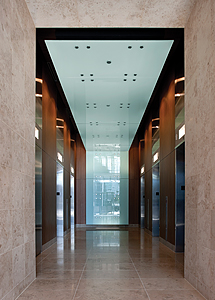
The material additionally extends into the elevator area to connect it to the lobby.
Roddy went on to explain that everything pertaining to the stonework was extremely precise. “The stone tile joints align with the glazing joints at the front door,” he said. “Everything was very well thought out.
“What it required from the design team was making sure we coordinated with all aspects of the job,” he continued. “Obviously, the stone is laid out in tiles, and we can control that. Then you have a different trade putting up adjacent bamboo [paneling for the ceiling and walls], and they don’t care what the mason is doing. We spent a lot of time documenting our drawings and making sure all of the subcontractors lined up the joints. Everything played off the dimensioning of the materials. It was a challenge for the subcontractors. The lobby was one of the last things to get done in the building. The general contractor got it, and became the biggest advocate for ‘alignment.’”
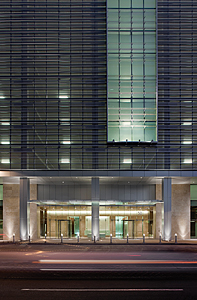
Thicker pieces of Jura Marble - in a different texture to avoid slippage - extend beyond the lobby glass to the exterior as pavers for the entrance.
“The client is very happy, very proud of the project, and we are as well,” said Roddy. “The building is completely leased, so from a market standpoint, it’s an indication that people like the building.”
Moreover, the Freeport-McMoRan Center, formally known as One Central Park East, received an American Institute of Architects (AIA) Western Mountain Region Design Citation award in the un-built category for “its simple planning and rigorous articulation of facades in response to the desert environment.”
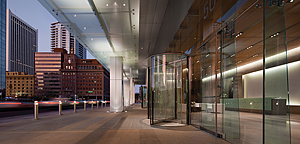
“This provides a seamless visual connection of the lobby to the street,” said Roddy of the exterior stone pavers. “The lobby experience starts before you even enter the building.”
Sidebar: Freeport-McMoRan Center
Phoenix, AZArchitect: SmithGroup, Phoenix, AZ
Stone Supplier: Franken-Schotter, Munich, Germany
Stone Installer: Sun Valley Masonry, Phoenix, AZ
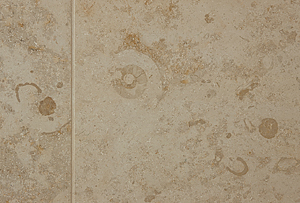
The decision to use Jura Marble came in part due to the stone’s organic feel. “The particular [stone] from that region [of Germany] has a lot of fossils, something we were really taken by,” said Roddy. “The fossils were a key design element that led to the selection of this specific stone.”
Additional Photo
Looking for a reprint of this article?
From high-res PDFs to custom plaques, order your copy today!