Stone World logo
search
cart
facebook twitter linkedin youtube
  • Sign In
  • Create Account
  • Sign Out
  • My Account
Stone World logo
  • NEWS
  • PRODUCTS
    • Machinery
    • Digital Technology
    • Tooling & Accessories
  • MATERIALS
    • Alternative Surfaces
    • Stone
    • Tile
    • Imports & Exports Data
  • FABRICATORS
    • Fabricator How-to
    • Fabricator Case Studies
    • Fabricator of the Year
  • A&D
    • Installation & Technical Tips
    • Outdoor Design
    • Interior Design
    • Hospitality | Commercial Design
    • Mosaics & Decorative Tile
    • Kitchen & Bath
    • Residential
    • Renovation | Restoration
  • MEDIA
    • Videos
    • Podcasts
    • EBOOK
  • EVENTS
    • STONE INDUSTRY EDUCATION
    • Industry Calendar
  • MORE
    • NEWSLETTERS
    • WOMEN SPOTLIGHT
    • MARKET RESEARCH
    • STONE WORLD STORE
  • DIRECTORY
    • TRADE ASSOCIATIONS
    • Stone Suppliers
    • GET LISTED
  • EMAG
    • eMagazines
    • Archives
    • Contact
    • Advertise
  • SIGN UP!

Producing a wide range of Jura limestone
By Michael Reis
September 2, 2009
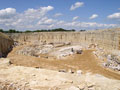
Vereinigte Marmorwerke (V.M.) Kaldorf GmbH has five quarries for Jura limestone in the heart of Germany’s stoneworking region, three of which are currently active.


Based in the center of Germany’s Jura limestone region, Vereinigte Marmorwerke (V.M.) Kaldorf GmbH was founded in 1971 as a supplier of local stone materials. Today, the company - whose name means “United Stoneworks” in English - operates multiple quarries and stoneworking facilities, and it supplies Jura limestone to markets around the world.

V.M. Kaldorf is located in the village of Kaldorf - part of the city of Titting - an area plentiful in Jura limestone resources. The company has a total of five quarry sites in the region, three of which are active. V.M. Kaldorf has a total of 130 employees, including 17 in the quarries and 14 in the sales/administration office. The remainder of the company’s employees work in production.
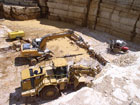
The Jura limestone quarries in the region have multiple layers, and they contain a number of different stone varieties.

Quarrying operations

The Jura limestone quarries in the region have multiple layers, and they contain a number of different stone varieties. Typically, the type of material that is yielded depends on which layer is being worked. Layers 1 through 7 yield gray-blue varieties; layers 8 through 16 are light beige and well-suited for products such as tiles and stairways; and layers 17 through 25 are dark beige and well-suited for elements such as facades and monuments.
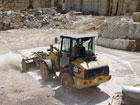
When extracting material, the top of the layer to be quarried is first brushed using a specially equipped Caterpillar 907 rig.

Approximately 60 to 70% of the material extracted is beige, and layers 10/11 (light beige) are the most requested material. Fortunately for V.M. Kaldorf, the company reports very good conditions for the blocks being extracted from these levels.

The breakdown of materials among the different layers is similar from quarry to quarry, explained Lorenz Branner, who directs quarry operations at V.M. Kaldorf. Of the three quarries currently in operation by V.M. Kaldorf, the company is working different levels in each quarry. Working multiple levels ensures that V.M. Kaldorf will have steady production and inventory of all materials. Blocks have a typical size of 1.3 x 2.5 x 1.5 meters, but the company is able to produce blocks as large as 3 meters in size. The thickness of the block is based on the natural characteristics of the quarry, and this can change depending on the layer. Block production is carefully organized according to the quarry layer, and the blocks are never mixed. Armed with cans of spray paint, Branner and others quickly identify blocks as they are produced.
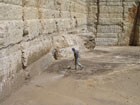
After brushing, the surface is then power washed. This allows the quarry workers to see the natural pattern of the material so they can drill to their best advantage. It is also a quality-control step to see the exact color of the layer.
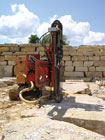
The quarries utilize five Caterpillar wheel loaders, four drilling machines and five trucks, among other equipment. “We have really invested a lot of money in our quarrying machinery,” Branner said. “If you are strong within the quarries, it makes the rest of the business much easier.” Some of the newest drilling rigs in use at the quarries are only one year old.

V.M. Kaldorf has made a range of financial investments in its quarrying equipment, including new drilling rigs.

When extracting material, the top of the layer to be quarried is first brushed using a specially equipped Caterpillar 907 rig, and then the surface is power washed. This allows the quarry workers to see the natural pattern of the material so they can drill to their best advantage. It is also a quality-control step to see the exact color of the layer.

As quarrying within a quarry site progresses, experience is an important factor in determining where to move. “You develop a sense of where you need to go,” Branner said. “It is always important to study the quarry walls and determine where to go. We prefer a wider quarry, where there is room to operate.”
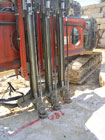
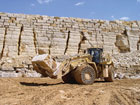
V.M. Kaldorf excavates approximately 20,000 cubic meters of material per year, and it only digs out what is needed for construction. In all, the company covers approximately 6,000 to 7,000 square meters of quarry area per year, and after quarrying operations are completed, the land is “reclaimed.” The quarry site is filled with waste and clay, followed by soil to encourage plant life to grow.

Large-scale loaders from Catepillar are used to move blocks around the quarry.

Production

V.M. Kaldorf has several stoneworking facilities in place, and all are located near the quarry sites.

Blocks are processed on a variety of sawing equipment, depending on the finished product. These include gangsaws and a Bidesimpianti diamond wire saw for slab production. The slabs are then processed on slab polishing lines from Simec of Italy.
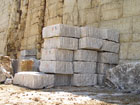
Block production is carefully organized according to the quarry layer, and they are labeled at the site.

For tile production, blocks are first cut on a large-diameter circular saw, and then the smaller blocks are processed on a German-made blockcutter, which produces strips to deliver to the tile line. A modern tile line from Simec is in place in the factory, and it includes robotic elements for material loading and unloading.

In the cut-to-size area, equipment includes bridge saws from Löffler of Germany and an automated edging machine, as well as a range of hand tools.

Of the three quarries currently in operation by V.M. Kaldorf, the company is working different levels in each quarry.

A variety of surface finishes are available for slabs, tiles and architectural/monumental work, including polished, bushhammered, brushed, sandblasted, slightly sandblasted, “tooth chiseled” and combinations of the various textures.

Water treatment is a priority in V.M. Kaldorf’s production, and the company has a system in place to separate the slurry from the wastewater. The slurry is then carted away, while the water is reused in the factories.

Blocks are processed on a variety of sawing equipment, depending on the finished product. Gangsaws are used for slab production.

Memorials and landscaping products are processed at the masonry department. Stone is cut to size as needed using Weha saws, although the key stoneworking elements within this department are the workers themselves. All of the bushhammering, lettering and detailing are done by hand by artisans who have honed their stoneworking craft over the years.

In all areas of production, quality-control is a key element of the process, and materials are carefully inspected before being packaged for shipment.
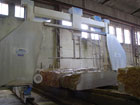
V.M. Kaldorf also operates a Bidesimpianti diamond wire saw from Italy.

Most of V.M. Kaldorf’s employees have been on staff for several years, although the company is also attracting some younger employees from the region.

Approximately 50% of the stone sold by V.M. Kaldorf is tile and slab production; 40% is cut-to-size work such as interior and exterior facades, custom-produced tiles and countertops; and 10% is blocks and landscape materials.
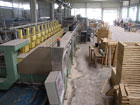
Raw slabs are processed on slab polishing lines from Simec of Italy.

Sales and marketing

A total of 70% of V.M. Kaldorf’s production is sold within Germany, and 30% is exported. Hungary is a key export market for the company, and China is strong for block sales. In the U.S., the company sells through representatives such as TriStone & Tile, Inc. of Nuys, CA, and Facings of America in Phoenix, AZ.
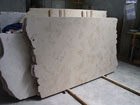
Full-sized slabs of Jura limestone are available in all material varieties.

In the area of high-profile projects, V.M. Kaldorf has been associated with a range of prominent architectural works. These include the Copenhagen Opera House in Denmark, a major banking facility in Hungary, the Nuremberg Airport in Germany and several high-end residences. At the time of Stone World’s visit, work was ongoing for the new museum in Liverpool, England, which has a range of custom-cut Jura limestone from V.M. Kaldorf.

According to Hubert Kuenzl, who works in the company’s commercial department, sales have been steadily improving over the course of 2009.
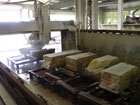
For tile production, blocks are first cut on a large-diameter circular saw, and then the smaller blocks are processed on a German-made blockcutter, which produces strips to deliver to the tile line.

Additional Photos
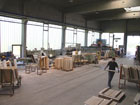


A modern tile line from Simec is in place in the factory, and it includes robotic elements for material loading and unloading.
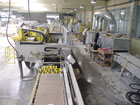


In the cut-to-size facility, equipment includes bridge saws from Löffler of Germany as well as a range of hand tools.
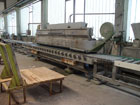


A Comandulli Edilux automated edger is also in place in the cut-to-size facility.
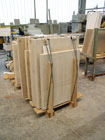


In all areas of production, quality-control is a key element of the process, and materials are carefully inspected before being packaged for shipment.
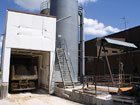


Water treatment is a priority in V.M. Kaldorf’s production, and the company has a system in place to separate the slurry from the wastewater. The slurry is then carted away, while the water is reused in the factories.
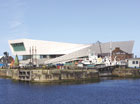


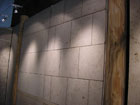
At the time of Stone World’s visit, work was ongoing for the new museum in Liverpool, England, which has a range of custom-cut Jura limestone from V.M. Kaldorf. The museum is expected to open in 2010.

photos courtesy of National Museums Liverpool


photos courtesy of National Museums Liverpool


A variety of surface finishes are available for all products, including polished, bushhammered, brushed, sandblasted, slightly sandblasted, “tooth chiseled” and combinations of the various textures.


Share This Story

Looking for a reprint of this article?
From high-res PDFs to custom plaques, order your copy today!


Recommended Content

JOIN TODAY
to unlock your recommendations.

Already have an account? Sign In

  • customer doing research online

    3 Reasons Why Quick Response Time Results in a Successful Fabrication Shop

    Your fabrication shop can have the best website. The best...
    Fabricator How-to
    By: Anthony Milia
  • Silica

    Renewed National Attention Ignites Over Silicosis Epidemic

    A major investigative report published on March 12, 2026...
    Industry Insights
    By: Jason Kamery
  • shipping containers

    U.S. Countertop Material Imports: February 2026

    U.S. countertop material imports collapsed in February...
    Stone
    By: Jason Kamery
Manage My Account
  • eMagazine
  • Newsletters
  • Online Registration
  • Manage My Preferences
  • Subscription Customer Service

More Videos

Popular Stories

artificial intelligence

5 Amazing AI Tools and Ideas That Every Stone Countertop Shop Can Implement

shipping containers

U.S. Countertop Material Imports: February 2026

Save Quartz Jobs Coalition Logo

ITC Moves Towards New Quartz Import Tariffs

Fabricator Focus

From profiles to roundtable discussions, Q&As to best business practices, we're turning a focus on topics and challenges impacting fabricators.

AI Talk Is Everywhere -- Where Does a Countertop Fabricator Begin?

Fabricators Discuss Pros and Cons of Chip Repair

How to Grow a Countertop Fabrication Shop

Events

June 25, 2026

North Carolina Stone Summit

You’ve probably heard a lot lately about how to calculate the profit for each job you produce. You likely have production benchmarks based on square footage since it’s the most common production metric in the industry. Come learn how focusing on these metrics can hurt your profitability and what to do about it.

July 16, 2026

Washington Stone Summit

Join us for "Taking Your Organization to the Next Level," a session dedicated to transforming your business practices. Discover strategies for setting clear agendas, encouraging participation, and driving actionable outcomes. Learn how to foster collaboration and communication, ensuring that every meeting enhances productivity and contributes to your business goals.

View All Submit An Event

Poll

Tariffs and Quartz Imports

If high tariffs are placed on U.S. quartz imports, how will this affect your business?
View Results Poll Archive

Products

Restoration & Maintenance Technical Module

Restoration & Maintenance Technical Module

See More Products
	
3 Reasons Why Quick Response Time Results in a Successful Fabrication Shop

Related Articles

  • New Liverpool landmark is defined by Jura limestone

    See More
  • Jura limestone supplier invests in the future

    See More
  • Quarrying and fabricating a broad range of Brazilian stone

    See More
×

Our Newsletters are a rock solid source of industry insights!

Stay in the know on the international stone and tile industry trends.

JOIN TODAY!
  • RESOURCES
    • Advertise
    • Contact Us
    • Directories
    • Store
    • Want More
  • SIGN UP TODAY
    • Create Account
    • eMagazine
    • Newsletter
    • Customer Service
    • Manage Preferences
  • SERVICES
    • Marketing Services
    • Reprints
    • Market Research
    • List Rental
    • Survey/Respondent Access
  • STAY CONNECTED
    • LinkedIn
    • Facebook
    • YouTube
    • X (Twitter)
  • PRIVACY
    • PRIVACY POLICY
    • TERMS & CONDITIONS
    • DO NOT SELL MY PERSONAL INFORMATION
    • PRIVACY REQUEST
    • ACCESSIBILITY

Copyright ©2026. All Rights Reserved BNP Media, Inc. and BNP Media II, LLC.

Design, CMS, Hosting & Web Development :: ePublishing