Considerations for purchasing a new bridge saw
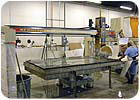
Since the saw is usually the “gateway machine†in most fabrication shops, it is important to consider features that will help with ease of operation and increasing efficiency.
So you're ready to buy a saw. Before getting started, there are a few fundamental questions you should ask yourself. First, identify the needs of your business. Is most of your business custom fabrication or commercial fabrication? Do you deal with dimensional stone, slabs, panels or all of the above? Second, assess your current production volume as well as your future production goals. There is no reason to purchase a saw today if it cannot meet the demands of tomorrow. Third is a budget consideration. There are many purchase options available to you. Whether you choose to bank finance, lease or pay cash, all have their own benefits, and each should be researched to determine which suits the needs of your business best.
Once you have answered these questions, there are some key features to consider when selecting a saw:
1. Features. Most saws come with a wide variety of available features, some standard and some optional. Since the saw is usually the “gateway machine†in most fabrication shops, it is important to consider features that will help with ease of operation and increasing efficiency. Features like remotes, laser guides and digital readouts are all valuable tools designed to assist the operator in performing fast accurate cuts. How the machine moves from cut to cut is another important detail. A typical gantry saw has three axes, and some form of direct-drive, variable-speed system should power each. If not, it may result in increased downtime if the operator has to manually move one or more of the axes between cuts. Some saws go a step further and offer automated programmable cutting. This feature allows the operator to create a program by inputting data into the saw's computer, based on the existing job. Though helpful for large commercial jobs such as hotels, it may not be beneficial to custom fabricators - who might find the programming too cumbersome. As you begin identifying which features are important to your operation, it should help narrow down the list of saws to consider. Always keep your bottom line in mind when deciphering between standard and optional features.
2. Gantry bridges. There are two types of gantry systems currently available. The first is the block wall gantry, which consists of two cement walls that the customer has to erect based on specifications provided by the manufacturer. The other is a freestanding steel gantry that is built and provided by the saw manufacturer. There are a few things to consider when making your selection. Do you plan to move your business at any time? If the answer is “yes,†you may want to opt for the freestanding gantries that can be moved and reinstalled with very little effort. Fabricators should also consider whether they have the time and the means to build block walls. Some manufacturers offer the freestanding gantries as options, as opposed to standard equipment. However, once installed, both systems are certainly appropriate for the job.
3. Table. Selecting a saw with the right table will help the operator get from cut to cut quicker and easier. A good table should have a couple of different stop features. First, the table should lock at commonly used stop angles, thus allowing the operator to go between angles quickly, usually in 45-degree increments. Second, it should also lock anywhere in the 360-degree rotation. This feature makes it easy for the operator to line up any out-of-square templates. Another thing to consider is whether you want a tilting table or not. A hydraulic tilting table is a great way to go for loading slabs onto the cutting surface. It can save time, and when used properly, it can reduce the risk of injury as well as reducing the risk of fracturing fragile stones during loading. Although this feature may cost you, it's one that will pay dividends in the end and should be considered.
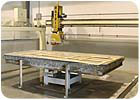
If asked, most manufacturers will provide a detailed footprint of their bridge saws. This footprint should also contain information regarding how close the machine can be placed to walls and other freestanding obstructions.
5. Power. When reviewing horsepower specifications on any machine, you will want to be somewhere between 10 and 20 horsepower. This will ensure fast, accurate, vibration-free cutting of all 2-cm and 3-cm slabs without working the motor beyond its capabilities. In addition, check with the manufacturer to make sure the motor is designed specifically for stone-cutting applications and not a general duty motor. Stone-cutting motors typically have higher lower-end torque and last much longer than general duty motors.
6. Size and stroke. Depending on your shop, you may have a limited amount of space to dedicate to a saw. If asked, most manufacturers will provide a detailed footprint of the machine. This footprint should also contain information regarding how close the machine can be placed to walls and other freestanding obstructions. It is important to select a machine that will fit without sacrificing quality and construction. A true gantry saw should have enough stroke to reach every inch of a full-sized slab without having to move the stone. Some saws achieve this by having to rotate the table 180 degrees. Others can execute this by rotating the saw head itself. Remember, the more things you have to move, the less time the blade is in the stone.
7. Service and parts availability. At some point in time during your ownership, you will be contacting the manufacturer for parts and or service, and it is important to find out beforehand how you will deal with this eventuality. If it is a foreign-built machine, do they have service in the U.S.? What type of components do they use? Are they off the shelf and readily available, or are they special-order components? The manufacturer should have a well-stocked inventory of components available to you during regular business hours. As a note, it is always best to regularly clean your machine and keep it maintained as per the manufacturer's recommendations to ensure its optimum performance and life.
One last thing, make sure you have a clear understanding of what is included in the price of the machine. Each manufacturer is different, and pricing may not include items such as shipping, installation or training. If overlooked, these expenses can add up to quite a large chunk of change.
Looking for a reprint of this article?
From high-res PDFs to custom plaques, order your copy today!