The Latium region: A showcase of Italian stoneworking
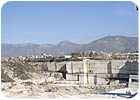
Surrounding the city of Rome, Italy, is the vital stoneworking region of Latium. Tivoli, which is a providence within Latium, is known for its travertine quarries. Many have existed since Roman times.
Text and photos by Jennifer Adams
Italy is a country rich in culture and magnificent stone architecture. And where better to observe both ancient and modern buildings than in Rome - the nation's capital. From the ruins of the “ancient city†to more recent contemporary designs, the use of natural stone is prominent throughout the city. But even more interesting than the stone structures and applications within Rome is the surrounding region of Latium, where the majority of the city's building material was quarried.
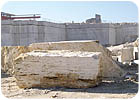
While Roman travertine has been used in building for centuries throughout Rome, many quarries are now targeting the U.S. market. The varying shades of beige and Old World texture of the stone meet the demands of American consumers.
The region is broken down into several provinces, and Rome remains its primary commercial, service and industrial center. With quarries scattered throughout Latium, each province specializes in its own variety of stone.

The providence of Viterbo was the site of volcanic activity years ago. As a result, many of the quarries in this area were formed by lava flow, such as this basalt quarry.
Tivoli
In Tivoli, travertine has been quarried for centuries. In fact, many quarrying sites in operation today date back to the days of the Romans. Several quarries visited by Stone World showed evidence of chiseling, which was the method the Romans used to remove travertine blocks. They would then place the blocks on a boat and ship them down a nearby river to Rome.The use of travertine in Rome is seen in many of the city's historic structures. This includes the exterior of the Colosseum as well as the ancient ruins and many historic churches. Additionally, the material was employed as paving throughout the city.
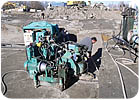
Peperino is another volcanic stone that is quarried in Viterbo. The name of the material, which is speckled-gray in color, actually refers to “salt and pepper.†Blocks are extracted in the quarry with large chainsaws.
Many stone quarriers and fabricators in Tivoli are also targeting the international market. In particular, several companies that Stone World had the opportunity to visit were focusing their efforts on the U.S. They believe the neutral and consistent tones in travertine - especially the premium Roman Classic product - meets the tastes of U.S. consumers.
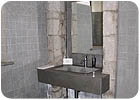
Because the lava flow came very quickly, the basalt did not have any time to take in air. For this reason, the stone is very strong and compact. It is an extremely durable material that is ideal for both interior and exterior applications.
Viterbo
Another providence known for its stone quarries within the Latium region is Viterbo. This area is also famous for being the site of the Roman baths centuries ago. Today, Viterbo is still a popular destination for those wishing to pamper themselves, as it is home to many exclusive spas. The scent of sulphur can actually be smelled in the air.This providence was also the location of volcanic activity years ago. As a result, many of the quarries in this area were formed by lava flow. Among the stone varieties found in Viterbo are basalt, Peperino and Tufa Stone.
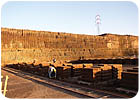
Tufa Stone quarries are also located in Viterbo. This material was formed due to sedimentation and lava action in the quarry. While Tufa Stone is slightly softer than other basalts, it becomes stronger and more compact at deeper layers of the quarry.
Peperino is another volcanic stone that is quarried in Viterbo. The name of the material, which is speckled-gray in color, actually refers to “salt and pepper.†Several varieties of the stone are available.

The providence of Frosinone is home to a very unique stone called Perlato Coreno - a material noted for its distinctive characteristics, including fossils of fish, shells, algae and sea plants on its surface.

In ancient times, the Romans built extensively with travertine. One of the most significant pieces of architecture within Rome's “ancient city†is the Colosseum, which was built with travertine.

Another magnificent site in Rome are the ruins, with massive travertine columns that still stand today.
Tufa Stone has remained popular for building and landscape designs throughout the decades. Additionally, skilled artisans handcraft the material into detailed ornamental work.
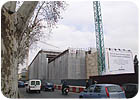
Today, travertine is being applied for modern applications in Rome, such as the Ara Pacis Museum, which was designed by the renowned U.S. architect Richard Meier.
Frosinone
The providence of Frosinone is home to a very unique stone called Perlato Coreno - a material noted for its distinctive characteristics, including fossils of fish, shells, algae and sea plants on its surface. And although the stone has existed for centuries, it is only in the last 50 years or so that commercial quarrying began.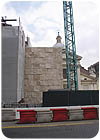
The Ara Pacis Museum, which sits along the Tiber River on the western edge of the Piazza Augusto Imperatore, was scheduled to open in April 2006.
In 1991, a group of local entrepreneurs and municipalities in the Perlato region joined together to form “Consorzio per la valorizzazione del Perlato Coreno.†The Consortium, as it is called, has grown to include more than 100 firms with about 1,300 employees. It works together on issues related to the quarrying and processing of Perlato Stone. With a unified front, the Consortium believes that it can present itself as a strong force to the international market.
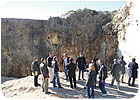
A group of North American architects were invited by the Italian Trade Commission to tour the Latium stone region of Italy to earn Continuing Education Credits. In Coreno Ausonio, the architects visited several quarries that produce Coreno Perlato Stone.
Sidebar: Touring the Latium Region of Italy
Several months ago, a select group of North American architects was invited to participate in a tour of the Latium stone region of Italy. The tour was sponsored by the Italian Trade Commission, and offered architects the opportunity to earn Continuing Education Credits from the American Institute of Architects, upon completing the course. Stone World was also invited to join the group and learn more about the many companies that quarry and process the stones of this region.Leading the architects on this incredible adventure was Vincent Marazita of Marazita & Associates of Canoga Park, CA. Marazita, who works closely with the Italian Trade Commission on many educational programs, was a source of knowledge for the participants as they visited the various stone-processing plants and quarries.
The tour began in Viterbo, where materials such as basalt, Peperino and Tufa Stone are quarried and processed. The group next moved on to Tivoli, where the architects viewed some of the largest travertine quarries in Italy. And before landing at its final destination in Rome, the group visited some of the quarries and fabrication facilities in Frosinone, which is home to the unique stone, Perlato Coreno.
At each stop, the architects learned about stone characteristics, quarrying and fabricating techniques, various finishes and stoneworking machinery. They were also educated on how to write efficient specifications for stone and how to work directly with stone producers to get the material they desire.

At Tufitalia in Viterbo, architect John Klockeman, AIA, of Opus Corp. in Minnetonka, MN, was given the opportunity to chisel Tufa Stone as the company's craftsmen do.
“I was very impressed with the state-of-the-art technology I have seen,†said Diana Brenner, AIA, of Brenner Design in Indianapolis, IN. “It reflects the investments the companies are willing to make. I am looking forward to taking home what I have learned and use it.â€
Mark Graham, AIA, of WLC Architects Inc. expressed similar sentiments. “It was a great learning experience for me - not only learning about the stones out there, but how to specify these stones,†he said. “I will definitely take this back with me and share this information.â€
The tour concluded with two days in Rome, where the architects observed how the raw materials they learned about were applied to architectural applications - both in years past and the present. The group received a guided tour of the “ancient city,†including the Ruins and the Roman Colosseum as well as a visit to the modern-day Auditorium Parco della Musica.
Looking for a reprint of this article?
From high-res PDFs to custom plaques, order your copy today!