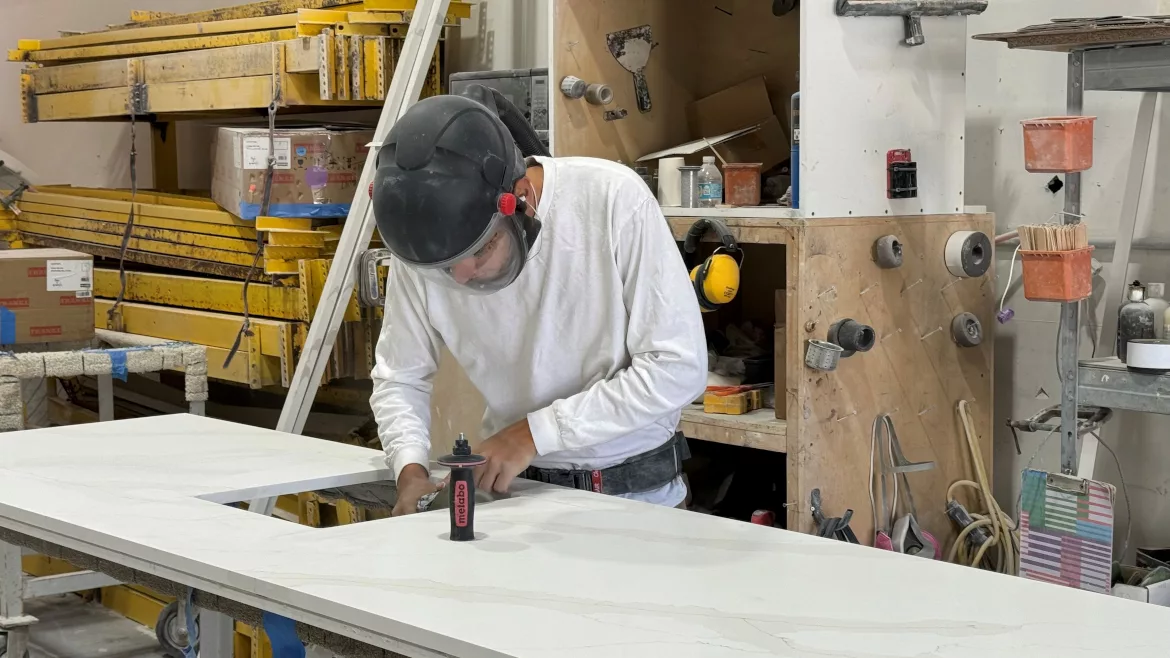
Profiling the perfect edge: Tips to help eliminate touch-up work

There are a number of factors that could be impacting the quality of your edge. But there are also several signs and checks that should be made periodically that could increase overall quality.
Whether your customer has requested a flat edge or a triple waterfall, your goal as a fabricator is to produce the ultimate, superior edge - the grand-of-all-grand edges - without breaking the bank by incurring extra labor costs in touch-ups. Below are some tips that will help you profile the grand-of-all-grand edges. The extra manpower you may be investing on touch-ups will be eliminated or drastically reduced.
Accurate sawing is critical
You have probably heard this a million times, but your bridge saw is literally the backbone of your operation. It is very important that your edge is accurate and straight. It is very hard and labor intensive to get a perfect edge if you begin with a waving, uneven edge.Follow the recommended speeds
Secondly, it is very important that you run your machine at the manufacturer's recommended speed. This is HUGE when it comes to profiling. People tend to push their machines harder, because that one job needs to get done by Friday, and they are getting crunched for time. By pushing your machine with higher RPMs, feed rates and PSI, you are only causing more problems that will need to be fixed later in the fabrication process, such as touching up the edges because they are rippled.RPMs, feed rate and PSI all need to be run at the equipment manufacturer's rate. A machine that is run slower than recommended will glaze up, and the diamond tools will not properly cut the stone. If the rates are dialed up too fast, too much heat is generated. The results? You have diminished your tool life substantially, and not only that, you may “burn†the stone. What do we mean by “burning†the stone? If the tool is running too fast, the granite begins to heat and becomes so tight that particulates of the stone will actually begin to pop out of the surface, leaving a large void, which can cause other problems that will cost you manpower and hurt your pocketbook. Also, if your feed rate is too slow, your tooling diamonds will become smooth, and they will not cut properly. The sharp diamond points become rounded and won't remove the material. The diamonds will actually spin on the material, creating a lot of friction and heat. Again, you may “burn†your stone.
Using the right tooling
Another tip: Don't cut corners on tooling. Your machine will only profile the best edge based upon the tooling. Do you have the right tool for the job? Whether you're working with granite, marble or engineered stone, it is important that you have the proper tooling for each material. Each material has a different composition and requires different tooling. Don't try to fabricate engineered stone with the same tooling you use for granite; you'll be disappointed in the results, and so will your customers. Don't take the chance. Invest in a set of tooling for each material “family.†It will be well worth the investment.It's important that you monitor your tooling for wear. There really is no magical, secret way to do this. Just be in tune to the signs of wearing. For example, the tool probably needs to be replaced if it has a shiny appearance and reflects light. This generally means that the tool has been “baked†or glazed. Also, a dead giveaway that your tool needs to be replaced is if the diamonds are physically gone, and the rubber center core remains. Have a new tool or “good†tool on hand to compare if you are having a hard time determining if your tool is worn and needs to be replaced. You'll be able to visibly see the difference in a new tool versus a worn tool.
Maintenance and replacement
Also, it is important to conduct regular check-ups on your machine. Equipment in good mechanical condition will not have “play†when the machine is operating. Worn machine components will comprise the stability or movement of the machine, which will cause problems with your edges. Give your machine a tune-up or check up as frequently as you can. It will save you headaches in the long run.So, you determined that your tool was worn and you decided to replace it with a new tool. Make sure that you “break-in†your tool before you start profiling the edge on your customers' Labrador Antique. Run your new tools through some remnant stone. It's like buying a new car; you don't want to drive it off the lot going 100 mph.
Ensure clean water
Another tip is that it is important to have good, clean water in your fabrication shop, especially for profiling. The micron levels should be at 5 or less. Please refer to your maintenance manual for micron recommendations, because they may vary depending upon your equipment. Recommended micron levels will be different for a radial arm polisher versus a CNC. High levels of microns will result in a hazy, low-gloss edge. Why? Tiny pieces of granite or diamonds are being picked back up and are running through your machine, thus contaminating the grit on your tools. Diamonds from coarser tools become lodged in finer tools, resulting in scratches on your profiled edge.In short, there are number of factors that could be impacting the quality of your edge. But by following the above examples, we hope that you have gained some insight to the signs and checks that should be made periodically.
Looking for a reprint of this article?
From high-res PDFs to custom plaques, order your copy today!