Exterior stone paver applications

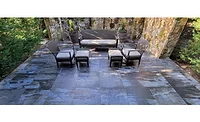
Exterior stone paving is unmatched in performance and appearance. Nothing makes a bolder statement and speaks class like a well-installed stone paving application. In order for the installation to be successful, good detailing, design and construction practices should be followed. This type of application requires the experience of tradesmen that are familiar with the nuances of these demanding installations.
Which mortars should be used?
It is always best to start out with high-performance installation products that are designed for stone paving applications. High-strength, liquid latex fortified, slurry bond coats, thick-bed mortars, thin-bed mortars and grouts are the choice for these installations. Ordinary “everyday†thinset will not cut it here. Many of these applications may be exposed to both pedestrian and vehicular traffic. The products must be shock and weather resistant. Consult your stone installation materials manufacturer to determine which products and systems can be used. Both latex Portland cement-based thin-bed and thick-bed methods can be utilized. If the stones are ungauged or sloping is required, the thick-bed method can be used. If the stones are evenly gauged and the substrate is at the right plane, the thin-bed method may be the correct option. The project specifications should also point out the fact that complete mortar compaction (for thick-bed applications) and coverage is necessary to ensure long-term performance. Back-buttering stones and proper beat-in will ensure the desired bedding and coverage. Stones can be periodically removed during the installation to confirm the desired coverage.What type of stone should be used?
The type of use and traffic that the paver area will experience will affect the type, thickness and finish of the stone used for these applications. Usually granite, Bluestone or other durable dense stones are the best choice for both pedestrian and vehicular traffic. In addition, usually a flamed or thermal finish provides the best results in the area of slip resistance and wear. The stone manufacturer can provide the best information on the potential use of its products.Impact of environmental issues during the installation
Many times, the installation is made during extreme climatic fluctuations. An installer may have to deal with cold windy days one week, and then deal with the heat and humidity another week. These climatic conditions will affect the way the mortars react during the installation. It is important to work within the prescribed temperature recommendations of the products being used. In addition, other precautions should be considered.For instance, cold weather installations may require tenting and temporary heat. Shielding an installation area from the wind is also a good idea. Windy conditions can cause the mortar to “dry out†prematurely, and will result in a drop off in strength of the mortars. If you couple that with high temperatures, even more challenges may result. This is why it is critical to shade the work areas or work during cooler periods of the day if high temperatures are in the forecast. These are just a few examples of climactic conditions that a seasoned installer will be able to tackle.
Cure periods
Cure periods of the installation/application will also require forethought. Typically, an installation that is only subjected to pedestrian traffic can be opened up to use in 24 hours after the final grouting period at 70 degrees Fahrenheit (21 degrees Celsius).On the other hand, an installation that will be subjected to vehicular traffic may need between 14 to 28 days to reach the strength required at 70 degrees Fahrenheit (21 degrees Celsius).
It is important to note that colder temperatures will require extended cure times. A good rule of thumb to follow is that for every 18 degrees Fahrenheit (10 degrees Celsius) below 70 degrees Fahrenheit (21 degrees Celsius), the installation should cure for twice as long in order to reach the desired result.
Critical detailing and expansion joints
The project architect and engineer should ensure that all elements of the application are well designed and installed correctly. Some exterior paver applications over occupied spaces will require the use of a suitable primary roofing membrane to be installed prior to the installation of the paver and installation system. This requires that direction be provided to treat issues such as penetrations through the system, tie in at drains and flashing at the base areas - just to mention a few. Consideration can also be given to the use of a drainage mat placed over the primary waterproofing membrane to aid in shedding water from the application.Proper detailing also needs to occur when the stone paving transitions to other areas and when changes occur from one surface finish type or plane to another.
Possibly the most important detail to include when designing and constructing an exterior paver application are the expansion joints. Due to the demanding nature of these projects, exterior installations will require more frequent and wider expansion joint placement.
For example, the North American Tile Council (TCNA) suggests that exterior expansion joints be placed every 8 feet (2.8 meters) to 12 feet (4 meters) in each direction (Detail EJ-171). Typically, joints placed 8 feet (2.8 meters) on center should be no less than 3/8 inch (9 mm) in width, and joints placed 12 feet (4 meters) on center should be placed no less than ½ inch (12 mm) in width.
However, notice that minimum widths should be increased 1/16 inch (1.5 mm) for each 15 degrees Fahrenheit (5 degrees Celsius) stone surface temperature change greater than 100 degrees Fahrenheit (36 degrees Celsius) between summer high and winter low. (Decks exposed to the sky in the Northern U.S. usually require ¾-inch-wide (19 mm) joints on 12 feet [4 meters] centers).
Typically, a dark stone paver can reach temperatures of 140 degrees Fahrenheit (58 degrees Celsius) in the summertime and then experience -10 degrees Fahrenheit (-21 degrees Celsius) in the dead of winter. That calculates to an additional 3/16-inch (4.5 mm) increase in width.
It is important to note that these types of applications will require calculated expansion joints that are determined by the project engineers rather than following industry-provided “guidelines.†Factors that are important to the equation include the coefficient of expansion rate for the concrete substrate, the mortar bed, the stone being used and the temperature extremes that each unique project will experience.
Samplings of these rates per degree Centigrade are as follows:
- Portland cement concrete - Sandstone
- 0.9 to 1.2 x 10⁻⁵
- Granite
- .0000085
- Marble
- .0000110
- Typical latex Portland cement mortars
- .0000065
- Brick
- .0000055
- Steel (drains, curbs, etc.)
- .0000120
When all of these rates are factored, the appropriate amount and width of movement joints can be calculated.
The project architect or engineer should provide direction on the design, placement and construction of all expansion joints. The movement joints should be fully functional and be brought up through the setting bed and stone layer from where they are placed in the substrate. Many times, additional movement joints are required even if they do not occur in the substrate. The setting bed and finish layer should still accommodate any movement that may occur. The sealant chosen for these joints should also be durable, weather-resistant and be able to handle the movement that it is subjected to. Typically, silicones and urethane sealants are best for these applications. Latex or acrylic caulks are only suitable for interior non-wet areas. Most of the sealants produced match the grout or stone colors to blend in with the entire color scheme of the installation.
Generally, latex-fortified Portland cement-based grouts are used for exterior paving projects.
The stone being used for the application should also be carefully chosen. Some types of stones may not be suitable for exterior paving, vehicular traffic or exposure to moisture. Make sure that the stone manufacturer or supplier of the stone recommends their stone for your specific application. When all of these factors are taken into consideration, a beautiful and successful exterior stone paver installation will be achieved.
Looking for a reprint of this article?
From high-res PDFs to custom plaques, order your copy today!