Travertine treatment and maintenance
1. Introduction
Travertine is a sedimentary limestone formed by chemical precipitation of calcium salts in watersheds. It consists essentially of calcite (around 99%), the crystalline, white porous structure of calcium carbonate. It is characterized by its spongy, vacuolar structure, due to the inclusion of organic matter (mostly vegetable) and gas emission (carbon dioxide) during its formation.
Calcite, the main mineral component of travertine, is white. However, due to impurities such as sulphur, ferrous compounds, organic pigments, etc., it is found in a variety of colors: walnut, yellow, red, and so on.
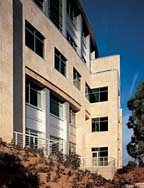
Travertine deposits can be found all over the world, including Iran, the U.S., Mexico and Italy, among other nations. Italian travertine has great historic importance, and because of its closeness to Rome, it was used in many of the city's monuments, including the Coliseum, the Trevi Fountain and the colonnade of Saint Peter's, which all testify to the ancient use of travertine as a construction material. Travertine has also found applications in the present day, as it was used for Lincoln Center in New York, the ABC Entertainment Center in Los Angeles and most recently the new mosque in Rome. It is also being used in residential applications around the world.
Travertine's physical characteristics make it an especially suitable material for use in adverse environmental and climatic conditions. Travertine can thus be used for a wide range of applications, from external wall facings to interior flooring; from urban furnishing to funerary monuments.
Let us look at the main problems associated with some of its many uses. Travertine has a vacuolar structure. That is, it contains actual cavities throughout its structure which accumulate dirt, no matter what the application. It is therefore best to plaster (fill) the travertine, as indeed is the normal practice, to prevent serious problems with cleaning.
Another very important aspect to emphasize is surface finish. Travertine usually has the following types of finish: polished, honed and split-faced. Travertine is also widely used as cobbles with a tumbled or sandblasted finish.
2. Floors
2.1 Initial wash
Do not use acid products. Since travertine is a calcium-based material, it reacts with acids and is dissolved by them. Use only neutral or alkaline detergents, depending on the type of residue to be removed.
In the case of polished travertine, do not use strong alkaline products because they could damage the mirror finish of the material. In this case, we recommend only the use of neutral detergents.
In the case of a rustic finish -- whether it is tumbled or sandblasted material -- and when removing installation residue (i.e. cements), disregard the above cautionary remarks and use an acid descaling agent, because this is the only way to thoroughly clean the surface of these residues.
In this case we strongly recommend the use of buffered acid descaling products, which are free of strong agents such as muriatic acid, at the greatest dilution compatible with the amount of dirt to be removed. Note that the material must be professionally installed. It is important to leave the smallest possible amount of residue so that it can be cleaned without the use of powerful chemicals.
2.2 Protection and care
2.2.1Polished
Just as with marbles and polished limestone, travertine is normally only used for special applications such as bathroom and kitchen flooring. In this case, protection is assured by the use of special water- and oil-repelling products which protect the surface without generally changing its look. After application of these products, a surface residue can crop up. This must be removed after drying, from four to 24 hours after treatment according to the type of solvent used in the protective product. The same type of treatment can be applied when polished travertine is used in non-walkover areas such as: vanity tops, cooktops, thresholds, etc.
Another widely used protective treatment is waxing. In the case of home floors, we recommend the use of traditional polishable wax, which requires polishing with a cloth or polisher after application to give it a shine.
In the case of public installations, and hence with high foot traffic, we recommend the use of self-shining waxes, such as metallized waxes.
Unlike marble, which is normally waxed when its shine starts to show wear, waxing on travertine can be carried out anytime in order to protect its surface. Foot traffic can damage the original shine faster than in the case of marble or granite, which are harder materials.
The material must be maintained with a neutral detergent to avoid damaging the surface, its shine or protective treatment. It can be applied manually, with a bucket, mop or brush and rag, normally in a 3 to 5% dilution, for traditional maintenance over a small surface area. It can alternatively be applied with a scrubber-drier machine for larger areas, in which case the dilution will normally be 1 to 2%.
If stronger solutions (5 to 10%) are required for washing away more tenacious stains, a final rinse is required.
In the case of waxed floors, an alternative is 200 to 300 ml (8 to 10 fluid ounces) of a “wash and wax†product that is poured into the washing solution. If the floor is treated with metallized wax, the normal procedure for these waxes must be followed. This includes the above-mentioned washes as well as dewaxing every one to two years, using a special wax-stripping detergent at the recommended dilution, with a subsequent application of two to three coats of the same wax.
A further maintenance treatment is crystallization, using a special crystallizing product.
This treatment is used in cases in which the mirror finish of the travertine is moderately damaged and the user wishes to avoid waxing or repolishing it. Crystallization attacks the already damaged surface to a greater or lesser degree according to the acid used in the crystallizing agent, followed by a partial repolishing with a wire wool disk added to the weight of the professional polisher. When the damage is significant, however, we recommend repolishing the floor mechanically in the traditional manner.
There is also special maintenance, which falls outside of the normal routine care schedule. Two of these operations have already been mentioned, crystallization and dewaxing. There is also a third procedure: stain removal.
A polished travertine surface can be stained in a variety of ways, especially if not treated. Note that in many instances -- as with marble and polished limestone in general -- these defects will not be penetrating stains, but rather surface opacity, which looks like a stain at first glance. This can happen when an acidic liquid is spilled onto the limestone surface: coffee, wine, ketchup, tea, beer, soft drinks, lemon juice, etc. In general, this covers the majority of food stains.
In such cases, there is an aggressive chemical reaction with the surface; the staining agent dissolves the salt constituting the mirror surface and renders it opaque. Normal protective agents can slow down and hold back this reaction, but they cannot fully prevent it. Only by creating a significant surface layer can the material be protected against stains of this type, but such a protective layer would destroy the natural aspect of the surface, and this is not generally an attractive option. A surface which has been damaged in this way can be partially restored with crystallization or using a polish. Other typical stains are those due to grease or oil, which can be completely removed using a stain remover spray or with poultice.
2.2.2 Honed
The difference between this type and the preceding lies only in the polish of the surface, so that the same types of protective treatments recommended above can be used also in this case. We can also recommend an alternative wax treatment, whereby this type of surface can be treated with two applications of a matte-finish wax, which is then obviously not polished. We can recommend this type of treatment in cases in which the customer -- having chosen a smooth but opaque surface finish -- wishes to keep the finish unchanged. A similar result can be obtained using a water- and oil-repelling product or a combination of water- and oil-repelling products, which normally gives a better result in terms of proofing but does not guarantee dirt repellence, which is what waxes do.
For routine care, the same considerations mentioned previously apply.
As for special maintenance, we must distinguish between the two cases. Crystallization is not an option, and staining is not a problem due to the inherently opaque surface of the material. In this case, we may see stains due to the color of the staining agent, whether it is coffee, the tomatoes in ketchup or red wine. In such cases, a special color stain remover must be used. For oily or greasy stains, stain remover sprays or poultice are both excellent solutions.
2.2.3 Tumbled stone
One of the most widely used materials employed to create tumbled stone is travertine, in all its colors: Roman, walnut, red, yellow, etc. The recommended treatment in this case consists of applying a base coat of a product, such as the usual non-filming solvent-based water and oil proofing or the more recent analogous water-based type of product, to ensure uniform absorption. This must be followed by a couple of applications of one of the vast range of commercial waxes, depending on the intended use and the type of finish desired: from extremely brilliant self-shining metallized waxes to opaque wax.
An alternative to this treatment, which is widely used especially for exterior surfaces, consists in applying two coats of a stone enhancer, which results in the so-called wet effect.This is normally an oil or resin of diverse origin.
Another possibility, which is widely used in exteriors, is the application of two coats of penetrating waterproofing, which proofs the surface against water -- thus preventing damage while also impeding the formation of mold, without altering the aspect of the material. If a more extreme degree of proofing is required, especially against greasy and oily dirt, this treatment can be completed with a finish coat of oil-proofing.
As for maintenance, in this case the problem is rather more complicated. Tumbled travertine has open cavities at the surface, in contrast with polished or honed materials which are filled. These cavities are excellent accumulation points for dirt, and hence, stronger products must be used for cleaning the surface, combined with the mechanical action of the cleaning machine. Furthermore, since tumbled stone is generally used in exteriors, the dirt in question is generally much more tenacious than indoor floor dirt. Cleaning therefore requires the use of alkaline products in combination with a professional cleaner with an abrasive disk (up to green disk) or hard nylon brush. On the other hand, the surface to clean is not particularly delicate, and therefore, it can accept the use of more energetic means than those employed in the case of polished or honed travertine. In extreme cases, a waterjet cleaner may be used, after application of a solution of the alkaline product mentioned above (at a suitable dilution), left to act for a few minutes.
3.Walls
Travertine has had a very wide use as a wall covering. The problems connected to this application are many and various, and they require different solutions according to the intended purpose of the protective treatment.
Travertine walls can have problems with water absorption, with consequent accelerated damage to the surface, also due to acid rain and the presence of aggressive gases in the atmosphere such as sulphur dioxide and carbon dioxide, both of which form acids in combination with the humidity in the air and can seriously damage the surface of the calcareous stone. This problem can be prevented with a waterproofing product, of the penetrating type if possible, which will prevent the absorption of the water that forms the aggressive acids and causes other types of damage. At the present time, effective water-based products are also available to provide this kind of protection as well as the traditional solvent-based products.
3.1 Graffiti protection and cleaning
Another problem of great importance is the graffiti, which degrades the urban landscape. In this case, we can use anti-graffiti products which prevent adhesion of the spray paints used to paint graffiti and hence facilitate subsequent cleaning operations. Two kinds of anti-graffiti products are suitable for use with travertine: sacrificial and permanent.
The sacrificial type, which is more suitable for rough surfaces and provides surface protection, is so-called because it sacrifices itself to protect the wall material. When the graffiti is cleaned off, the protective agent onto which the paint has been sprayed comes away, leaving the wall clean. The permanent type, on the other hand, is more suitable for polished surfaces and penetrates into the material, diminishing the adhesion of the graffiti, which can thus be removed more easily.
Removing graffiti requires the combined use of cleaning products and machinery. Surface-specific products must be used and are generally supplied as gels or viscous fluids to ensure better adhesion to the surface. They must be chosen according to the delicacy and type of the surface. In the case of polished travertine, the least aggressive cleaning product must be used in order to avoid damaging the surface, In the case of rough surfaces, no particular precautions need be taken, as long as acidic products are avoided, and hence it is best to use the strongest product possible in order to remove the paint from the surface cavities.
The procedure is to apply the viscous cleaning agent, allow it to act for a few minutes and then use a waterjet cleaner at 100-120 bar to remove the gel together with the paint, which has been lifted away from the surface by the cleaning agent itself.
Looking for a reprint of this article?
From high-res PDFs to custom plaques, order your copy today!