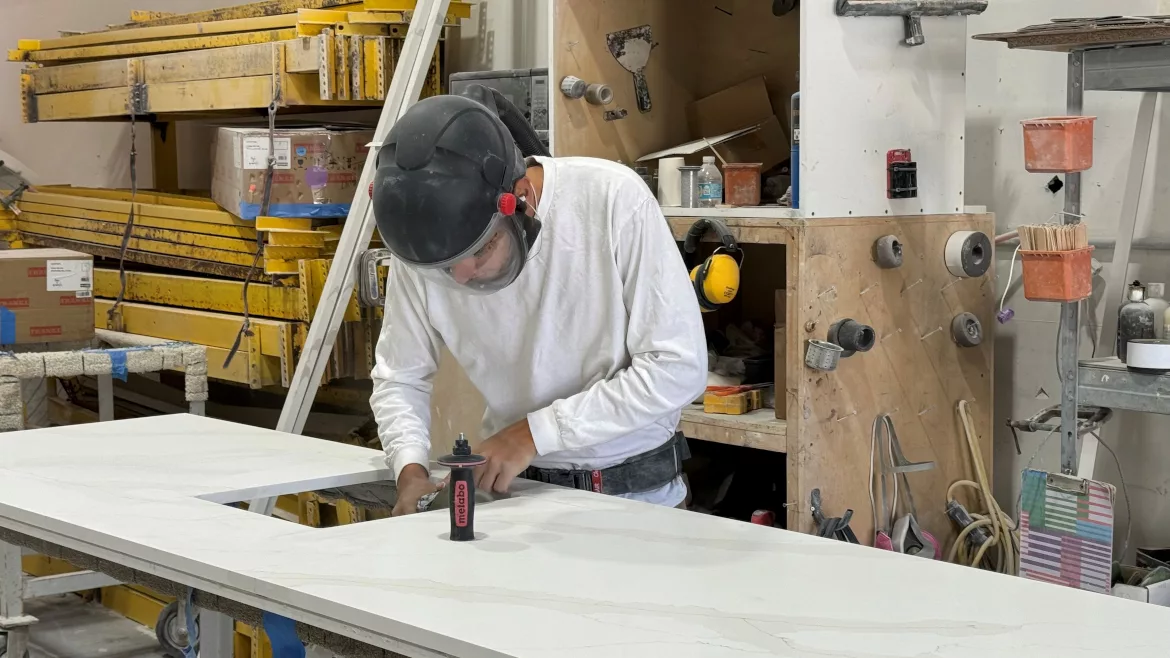
Re-Polishing At The Seams -- Should I Or Should I Not?

Let's look at the reasons why a fabricator might need to contemplate surface polishing, re-grinding or otherwise changing the existing factory polish on a piece of stone. The first and probably most common reason is that a seam is just not looking good (for a variety of reasons) to the customer. Maybe the two pieces of stone that make the seam are bowed, and the seam really shows it. Maybe there's way too much lippage showing at the seam, because the two pieces of stone are not correctly aligned with one another. Or perhaps the installer was just having a bad day.
The procedure known as “surface re-polishing,†“re-grinding†or changing the factory polish on the face of any piece of stone, is an operation that should not be attempted by the beginner or even a novice fabricator. Once you start this process, there is no turning back.
Even more of a concern is whether this will really make the situation more acceptable to your customer, particularly when it comes to seams. Let's take the situation where you've worked really hard to get that seam looking good and smooth with hardly any lippage. The problem is that your customer notices the seam, and the more they dwell on it, the worse the seam gets in their own minds.
I try to deal with this particular scenario through prevention. First, I always make sure that my customer knows that seams are going to be part of the finished product, and that the seams will be noticeable. I tell my customer that we try to make their seams as inconspicuous as possible, but I will always add, “If you look for the seams, you'll always find them.†Next, I'll have a sample of a seam (showing a little more lippage than normal, but in general an acceptable example) of what a finished seam will look like. It is important to make sure that the seams in the finished project are tighter, smoother and less noticeable than the sample that the customer is first shown.
Next, I always make sure that my customer knows in advance the “style†of seam that will be used in their application. By “style,†I am talking about the preferred method of the seam that I like to employ. Start by letting your customer know that a cardinal rule of seaming is “shorter is always better.†Some people naturally assume that their seams will be on a 45-degree angle “just like the laminate countertop that's being replaced.†A 45-degree seam may sound like a good idea, but in reality, you as the installer will be having a harder time controlling the amount of lippage that will be evident -- especially as the seam heads back into the far corner, right where it's most difficult to keep the two pieces of stone in perfect alignment. (Perhaps some have mastered the technique of doing perfect 45-degree seams in their applications, but this is a technique that I'd rather not offer.)
Typically, a seam that winds up in your customer's finished project will be a 90-degree presentation, either complete or as a “lock notch†(also known as a “butterfly seamâ€). In any event, you'll have two pieces of stone that need to be on the same plane and as close together as possible.
Depending on the amount of final lippage that is visible, you'll either elect to leave the seam alone, or, attempt to “smooth out†the seam by first grinding down the offending lippage, and then polishing the two adjoining surfaces to better present a “uniform†surface. One primary way of avoiding the “re-polishing†scenario at the jobsite is to employ seaming tools to control the amount of lippage that's going to occur in a seam. Many fabricators use some kind of seaming tool that pulls the two pieces of stone together and adjusts the heights of the two pieces to bring them into alignment with one another. Nine out of 10 seams that you'll see done using a seaming tool will not require additional treatment, such as re-grinding or re-polishing.
But what if you've done everything possible to keep the seam perfect, but your customer is just not happy with the final product? You know this, because they will ask something along the lines of, “Isn't there something more that you can do to fix this?†At this point in time, you have to decide whether to explain that this is better left “as is,â€or you give in to your customer and say, “OK, maybe we can grind this down and re-polish it.â€
Before you get out the wax crayon and the grinding and polishing tools, you should take some time with your customer and establish their expectations -- prior to starting this “last resort.†First, you need to know if the stone has been resined, and how easy (or difficult) it will be for you to adjust the color of the area that's going to be worked on. Remember, not all slabs are resined the same way. The first thing to look for (to tell if a stone has been resined) is “dribble†on the edges of the slab. If the stone is already in place, and you have to look at a finished product, there are some questions you must ask yourself. Does the face look darker than the finished edges, such as a full bullnose or top bevel? If the resin layer is only a few thousandths of an inch deep, you may risk grinding through the layer of resin, and exposing a deeper layer of un-resined stone that will appear lighter than the surrounding stone. If this happens, how are you going to fix your new problem? Your customer needs to know about this risk that you will be exposing them to if you attempt to alter the factory finish of the stone. If the stone resin issue happens during your re-grinding of the surface, you'll be trading one problem for another.
Another potential risk that you will be looking at (literally) is from the standpoint of reflection. In many cases, the stone's finished surfaces will look like a mirror. When you grind into the surface to adjust for lippage or a surface defect, you'll be changing the way that the stone reflects an image back at you; thus, you'll be creating “distortion.†Once you've ground into the surface of the stone, and then polished it back up to a 3000 grit, the surface reflection will be changed by showing a distorted image wherever you worked. Does your customer know that they will see this after you are finished with the fix? Can they live with this new look, and are the results of the latest “fix†going to be more troubling than the original complaint?
Visual examples that I can show the customer can help them make an informed decision. Remember that most people are visual and have to see things for themselves. It's easy for us in the business to verbally describe what the surface will look like without having pictures handy because we already know what this will look like. Our customers, on the other hand, don't know what it looks like. So it's best to try and have pictures that illustrate this quality, or even better yet, have a sample or application that you can show them first hand.
The bottom line in this whole discussion is this: “Is the visible problem that is being considered for a fix worse than the result of the fix that's being proposed?†Will you just be trading one set of headaches for another? The answer is in your hands and how you handle your customer through the minefield of answering the initial question of surface polishing stone: “Should I or should I not?â€
Looking for a reprint of this article?
From high-res PDFs to custom plaques, order your copy today!