A gothic revival in Chicago
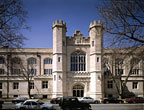
Although it maintained a timeless visual appeal, Bartlett Hall at the University of Chicago had become somewhat outdated in its usefulness to the school over the past 100 years. Last year, the building received new life, as it underwent an extensive renovation and restoration project by Bruner/Cott and Associates of Cambridge, MA.
The building, which makes extensive use of Bedford (Indiana) limestone, was designed by Shepley, Rutan, and Coolidge in 1901 in a Gothic style. Originally conceived as the U.S. Olympic Team men's training facility at the turn of the century, the three-story limestone structure had served as the university's athletics department for nearly a century.
In its new incarnation, Bartlett Hall has been converted for use as a 550-seat dining hall -- with a servery preparing 2,500 meals per day -- and a multi-purpose event space with a 6,000-square-foot student lounge. The project also included a new 2-story receiving facility and service bay, a new major storage facility, new mechanical and HVAC systems and code and accessibility upgrades.
And in addition to renovating and adapting the structure for re-use, Bartlett Hall's limestone facade would have to undergo a conservation process to address 100 years of weathering. Interestingly, the renovation work actually enhanced the conservation efforts, as the masons were able to harvest existing limestone from the areas being renovated.
Limestone restoration
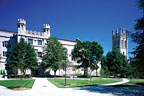
"The entire project is a large gothic cathedral from the outside, and the whole existing limestone facade was in pretty bad disrepair," explained Robert Simmons, AIA, of Bruner/Cott. The stones had spalled due to the steel anchors' oxidizing and expanding. As a result, the masonry team at George Court Construction Services installed new anchors around the areas of spalling. Stainless steel anchors replaced the iron straps, minimizing the need for future repair.The entire stone facade was also cleaned using a two-step chemical cleaning process with ProSoCo products. "Because of the fragile tooling of the surface on the stone, we did not take the cleaning to the point that it would erase all signs of aging and patina," Simmons said. "Even shadows from ivy vinework and carbon were not completely removed, because we didn't want to ruin the surface and patina that gave the building a nice feeling."
In addition to the cleaning, some of the stonework at Bartlett Hall was damaged to the point that it needed more extensive restoration. Part of this work entailed harvesting limestone from elsewhere on the building to replace units that were damaged beyond repair. "We took the salvage stone from the south facade, where we were building the addition, so it was going to be covered up anyway," Simmons said. "We were able to find a place in the stonework where the projection of the stone changed -- a water table course -- and we were able to remove a whole course of stone between the water table and the belt course where we wouldn't have to put any lintels in. The thickness of the wall allowed us to remove the [salvage] veneer below without installing any lintels."
Once the salvage stone was removed south facade, the pieces had to be carefully sorted before they could be re-installed in other areas. "One interesting thing about the building was that the stone had a tooled surface to it," Simmons said. "It was around 9 or 10 teeth to the inch. But it wasn't tooled in all areas. Some of the stones were smooth, and some were tooled to accentuate the gothic rustication. The castellation around all the openings was highlighted by the change in the surface texture. Also, we had to review the differences in weathering. The stone from the south facade got the most sun, and so it had the least weathering as compared to those on the west facade, for example."
Although the salvaged stone proved to be useful during the restoration process, the architects also had to specify new material to replace some damaged units. This material was supplied from the same vein of limestone in Indiana. "We didn't have enough salvaged material to replace all of the damaged units. Also, the building was covered with ivy while we were doing the contract documents, so some of the spalling was missed, and we ended up buying more replacement stone," Simmons said. "It took some color matching to get the right stone for the replacements. The university had pretty good records of what they used campus-wide. A lot of the buildings came from the same quarry, so we had a standard to help narrow the stone to a specific family of materials."
During the restoration process, the architects and the masons made the decision to replace entire stone units, rather than portions of the individual pieces. "Because the stones were so large, we originally had shown that a stone could be repaired by taking a cut out of the damaged stone rather than removing the whole stone," the architect explained. "But in the field, we found that many times it was cheaper to buy a little more stone and simply replace the full stone. The labor involved in cutting and working the stone out from the cut was too much. This also allowed us to put spring-loaded dowels on either side, and the new stone would fit in pretty neatly."
In addition to replacement stone, the restoration effort included the use of Jahn patching mortar in some areas. "We used it in places where we couldn't replace the stone; for large, deep pieces where the cost of replacement was just too big in difference," Simmons said. "There were also quite a few stones that only had the corners chipped off, so we did those kinds of repairs there as well."
Most of the stone at Bartlett Hall is comprised of 4-inch-thick veneer, in random courses that varied in height and length. Typical pieces are 12 inches in height x 30 to 36 inches long, although some of the detailed architectural elements, such as the corners and moldings, are larger in size. Overall, the building has approximately 44,000 square feet of stone.
In addition to restoring the stone itself, the stonemasons also repointed the entire facade. "During the repointing, one of the surprises was instead of going back and repointing 3/4 inch, a lot of the joints were completely washed out. At the large octagonal turrets, there was literally no mortar left on the upper 20 feet, so we had to re-do the joints entirely, and there was an additional cost involved in doing that," Simmons said. "We also had a surprise with one of the parapet walls. It was so bowed out that they rebuilt a section of about 80 feet long. They took the majority of the stone and put it back up with a concrete block backup and seismic reinforcing."
To ensure the longevity of the restoration, the project also specified the installation of new copper downspouts as well as and flashings under the coping stones.
A thoughtful expansion
The re-use strategy for Bartlett Hall required the creation of a two-story, 2,300-square-foot addition, which would house a truck loading dock. This addition was in a prominent setting in relation to the rest of the campus, and it had to be designed to match the historic character of the original structure. The addition was designed using tooled Bedford limestone cladding to match the university palette."For the addition, [the stone selection] was relatively easy," according to the architect. "I think it was helped by the fact that the stonemasons did their homework before we saw the sample. Because it was an addition, we designed it with setbacks so the old stone and the new stone were never co-planar, which helped [mask] any subtle differences. So it was easy to get a good match."
The stonework for the addition was designed to blend into the existing campus architecture, but without necessarily replicating the specifications of the original. "The general impression that you get is that [the addition] looks like it has always been there," Simmons said. "If you look closely at the details, you'll see that the molding and the profiles of the stones are different from the existing building. We mainly just tried to mimic the intent of what the existing building was doing. The sizes are similar, and the detailing was essentially similar. We used an 8-inch block backup wall for the addition, and the biggest challenge was trying to maintain the look for the deep returns for the masonry openings -- windows and doors -- which we were able to accomplish by using l-shaped units at the jambs without a mortar joint."
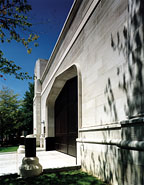
To minimize the impact of activity at the loading dock, the structure is recessed inside its enclosure, so that only part of a trailer will be visible when in use. The heavy wood gothic doors and stone portico create an unobtrusive two-bay entrance.
During construction, the project also underwent a midstream design change in which a new west entrance to Bartlett Hall was created. As part of the original building plan from the turn of the century, all of the main entries to the building had changes of levels within the ground floor lobbies, making handicapped accessibility difficult. At the west entrance, Bruner/Cott relocated the exterior stair outboard of the facade and inserted a curved limestone ramp walkway without disrupting a stand of mature trees.
Now that the work at Bartlett Halls is complete, the building has taken on a position of renewed significance at the University of Chicago. "I think all of the departments of the university were happy with the turnaround," Simmons said. "It potentially saved the building from the wrecking ball because it didn't have an easily defined new use for academic purposes [prior to the renovation]." Bruner/Cott's work on Bartlett Hall has also been acknowledged outside of the university community, as it has already received two awards, including a 2002 Honor Award Citation from the Boston Society of Architects and the 2002 Renovation Project of the Year from Midwest Construction Magazine.
Credit Box
Bartlett Hall University of ChicagoChicago, IL
Original Architect: Shepley, Rutan, and Coolidge
Renovation and Restoration Architect: Bruner/Cott and Associates, Cambridge, MA.
Stone Restoration Contractor: George Court Construction Services, Chicago, IL
Stonemason: Ceisel Masonry (south facade addition and west entry)
Looking for a reprint of this article?
From high-res PDFs to custom plaques, order your copy today!