Marble Landmark Rises in Norway
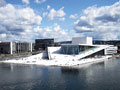
Photo courtesy of the Oslo Opera House
Comprised primarily of Carrara White marble from Italy, the Oslo Opera House is a re-defining element for Norway’s largest city. The design of the facility takes advantage of its site on Oslo’s Bjørvika peninsula. Architect: Snøhetta AS, Oslo, Norway; Stone Quarrier/Fabricator: Campolonghi Italia S.p.A./La Facciata, Italy
Comprised primarily of Carrara White marble from Italy, the Oslo Opera House is a re-defining element for Norway’s largest city. The design of the facility takes advantage of its site on Oslo’s Bjørvika peninsula. Architect: Snøhetta AS, Oslo, Norway; Stone Quarrier/Fabricator: Campolonghi Italia S.p.A./La Facciata, Italy
The design competition for the new Oslo Opera House in Norway - which took place earlier this decade - drew 230 entries from around the world, including submissions from renowned architects such as Mario Botta, Richard Rogers and Eric Moss, among others. In the end, however, the anonymous competition was won by a local Norwegian firm, Snøhetta AS of Oslo, and the firm’s design utilizes a variety of Carrara White marble from Italy as a defining element.
“The government wished that the Opera House should be a monumental building which would mark Norway as a cultural nation as well as highlighting the social and cultural importance of The Norwegian Opera & Ballet,” according to a design statement from Snøhetta. “The building should be a landmark within architecture, construction, use of materials and technical solutions.”
The new opera house is sited upon the Bjørvika peninsula in Oslo, which Snøhetta describes as an area “which is historically the meeting point with the rest of the world.” With this in mind, a “wave wall” stands between the built environment and the water. “The dividing line between the ground ‘here’ and the water ‘there’ is both a real and a symbolic threshold,” stated the architects. “This threshold is realized as a large wall on the line of the meeting between land and sea, Norway and the world, art and everyday life. This is the threshold where the public meets the art.”
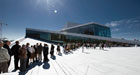
Photo courtesy of the Oslo Opera House
To add a “monumental” element to the facility, Snøhetta sought to lay out a “carpet” of horizontal and sloping surfaces, and the “La Facciata” marble was specified in a broad range of sizes and finishes.
To add a “monumental” element to the facility, Snøhetta sought to lay out a “carpet” of horizontal and sloping surfaces, and the “La Facciata” marble was specified in a broad range of sizes and finishes.
Meanwhile, to add a “monumental” element to the facility, Snøhetta sought to lay out a “carpet” of horizontal and sloping surfaces on top of the building. “This carpet has been given an articulated form, related to the cityscape,” stated the firm. “Monumentality is achieved through horizontal extension and not verticality. The conceptual basis of the competition - and the final building - is a combination of these three elements: the wave wall, the factory and the carpet.”
Use of stone
In choosing materials for the facility, the architects had several criteria in mind -particularly for the stonework. “The materials - with their specific weight, color, texture and temperature - have been vital to the design of the building,” stated the architects. “Snøhetta’s architecture is narrative. It is the materials which form the defining elements of the spaces. It is the meeting of the materials which articulates the architecture through varied detail and precision.”
The stone was quarried and fabricated in the Carrara region of Italy by Campolonghi Italia S.p.A. at the La Facciata quarry site. The material has been used for several exterior projects, including load-bearing temples, which gave the architects confidence that the stone would be suitable for the project from a practical standpoint.

Photo by Nicolas Buisson, courtesy of the Oslo Opera House
“As early as the competition entry, Snøhetta proposed that the roofscape should be openly accessible to the general public and that it should be clad with white stone,” reads a design statement from Snøhetta, which also specified a non-repetitive pattern - with integrated raised areas, special cuts, various surface textures and specific details.
“As early as the competition entry, Snøhetta proposed that the roofscape should be openly accessible to the general public and that it should be clad with white stone,” reads a design statement from Snøhetta, which also specified a non-repetitive pattern - with integrated raised areas, special cuts, various surface textures and specific details.
Of particular note, the marble forms the complex “carpet” that is central to Snøhetta’s design, and it was specified in a broad range of sizes and finishes. “The accessible area of the ‘carpet’ is approximately 18,000 square meters [195,000 square feet,]” stated the architects. “Its detailed design has been important; the architect desired that it should not interfere with the general form of the building, but that it simultaneously was articulated enough to be interesting at close quarters. Together with the artists, several alternatives were proposed before a particular non-repetitive pattern - with integrated raised areas, special cuts, various surface textures and specific details - were designed to articulate the main geometry.”
In addition to the stone flooring, marble was also used for several other aspects of the Oslo Opera House, according to the architects. “The opera’s landscape comprises the marble roof, additional marble-clad areas and the areas between the building and the surrounding streets,” stated Snøhetta. “Access to the plaza and the main entrance is over a marble-clad footbridge over the ‘Opera Canal.’ The plaza forms a part of a public promenade and cycle lane which continues around the west and south sides of the building, eventually coming to a planned bridge over the Aker river to the east.
“As early as the competition entry, Snøhetta proposed that the roofscape should be openly accessible to the general public and that it should be clad with white stone,” the firm’s statement continued. “Today, the building’s defining feature is the characteristic geometry of the roof as it rises from the fjord and is laid out like a carpet over the public areas. An important move has been to introduce channels along the roof edges with ramps and steps. This allows the integration of regulation height balustrades with raising the line of the roof itself.”
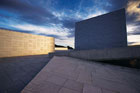
Photo by Carsten Aniksdal, courtesy of the Oslo Opera House”
“The accessible area of the ‘carpet’ is approximately 18,000 square meters [195,000 square feet,]” stated the architects. “Its detailed design has been important; the architect desired that it should not interfere with the general form of the building, but that it simultaneously was articulated enough to be interesting at close quarters.”
“The accessible area of the ‘carpet’ is approximately 18,000 square meters [195,000 square feet,]” stated the architects. “Its detailed design has been important; the architect desired that it should not interfere with the general form of the building, but that it simultaneously was articulated enough to be interesting at close quarters.”
A total of 20,000 tons of stone was quarried for the project, and it comes from one specific section of the La Facciata quarry - which was further broken down into four sub-sections. Representatives from Snøhetta visited the quarry site to determine what would be most appropriate for the project.
The La Facciata quarry is located high in the Apuan Alps of Italy, reachable only by four-wheel-drive vehicles. It was necessary to extract the stone from the highest level of the mountain in order to obtain the proper quality and structural characteristics, according to Campolonghi, which began working the upper levels more than a decade ago, extracting 300,000 tons of stone during that time.
The quarry operations have been documented for 300 years, but there is evidence that stone was taken from the site as far back as Roman times. Quarry workers have discovered hand-carved bowls as well as signs of ancient quarrying activity in discarded blocks.
Today, the stone is extracted using modern techniques and machinery. The quarry master is Stefano Lorenzoni, whose family has been working in the quarry for 100 years. Lorenzoni explained that even with the technological advancements in place, the quarry operation is still very much a creative process. He added that no standard methods could be followed because the quarry master and geologists must “read” the earth to determine how to approach the extraction for each individual area.
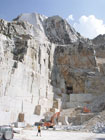
Photo by Michael Reis
A total of 20,000 tons of stone was quarried for the project, with 10,000 tons being used after fabrication. Representatives from Snøhetta visited the quarry site to determine what would be most appropriate for the project.
A total of 20,000 tons of stone was quarried for the project, with 10,000 tons being used after fabrication. Representatives from Snøhetta visited the quarry site to determine what would be most appropriate for the project.
The quality control for block production was so strict that blocks were approved at the quarry as soon as they were extracted. After the blocks were washed, a second approval process would take place at the adjacent fabrication plant. Prior to being processed, each block was inspected, and a determination was made on which specific architectural pieces would be taken from the block. Also, to ensure that the blocks being extracted have the proper flexural and compressive strength, an independent firm systematically tested the blocks being quarried for the project.
The finished pieces have a nominal size of 62.5 cm high in various lengths. Flooring pieces are 8 cm thick, while cladding pieces are 5 cm thick. There are also some larger pieces ranging from 10 to 25 cm thick.
Among its honors since opening, the Oslo Opera House won the culture award at the World Architecture Festival in Barcelona in October 2008. Jury member Sir Peter Cook said of the Opera House that it “in its scale, ambition and quality has raised the bar for Norwegian architecture.”
Looking for a reprint of this article?
From high-res PDFs to custom plaques, order your copy today!