Vertical Integration in the stoneworking shop
In many cases in the past, the method of setting up a granite or stone processing shop was to simply place equipment in any available open space - with no thought given to material flow. Usually, the material slab would be loaded onto the bridge saw for initial shaping, cut to size and then unloaded from the same side and transferred to the next operation for edging, profiling, polishing, etc., wherever the next processing operation was located in the shop.
Today, the efficient, production-line “Vertical Integration” concept has proven to increase productivity in numerous installations - typically by more than 20%. In fact, some shops are realizing return-on-investment (ROI) gains of 40 to 50% simply by redesigning the layout of the shop to increase its efficiency and take full advantage of automated equipment.
Vertical Integration processors have planned their production areas to maximize the smooth flow of material through each stage of the production process, so it progresses logically and virtually seamlessly from one stage to the next.
The new thinking is to position the equipment to facilitate material handling from one operation to the next: loading material slabs at the front of the bridge saw, unloading at the back and continuing the flow through to the edging equipment, CNC machine, polishing equipment, hand finishing, final inspection and then out the door.
A “production line†approach
In general, even though each job is custom made (in the sense that it is being fabricated to a unique set of specifications), the processes for each job are all basically the same. Only the size, shape, edge and cutout details are different. So there is really not that much variation from one job to the next, making this new production line approach that much more practical and efficient.Larger shops operating more than one production line have also instituted a “team concept” similar to those employed in highly automated factories of many other industries. In the case of stone-cutting facilities, the production lines are operated by a dedicated team of operators that are trained to run each processing machine in their respective line.
The team concept is designed to keep the operators engaged and focused on their assignments to minimize unnecessary socializing during processing operations and to foster a sense of competition between the teams. Each team has a supervisor overseeing their operation, and that supervisor in turn reports to a regional supervisor, who reports to the plant manager.
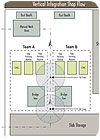
A typical shop based on the Vertical Integration of processes as described above is illustrated in the accompanying diagram.
Each processing line, such as those in the illustration, generally consists of a bridge saw, a multi-head edge polisher, a flat polisher and a CNC machine. This line, with operators organized based on the team concept, can produce five to eight kitchens per day by following production line principles.
In the example, a typical shop can produce 10 to 16 kitchens a day with two parallel processing lines operated by two teams working essentially in competition to produce the highest quality product at the best rate.
Equipping the line
The machines in each line are selected based on the desired output of the operation - for example, a CNC machine plus a flat polishing machine. The polishing machines should be facing each other so one operator can operate both machines with a minimum of movement from one to the other.To begin the operation, marble or granite slabs to be made into kitchen countertops, island counters or bathroom vanities are first stored in a designated area in the shop where they are selected by the customer. Then they are placed in A-frames adjacent to the bridge saws and tagged with paperwork describing the various operations to be performed during fabrication. The A-frames are positioned sequentially so that while cutting is completed on one slab, the next slab to be processed is in position and ready for loading onto the bridge saw.
Preparing the paperwork that clearly describes each operation to be performed, the sequence of those operations and establishing a realistic schedule of deadlines for each project is especially critical to a successful operation. One of the biggest failures of most shops is their inability to properly establish the logistics for each job in order to assure a smooth, error-free flow of product through the production process.
Effective material handling is an important key to the successful execution of this strategy, facilitating the flow of product while the production line set-up permits reductions in the number of operators required to operate the line.
Jib cranes, which generally are used for loading and unloading the bridge saws, can be operated by the bridge saw operators without additional help. Two cranes are used; one at the front of the saw for loading the slab and the other at the rear for unloading it once cutting is complete.
The slabs are then placed on carts for moving to the next processing machine by that machine’s operator. The second jib crane also is used to load and unload the slab as it progresses through the subsequent processing operations. Since the cranes are only used for a minute or two at each station, there should be little interference between the two lines, although some shops will employ a third crane to avoid any conflicts.
The final station in the production facility is a manual work area where any finishing touches requiring handwork are performed. This includes touching up any edging, radius corners, polishing hard-to-reach areas, etc. Final inspection also is generally conducted at this time.
If all of the processing machines are water-cooled, with the water also being used to dampen dust, there is no need for additional dust-control measures at those workstations. However, dust booths are maintained adjacent to the manual work area to control dust during final handwork operations, which can include the use of a dry-cutting saw that has no internal dust controls.
Since water is an essential cooling medium for the bridge saws and processing equipment, and since water has become quite costly in most industrial centers - with its disposal in many cases costing more than the water itself - a water reclamation system should definitely be included in planning today’s stone-cutting shop.
This is especially critical considering the fact that each machine may require anywhere from 12 to 30 gallons of cooling water per minute, so an effective water reclamation system can pay for itself - often within the first six months depending on the size of the equipment being purchased.
The water reclamation system can be set up in any convenient location out of the loop of the processing machinery. This can be inside or outside the facility, depending on the area weather, as outside water systems clearly would not fare well in northern areas during the winter months. This system also should be oversized when initially installed to anticipate future expansion.
Looking for a reprint of this article?
From high-res PDFs to custom plaques, order your copy today!