Stone World logo
search
cart
facebook twitter linkedin youtube
  • Sign In
  • Create Account
  • Sign Out
  • My Account
Stone World logo
  • NEWS
  • PRODUCTS
    • Machinery
    • Digital Technology
    • Tooling & Accessories
  • MATERIALS
    • Alternative Surfaces
    • Stone
    • Tile
    • Imports & Exports Data
  • FABRICATORS
    • Fabricator How-to
    • Fabricator Case Studies
    • Fabricator of the Year
  • A&D
    • Installation & Technical Tips
    • Outdoor Design
    • Interior Design
    • Hospitality | Commercial Design
    • Mosaics & Decorative Tile
    • Kitchen & Bath
    • Residential
    • Renovation | Restoration
  • MEDIA
    • Videos
    • Podcasts
    • EBOOK
  • EVENTS
    • STONE INDUSTRY EDUCATION
    • Industry Calendar
  • MORE
    • NEWSLETTERS
    • WOMEN SPOTLIGHT
    • MARKET RESEARCH
    • STONE WORLD STORE
  • DIRECTORY
    • TRADE ASSOCIATIONS
    • Stone Suppliers
    • GET LISTED
  • EMAG
    • eMagazines
    • Archives
    • Contact
    • Advertise
  • SIGN UP!

Landmark expansion relies on natural stone

By Michelle Stinnard
November 18, 2006
Pei Cobb Freed & Partners Architects LLP of New York, NY, designed the Headquarters 2 Project for the International Monetary Fund in Washington, DC, which included the extensive use of limestone and granite throughout the building's interior.
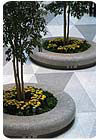

At the center of the lobby, several planters of Deer Isle granite - supplied by Polycor Granite Bussiére of Saint-Sébastien, Québec, Canada - are a signature element.
The International Monetary Fund (IMF) Headquarters 2 Building in Washington, DC, included the extensive use of stone throughout the building. Pei Cobb Freed & Partners Architects LLP of New York, NY, was responsible for the design of the 800,000-square-foot facility, which incorporated both limestone and granite for elements such as flooring, walls and planters.

At the center of the lobby, several planters of Deer Isle granite - supplied by Polycor Granite Bussiére of Saint-Sébastien, Québec, Canada - are a signature element. The stone for these circular planters was quarried in Maine, and the radius cutting and finish was performed at Polycor's Granite Bussiére facility in Canada.
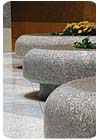
The stone for these circular planters was quarried in Maine, and the radius cutting and finish was performed at Polycor's Granite Bussiére facility in Canada.
Deer Isle granite was also used for portions of the interior veneer, where it was specified as 2-inch-thick pieces. Large-format panels of Deer Isle granite add contrast to the walls and flooring throughout the first two levels of the building.

Polycor also supplied Brazilian Lilas Gerais granite in a polished finish for an exterior waterwall, providing a unique element at the Pennsylvania Avenue frontage. The same material was also used for countertops and vanity tops in the serving / dining areas.

While the flooring throughout the main lobby is a triangular terrazzo pattern, complementary elements are made from natural stone, which was used in a wide variety of applications. The terrazzo floor pattern is framed by a perimeter band of Valreuil Claire limestone from France. According to architect Craig Dumas of Pei Cobb Freed & Partners Architects, the overall pattern is based on the geometry of Pennsylvania Ave., which is the street located at the main front of the building.

In addition, the Valreuil Claire was used for two monumental staircases. Dumas explained that French limestone was selected for these elements because of its durability and richness of character. Meanwhile, Valanges limestone from France was used as interior wall cladding. Typical sizes of the material, which is a softer limestone variety, measure 2 feet, 4 inches x 5 feet. Both French limestone varieties were supplied by Rocamat of Paris, France.

A terrazzo floor pattern is framed by a perimeter band of Valreuil Claire limestone from France. According to architect Craig Dumas of Pei Cobb Freed & Partners Architects, the pattern is based on the geometry of Pennsylvania Ave., which is the street located at the main front of the building.
Indiana limestone from Bybee Stone Co. Inc. of Bloomington, IN, was used for the exterior of the project, in order to match the adjacent complex, which houses IMF's original headquarters. According to the architect, the use of Indiana limestone as a common thread on the expansion connects the current phase to the previous stonework - while also allowing them to change some elements. “The goal was to make a linkage to the adjacent original headquarters building, which is from another era and is completed in Indiana limestone,” explained Dumas. “The clients wanted something that wasn't as heavy as the other building. They wanted this one to have more light and transparency with the use of glass.” Dumas added that the clients wanted the color and texture of the new headquarters to be similar to the existing building.

The exterior base of the building features 4,000 square feet of honed Deer Isle granite, while the first two floors of the facade are clad in Indiana limestone. Additionally, Deer Isle granite was used for exterior paving, stairs, planters and caps.

Polycor also fabricated 11,000 square feet of thermal-finished Swedish Mahogany granite - which was used for exterior cobblestone pavers measuring 6 x 6 x 4 inches. The material was also used for standard pavers that measured 2 inches thick, as well as street curbs that were 6 inches thick. Also, 800 square feet of Kodiak granite was implemented outdoors in 2-inch-thick pieces as part of the water feature pools.

Valreuil Claire limestone was also used for two monumental staircases, while Valanges limestone was used as interior wall cladding. Both materials were quarried in France and supplied by Rocamat.

Installing the stone

Rugo Stone LLC of Lorton, VA, was responsible for installing and fabricating all of the stonework for the building. According to installer Fred Rugo, the installation lasted for a period of 16 months with an average of 75 to 80 workers on the job at the peak of the project.

Rugo said that a few minor challenges arose on the jobsite, such as an accelerated work schedule and minimal workspace, among others. Carrying the interior limestone from the first floor to the second floor was also challenging for the crew. “It was difficult to maintain the perfect grade around the perimeter of the building to ensure that the second floor matched where we left off on the first floor,” said Rugo.

Dumas felt the biggest challenge arose when working with the French limestone. “The stone has a lot of character to it, and we spent a lot of time establishing the level of quality and figuring out where to use which parts of the range,” he explained.

Construction on the building took approximately two years, and was completed in April 2005. Rugo Stone LLC received the 2006 Washington Builders' Congress Award of the Year for its stonework excellence on this project. According to Dumas, the project was very well received, and the clients were pleased with the outcome.
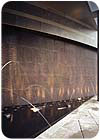
Stone water features provide yet another unique element to the overall design of the space.
The Headquarters 2 Project International Monetary Fund
Washington, DC

Architect: Pei Cobb Freed & Partners Architects LLP, New York, NY

General Contractor: Clark Construction Group, LLC

Stone Installer: Rugo Stone LLC, Lorton, VA

Stone Suppliers: Polycor Granite Bussiére, Saint-Sébastien, Québec, Canada (Deer Isle granite, Swedish Mahogany granite, Kodiak granite, Lilas Gerais granite); Bybee Stone Co. Inc., Bloomington, IN (Indiana limestone); Rocamat, Paris, France (French limestone)

Share This Story

Looking for a reprint of this article?
From high-res PDFs to custom plaques, order your copy today!

Michelle is the assistant editor of Stone World.

Recommended Content

JOIN TODAY
to unlock your recommendations.

Already have an account? Sign In

  • customer doing research online

    3 Reasons Why Quick Response Time Results in a Successful Fabrication Shop

    Your fabrication shop can have the best website. The best...
    Fabricator How-to
    By: Anthony Milia
  • Silica

    Renewed National Attention Ignites Over Silicosis Epidemic

    A major investigative report published on March 12, 2026...
    Industry Insights
    By: Jason Kamery
  • shipping containers

    U.S. Countertop Material Imports: February 2026

    U.S. countertop material imports collapsed in February...
    Stone
    By: Jason Kamery
Manage My Account
  • eMagazine
  • Newsletters
  • Online Registration
  • Manage My Preferences
  • Subscription Customer Service

More Videos

Popular Stories

shipping containers

U.S. Countertop Material Imports: February 2026

Save Quartz Jobs Coalition Logo

ITC Moves Towards New Quartz Import Tariffs

cal osha

Cal/OSHA Standards Board to Vote May 21 on Engineered Stone Ban Petition

Fabricator Focus

From profiles to roundtable discussions, Q&As to best business practices, we're turning a focus on topics and challenges impacting fabricators.

AI Talk Is Everywhere -- Where Does a Countertop Fabricator Begin?

Fabricators Discuss Pros and Cons of Chip Repair

How to Grow a Countertop Fabrication Shop

Events

June 25, 2026

North Carolina Stone Summit

You’ve probably heard a lot lately about how to calculate the profit for each job you produce. You likely have production benchmarks based on square footage since it’s the most common production metric in the industry. Come learn how focusing on these metrics can hurt your profitability and what to do about it.

July 16, 2026

Washington Stone Summit

Join us for "Taking Your Organization to the Next Level," a session dedicated to transforming your business practices. Discover strategies for setting clear agendas, encouraging participation, and driving actionable outcomes. Learn how to foster collaboration and communication, ensuring that every meeting enhances productivity and contributes to your business goals.

View All Submit An Event

Poll

Tariffs and Quartz Imports

If high tariffs are placed on U.S. quartz imports, how will this affect your business?
View Results Poll Archive

Products

Restoration & Maintenance Technical Module

Restoration & Maintenance Technical Module

See More Products
	
3 Reasons Why Quick Response Time Results in a Successful Fabrication Shop

Related Articles

  • Corporate structure relies on stone's timelessness

    See More
  • High-end custom shop relies on waterjet

    See More
  • Slate in Architecture: Civic project design relies on slate

    See More
×

Our Newsletters are a rock solid source of industry insights!

Stay in the know on the international stone and tile industry trends.

JOIN TODAY!
  • RESOURCES
    • Advertise
    • Contact Us
    • Directories
    • Store
    • Want More
  • SIGN UP TODAY
    • Create Account
    • eMagazine
    • Newsletter
    • Customer Service
    • Manage Preferences
  • SERVICES
    • Marketing Services
    • Reprints
    • Market Research
    • List Rental
    • Survey/Respondent Access
  • STAY CONNECTED
    • LinkedIn
    • Facebook
    • YouTube
    • X (Twitter)
  • PRIVACY
    • PRIVACY POLICY
    • TERMS & CONDITIONS
    • DO NOT SELL MY PERSONAL INFORMATION
    • PRIVACY REQUEST
    • ACCESSIBILITY

Copyright ©2026. All Rights Reserved BNP Media, Inc. and BNP Media II, LLC.

Design, CMS, Hosting & Web Development :: ePublishing