Stone World logo
search
cart
facebook twitter linkedin youtube
  • Sign In
  • Create Account
  • Sign Out
  • My Account
Stone World logo
  • NEWS
  • PRODUCTS
    • Machinery
    • Digital Technology
    • Tooling & Accessories
  • MATERIALS
    • Alternative Surfaces
    • Stone
    • Tile
    • Imports & Exports Data
  • FABRICATORS
    • Fabricator How-to
    • Fabricator Case Studies
    • Fabricator of the Year
  • A&D
    • Installation & Technical Tips
    • Outdoor Design
    • Interior Design
    • Hospitality | Commercial Design
    • Mosaics & Decorative Tile
    • Kitchen & Bath
    • Residential
    • Renovation | Restoration
  • MEDIA
    • Videos
    • Podcasts
    • EBOOK
  • EVENTS
    • STONE INDUSTRY EDUCATION
    • Industry Calendar
  • MORE
    • NEWSLETTERS
    • WOMEN SPOTLIGHT
    • MARKET RESEARCH
    • STONE WORLD STORE
  • DIRECTORY
    • TRADE ASSOCIATIONS
    • Stone Suppliers
    • GET LISTED
  • EMAG
    • eMagazines
    • Archives
    • Contact
    • Advertise
  • SIGN UP!

Perfect stone slabs: Do they really exist?
By Chuck Muehlbauer
January 25, 2006
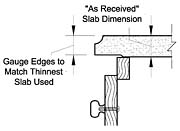
Figure 1: Gauged edges to eliminate lippage at underside of overhang.

A few large companies exist in the countertop industry with the capacity to perform both the sawing/face finishing of the stone slabs and the final fabrication of the finished countertop material. This scenario is indeed the exception to the normal course of business. The typical arrangement is for the fabricator to purchase the slabs, already sawn to nominal thickness, with one surface finished. The fabricator then continues the refinement of the product by sawing to finished sizes, applying the appropriate edge treatments, and making necessary accommodations for mechanical equipment and anchorage. The fabricator, in effect, is then the party in the contractual chain that insulates the sawyer of the slabs from the final customer. When different importing, brokerage or wholesaling companies are involved, there can be several companies contractually between the slab sawyer and the end user of the countertops.

How then, does one address the end user's complaints when these complaints are the result of slab quality? Variation in slab thickness and variation from true plane (warpage) are two common causes of homeowner complaints. Neither of these issues are under the control of the countertop fabricator. We then look for an industry-adopted standard - one that has been based on consensus opinion - to establish the limits of variation allowable for this product.
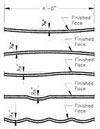
Click image for larger view. Figure 2: All slab surface profiles shown above would be compliant with the NBGQA's Flatness Tolerance.

Because we do not live in a perfect world, all dimensional standards must include tolerances, or allowable deviation from the targeted dimension. In the case of granite slabs, the National Building Granite Quarries Association (NBQGA) establishes these tolerances. The NBGQA's current edition of their Specifications for Architectural Granite lists the allowable variation in panel thickness for thicknesses between 3⁄4 and 15⁄8 inches (20 to 41 mm) as +/- 1⁄8 inch (+/- 3 mm). The Marble Institute of America Dimension Stone Design Manual adopts this same tolerance. Considering the accuracy capability of modern shot-sawing equipment, this tolerance seems extreme. And one could easily note that this tolerance was established for slabs to be used as granite building panels, and not granite countertops. Yet, this is the only industry-established tolerance for this particular condition. Unless more stringent dimensional control was established and agreed to in the purchase documents, all slabs delivered with +/- 1⁄8 inch (+/- 3 mm) of the nominal dimension would be deemed acceptable by industry adopted standards.

Will the homeowner accept this degree of variation in the slabs used in their countertops? Not very likely, at least not at exposed edge conditions. Additionally, the Marble Institute's recently revised Residential Stone Countertop Installation guide limits the slab-to-slab variation on the underside of an exposed edge to 1⁄32 inch. To the fabricator, the only means of making these slabs acceptable to the homeowner and compliant with the MIA's installation guide is by machining the underside of the overhanging portion of the slabs to a uniform thickness (see Figure 1). All slabs must be accurately measured to determine the thinnest slab in the project, and the exposed edges would need to be ground down to this thickness. When the fabricator does not have the capability to do this, or if this is simply cost prohibitive, the only options involve modifying the standard. As with any standard, the involved parties have the right to agree to a more or less stringent tolerance, provided the agreement is properly documented. In this case, that agreement can occur between the seller of the slabs and the fabricator, where the seller agrees that the sawing tolerance will be less than the +/- 1⁄8 inch (+/- 3 mm) prescribed by the NBGQA. Or the agreement can occur between the fabricator and the homeowner, where the homeowner can agree to accept greater than 1⁄32 inch of variation between adjacent slabs.
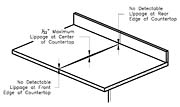
Figure 3: MIA's Residential Countertop Installation Guide limits lippage to 1⁄32 inch at center of countertop.

A similar issue occurs with the flatness of the slabs. The NBGQA establishes allowable variation from a true plane to 1⁄16 inch (1.5 mm) when checked with a 4-foot (1.2 m) straight edge, placed in any direction on the slab (see Figure 2). In the MIA's recently revised Residential Stone Countertop Installation guide, the maximum lippage allowed between adjacent slabs is 1⁄32 inch (0.8 mm) (see Figure 3). A 1⁄16-inch warp in 4 feet would generally be less than 1⁄32 inch in a standard countertop width, but this tolerance is applicable to both concave and convex warps. It is entirely possible to have contra-directional warps adjacent to each other in the installation. This problem is magnified when the slab width is of a greater dimension, as in the case of an island top. When using 20-mm slabs, it is sometimes possible to bend the material sufficiently to eliminate, or at least reduce, the warp. In 30 mm materials, this is unlikely, and in such cases the only available remedy would be to grind and refinish the slab surface to eliminate the lippage. In some materials, it is not possible to replicate the same gloss levels as the original line polish on the slab, so this remedy may actually make the problem more noticeable than if left untreated.

While the issue of thickness tolerance in slabs is one that can be addressed with improved equipment, the warpage of slabs cannot be so addressed. Warpage of stone slabs is a naturally occurring condition in the slabs. Often times, the force required to eliminate the warp of a slab approaches the stress at which fracture occurs. A technology that controls warps would be welcome, but I don't see it arriving any time soon, if at all. Diligent customer communication and education will go a long way in reducing complaints due to warps. As a last resort, some stock culling may be necessary to produce acceptable results in the finished installation.

Share This Story

Looking for a reprint of this article?
From high-res PDFs to custom plaques, order your copy today!


Chuck Muehlbauer is the Technical Director of the Marble Institute of America.

Recommended Content

JOIN TODAY
to unlock your recommendations.

Already have an account? Sign In

  • customer doing research online

    3 Reasons Why Quick Response Time Results in a Successful Fabrication Shop

    Your fabrication shop can have the best website. The best...
    Fabricator How-to
    By: Anthony Milia
  • Silica

    Renewed National Attention Ignites Over Silicosis Epidemic

    A major investigative report published on March 12, 2026...
    Industry Insights
    By: Jason Kamery
  • shipping containers

    U.S. Countertop Material Imports: February 2026

    U.S. countertop material imports collapsed in February...
    Stone
    By: Jason Kamery
Manage My Account
  • eMagazine
  • Newsletters
  • Online Registration
  • Manage My Preferences
  • Subscription Customer Service

More Videos

Popular Stories

shipping containers

U.S. Countertop Material Imports: February 2026

Save Quartz Jobs Coalition Logo

ITC Moves Towards New Quartz Import Tariffs

cal osha

Cal/OSHA Standards Board to Vote May 21 on Engineered Stone Ban Petition

Fabricator Focus

From profiles to roundtable discussions, Q&As to best business practices, we're turning a focus on topics and challenges impacting fabricators.

AI Talk Is Everywhere -- Where Does a Countertop Fabricator Begin?

Fabricators Discuss Pros and Cons of Chip Repair

How to Grow a Countertop Fabrication Shop

Events

June 25, 2026

North Carolina Stone Summit

You’ve probably heard a lot lately about how to calculate the profit for each job you produce. You likely have production benchmarks based on square footage since it’s the most common production metric in the industry. Come learn how focusing on these metrics can hurt your profitability and what to do about it.

July 16, 2026

Washington Stone Summit

Join us for "Taking Your Organization to the Next Level," a session dedicated to transforming your business practices. Discover strategies for setting clear agendas, encouraging participation, and driving actionable outcomes. Learn how to foster collaboration and communication, ensuring that every meeting enhances productivity and contributes to your business goals.

View All Submit An Event

Poll

Tariffs and Quartz Imports

If high tariffs are placed on U.S. quartz imports, how will this affect your business?
View Results Poll Archive

Products

Restoration & Maintenance Technical Module

Restoration & Maintenance Technical Module

See More Products
	
3 Reasons Why Quick Response Time Results in a Successful Fabrication Shop
×

Our Newsletters are a rock solid source of industry insights!

Stay in the know on the international stone and tile industry trends.

JOIN TODAY!
  • RESOURCES
    • Advertise
    • Contact Us
    • Directories
    • Store
    • Want More
  • SIGN UP TODAY
    • Create Account
    • eMagazine
    • Newsletter
    • Customer Service
    • Manage Preferences
  • SERVICES
    • Marketing Services
    • Reprints
    • Market Research
    • List Rental
    • Survey/Respondent Access
  • STAY CONNECTED
    • LinkedIn
    • Facebook
    • YouTube
    • X (Twitter)
  • PRIVACY
    • PRIVACY POLICY
    • TERMS & CONDITIONS
    • DO NOT SELL MY PERSONAL INFORMATION
    • PRIVACY REQUEST
    • ACCESSIBILITY

Copyright ©2026. All Rights Reserved BNP Media, Inc. and BNP Media II, LLC.

Design, CMS, Hosting & Web Development :: ePublishing