Features and benefits to consider when choosing a bridge saw
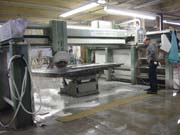
The first consideration for any countertop fabricator that wants to grow is usually deciding what type of saw to purchase. Whether manual or automatic, the heart of a shop's production is the saw. If you are not cutting enough slabs, your saw is the bottleneck to increased throughput. The different configurations cut by the saw determine what can be fed to the edging machine, CNC and other operations. By carefully choosing a saw, a facility can often pay for its purchase within a year and reap years of profits many times the original investment.
A good bridge saw is a must for any fabricator turning out one or more kitchens a day. Unlike a manual saw, an automated bridge saw provides a consistently clean cut at a high rate of production. Even if all of the other equipment in a shop consists of hand tools, a good bridge saw is a must. The numbers back this up. Whereas the best worker operating a manual saw will rarely exceed 10 lineal feet per hour, an automatic bridge saw can cut up to 120 lineal feet of material per hour. Furthermore, the cost per foot on the automated saw is only around $2.00 to $2.50, compared to the hourly worker's wages and benefits plus tooling costs.
The bridge and beams
When selecting a bridge saw, there are a number of things you should investigate. The first is the strength and stability of the bridge and beams. As its name implies, a bridge saw is a gantry machine tool with a bridge that moves on rails. The business end is usually a tilting cutting head attached to the bridge. The accuracy of the cut is determined by how substantial the bridge and beams are built.
If you are cutting a thick slab of granite, which is one of the hardest materials on earth, a lot of pressure is created in the cutting head, which transfers to the supporting bridge and beams. If the bridge and beams are able to bend, bow or give in any way, the resulting cut will be far less accurate than if these components are unyielding. Therefore, look for a bridge saw built with beams made of cast iron and may weigh up to two tons more than less substantial beams of a saw with similar capacity. In addition to providing a more accurate cut, well-built equipment like this can take far more stress and abuse than less substantial equipment.
The oil bath
Just as rugged beam and bridge construction ensures accuracy and longevity, self-maintaining features on a saw will also do the same. This is why it is important that a bridge saw is equipped with an oil bath to reduce wear of the rollers and bearings. This is especially important in the harsh environment of a granite shop, where dust and moisture can be very taxing on machinery. Because the operators are primarily concerned with production - sometimes to the neglect of maintenance - any self-maintaining feature is a benefit. So look for a saw with an oil bath that reduces maintenance costs while providing smoother movements that make a more accurate cut than do bridge saws that run on dry, open channels.The programmable controller
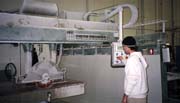
Today, a programmable controller automates movement of the bridge and cutting head. A key consideration is to have programming that is easy for any operator to learn. This allows the equipment to be operated efficiently for high production. Programmable controllers typically permit manual, semi-automatic and fully automatic operation. Most use industry standard circuitry and are manufactured by such companies as Siemens and General Electric, to name a couple.
The most user-friendly saws place all the controls on a swinging pendant, while less friendly saws have different functions on different parts of the machine. Having all the controls on a one touch-screen pendant eliminates the need for the operator to walk around to different areas for turning on the water, setting and locking the table, lifting the table, raising and lowering the head, starting the saw, and other tasks.
The water system
An automatic water valve can also save time to speed production. Instead of having to turn the water on and off from a separate location, the automatic water valve provides water only when it is needed. This helps to reduce water expenses, an important consideration, because these saws typically require 15 liters or more per minute.
As production increases, water consumption increases as well. For a medium or large fabrication shop, a closed water system can pay for itself in a year or two. It recycles the water that runs through the machines to keep the guiding tools cool instead of dumping it into the sewer. It can also recycle water used in a dust booth. Beyond reducing the water bill, such a system guarantees the rate of flow needed to meet the demand of the machines.
The tilting table
An efficient, hydraulic tilt table allows the slab to be easily loaded from a slab lifter or forklift. A heavy duty tilting and rotating table that can be locked in any position is preferable to a table that locks only at preset angles dictated by the manufacturer. This permits a limitless number of cut angles to satisfy the job's requirements.The motor
Bridge saws come in a variety of size and power configurations. An entry level or “standard†saw for a shop producing one to three kitchens a day usually has a motor ranging from 10 to 15 horsepower. Larger, production-oriented saws usually have a 20-horsepower motor. The smaller saws will usually do a good job of cutting material up to 3 cm thick, while the larger saws are needed to cut thicker slabs or blocks of material such as limestone, granite and marble used for monuments, headstones, signs and industrial applications. While saws for these applications may have blades up to 36 or 48 inches in diameter, saws for countertop fabricators seldom exceed 24 inches. Larger blades permit faster surface speeds for faster cutting, but require a more powerful motor to overcome the reduction of torque needed for hard or dense materials such as granite.Other factors
A laser is an important tool for efficiency in aligning the saw blade to the line that has been templated on the material. It does this by projecting a beam on the exact spot that the blade will cut. Thus, a laser also ensures greater accuracy than depending on the operator's eye alone.While accuracy, production and durability are important in a saw, most important is operator safety. Thus, an important feature to look for is a safety shut-off protection device surrounding the saw blade that stops the saw when tripped before the operator is accidentally injured.
Look for a saw with a one-year warranty on mechanical parts and labor and 90 days on the electrical components. It's an industry standard.
In addition to carefully examining these various bridge saw features, ask for customer references and talk to colleagues to discover their experiences with bridge saws. By carefully choosing the right bridge saw with the right equipment, a fabricator can turn it into a profit center for many years to come.
Looking for a reprint of this article?
From high-res PDFs to custom plaques, order your copy today!