Stone World logo
search
cart
facebook twitter linkedin youtube
  • Sign In
  • Create Account
  • Sign Out
  • My Account
Stone World logo
  • NEWS
  • PRODUCTS
    • Machinery
    • Digital Technology
    • Tooling & Accessories
  • MATERIALS
    • Alternative Surfaces
    • Stone
    • Tile
    • Imports & Exports Data
  • FABRICATORS
    • Fabricator How-to
    • Fabricator Case Studies
    • Fabricator of the Year
  • A&D
    • Installation & Technical Tips
    • Outdoor Design
    • Interior Design
    • Hospitality | Commercial Design
    • Mosaics & Decorative Tile
    • Kitchen & Bath
    • Residential
    • Renovation | Restoration
  • MEDIA
    • Videos
    • Podcasts
    • EBOOK
  • EVENTS
    • STONE INDUSTRY EDUCATION
    • Industry Calendar
  • MORE
    • NEWSLETTERS
    • WOMEN SPOTLIGHT
    • MARKET RESEARCH
    • STONE WORLD STORE
  • DIRECTORY
    • TRADE ASSOCIATIONS
    • Stone Suppliers
    • GET LISTED
  • EMAG
    • eMagazines
    • Archives
    • Contact
    • Advertise
  • SIGN UP!

Breathing new life into a Normandy manor
By Jennifer Richinelli
August 29, 2002


Sitting atop the steep northern coast of the La Hague peninsula, which is located at the extreme tip of Cotentin on the Normandy coast of France, is the manor of Tourp. Dating back to the 1600s, the estate is considered an historic treasure. But after standing for several centuries, the interior stonework as well as the slate roof was in dire need of repair. As a result, a recent restoration process was completed, which not only repaired the existing architecture, but also transformed the manor into a cultural center and museum.

The name of the estate is derived from the Scandinavian word "Thorp," meaning "village," a term that is used in this area of Normandy for rural buildings. Originally, Tourp manor was the property of a noble family, whose coat of arms still hangs on the stained glass windows of the chapel. In addition to the chapel, the property includes an old manor house, a dovecote and other various buildings.

It was the district of La Hague which initiated the restoration, with the intention for the new operation to be a place where visitors will be able to inquire about tourist activities in the region, local life and traditions, history and the natural habitat of the La Hague peninsula. Additionally, a restaurant will be open for tourists, and some accommodations will be available for hikers.

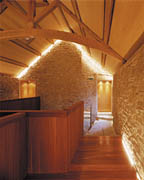
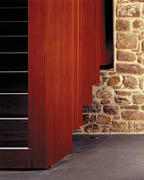
Inside, several walls are clad from the ceiling to floor with local fieldstone. The exposed stone combined with wood beams creates a rustic feel for the interior. In some areas, the stonework showed weaknesses and required extensive pinning, according to French architect Patrick Mauger, explaining that it was necessary for the walls to be strengthened.

"To restore the interior walls that were weakened, cement was injected into the walls," said the architect. "In fact, the walls were composed on both sides with good stone, with the interior space between them originally filled with clay that had disintegrated over time. To make the two surfaces connected again, the exterior joints of the walls were tuck pointed, with cement then pumped in through hoses into the interior space."

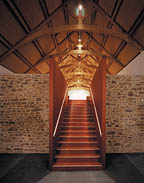
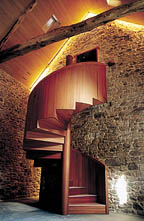
To satisfy safety standards, two staircases had to be built in each building. Mauger designed two spiral staircases and two other straight staircases with handrails. One of the spiral staircases was carved from exotic wood and built into the stone walls. Because of the narrowness of the location, the staircase had to be turned in order to fit correctly in the building.

Complementing the fieldstone walls, Green Amazone granite from China was employed for the floor in the rooms on ground level. According to Mauger, each piece was 70 x 70 cm with a thickness of 3 cm. While the appearance of the granite is identical to that extracted locally in Cotentin, the material was imported from China because it was not possible to extract the local granite in a sufficient quantity, explained the architect.
Repairing the roof

The restoration process also involved strengthening the roof structures to support heavier loads while retaining their original appearance. Originally, only the living quarters on the manor had a roof of thick schist slate tiles. The other structures were thatched, covered with clay tiles and then finally covered with a thin slate. Because schist roofing slates are twice as heavy - the weight of the new roof is on average 29 pounds per square foot - it was necessary to double the number of rafters in the roof.

"Before restoration, the distance between the roof's trusses was quite large - around 5.5 meters - with straining struts along the walls which transferred the weight to the floor," said Mauger. "The roof supported a covering of thin and lightweight Angers slate. The new roof in schist slate is much heavier. The number of trusses was doubled - one every 2.75 meters - and designed to do away with the straining struts, thus opening up the wall space to allow exhibits to be hung." The architect explained that the new roofing structure was designed with the assistance of the specialized engineering and design department RFR, which participated in the design of the Louvre Pyramid.

According to Mauger, all of the roof coverings were renovated with salvaged stones. "It was not possible to find new ones," he said. "They tried to reopen a quarry and train masons over a period of 18 months, but it just was not possible. Even for the Mont Saint Michel Abbey, which is located in the same region of France, one cannot find stone." Today, only one local schist quarry is open, which was not capable of producing the 10,800 square feet of slate that was required for the roofing of Tourp Manor.

The architect explained that it took two months per building to restore the roof coverings. "The [schist slate] was laid in descending order, with the larger and heavier stones laid first at the bottom of the roof. Each piece measures around 50 cm long and 25 to 30 cm wide, with thicknesses between 1 to 3 cm. The pieces are irregular in all of their dimensions."

The smallest stones are situated in the roof's ridge beam, according

to Mauger. "These stones have dimensions of 15 cm long x 10 cm wide," he said. "Stones were laid from the bottom of the roof to the ridge beam, with the first stone jutting out and going beyond the edge of the roof to direct water far from the outer wall. The traditional stone laying was respected. These stones are fixed to the roof lath by dowels made of chestnut or oak. An artisan, Jacques Hochet, did this work."

The restoration of Tourp Manor required careful collaboration between all those involved. While construction of the restaurant still has to be completed, the buildings and grounds were open to the public in March 2002.
END BOX

Tourp Manor
Cotentin Peninsula
Normandy, France

Architect: Patrick Mauger
Stone Supplier: Rocamat Cominex (Chinese granite)
Stone Installer: Martin Gregoire
Engineer: RFR

Share This Story

Looking for a reprint of this article?
From high-res PDFs to custom plaques, order your copy today!


Jenniferrichinelli 200px

Launching her career with BNP Media in 1996, Jennifer Richinelli is the Editor-in-Chief of Stone World, a leading publication serving the global stone and tile industry. With a strong background in journalism and trade publishing, she oversees the magazine’s editorial direction, delivering in-depth coverage of industry trends, innovative technologies, architectural applications and breaking industry news.

Throughout her career, Jennifer has built a reputation for connecting industry professionals with valuable insights, highlighting the work of fabricators, designers, architects and other industry leaders. Known for her thoughtful editorial voice and commitment to quality content, Jennifer continues to play a vital role in shaping conversations within the stone industry while fostering a platform that celebrates craftsmanship, innovation and design excellence.

In 2010, the Spanish Ceramic Tile Manufacturers’ Association (ASCER) awarded Jennifer with the International Journalism Award for her extensive coverage of the Spanish tile industry. Additionally, she was the recipient of the 2026 Coverings Champions People’s Choice Award.

email: richinellij@bnpmedia.com | office: (201) 245-5204

Recommended Content

JOIN TODAY
to unlock your recommendations.

Already have an account? Sign In

  • customer doing research online

    3 Reasons Why Quick Response Time Results in a Successful Fabrication Shop

    Your fabrication shop can have the best website. The best...
    Fabricator How-to
    By: Anthony Milia
  • Silica

    Renewed National Attention Ignites Over Silicosis Epidemic

    A major investigative report published on March 12, 2026...
    Industry Insights
    By: Jason Kamery
  • shipping containers

    U.S. Countertop Material Imports: February 2026

    U.S. countertop material imports collapsed in February...
    Stone
    By: Jason Kamery
Manage My Account
  • eMagazine
  • Newsletters
  • Online Registration
  • Manage My Preferences
  • Subscription Customer Service

More Videos

Popular Stories

cal osha

Cal/OSHA Standards Board to Vote May 21 on Engineered Stone Ban Petition

shipping containers

U.S. Countertop Materials Imports: March 2026

kitchen

Building a Reputation on Strong Craftsmanship and Customer Service

Fabricator Focus

From profiles to roundtable discussions, Q&As to best business practices, we're turning a focus on topics and challenges impacting fabricators.

AI Talk Is Everywhere -- Where Does a Countertop Fabricator Begin?

Fabricators Discuss Pros and Cons of Chip Repair

How to Grow a Countertop Fabrication Shop

Events

June 25, 2026

North Carolina Stone Summit

You’ve probably heard a lot lately about how to calculate the profit for each job you produce. You likely have production benchmarks based on square footage since it’s the most common production metric in the industry. Come learn how focusing on these metrics can hurt your profitability and what to do about it.

July 16, 2026

Washington Stone Summit

Join us for "Taking Your Organization to the Next Level," a session dedicated to transforming your business practices. Discover strategies for setting clear agendas, encouraging participation, and driving actionable outcomes. Learn how to foster collaboration and communication, ensuring that every meeting enhances productivity and contributes to your business goals.

View All Submit An Event

Poll

Tariffs and Quartz Imports

If high tariffs are placed on U.S. quartz imports, how will this affect your business?
View Results Poll Archive

Products

Restoration & Maintenance Technical Module

Restoration & Maintenance Technical Module

See More Products
	
3 Reasons Why Quick Response Time Results in a Successful Fabrication Shop

Related Articles

  • Illinois fabricator pursues alternative avenues

    See More
×

Our Newsletters are a rock solid source of industry insights!

Stay in the know on the international stone and tile industry trends.

JOIN TODAY!
  • RESOURCES
    • Advertise
    • Contact Us
    • Directories
    • Store
    • Want More
  • SIGN UP TODAY
    • Create Account
    • eMagazine
    • Newsletter
    • Customer Service
    • Manage Preferences
  • SERVICES
    • Marketing Services
    • Reprints
    • Market Research
    • List Rental
    • Survey/Respondent Access
  • STAY CONNECTED
    • LinkedIn
    • Facebook
    • YouTube
    • X (Twitter)
  • PRIVACY
    • PRIVACY POLICY
    • TERMS & CONDITIONS
    • DO NOT SELL MY PERSONAL INFORMATION
    • PRIVACY REQUEST
    • ACCESSIBILITY

Copyright ©2026. All Rights Reserved BNP Media, Inc. and BNP Media II, LLC.

Design, CMS, Hosting & Web Development :: ePublishing