CNC Case Study: Spanning generations of technology
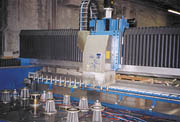
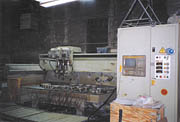
Now headed by Mario Sardo, Salvatore's grandson and the third generation of the family to operate the company, Fordham Marble has been one of the leading users of CNC technology for the last 16 years. It was the first company in America to import a CNC milling machine from CMS/Brembana of Italy, and it recently added a second machine. Both of the CNC machines operate simultaneously at Fordham Marble's 16,000-square-foot plant in the Bronx, which also features 15,000 square feet of outdoor storage area.
Sardo chose to buy his first CNC machine in 1986 after a visit to CMS/Brembana's factory in Bergamo, Italy. "At the time, it was like a rocket ship," he said, adding that he was impressed by the level of sophistication at CMS/Brembana, which was also manufacturing equipment for the woodworking industry. "I saw the capabilities of what could be done with the [woodworking] equipment, and even though my machine was rudimentary by those standards, it catapulted our company from run of the mill to an entirely different level."
Shortly after installing the CNC machine, Fordham Marble began going after complex jobs, including kitchen countertops and vanities as well as other applications such as flooring. "We're a job shop. We'll do whatever is specified," Sardo said. "We'll even turn columns."
Looking at some of the early projects completed with the CNC machine, Sardo pointed to an instance when Fordham Marble bid on a job for an intricate floor pattern. "We fabricated the floor so that any piece went with any other piece. It didn't have to be numbered. The installers sorted it by veining and by color only," he said. "Architectural Digest covered the job, and the contractor was so happy with the project that he has given us every single residential job since 1986."
The new acquisition
Recently, the company's CNC capabilities were significantly expanded with the purchase of a new Speed 3, which was recently installed at the company's shop in the Bronx. The machine is equipped with 4 axes and features automatic tool changing. The machine can hold as many as 26 different tools, although a typical project requires around eight different tools.With the new machine in place, Fordham marble expects to increase its production rate, as both machines are operating simultaneously. The company has a production goal of three kitchens per day, although the rate can change dramatically depending what projects are on the books. Sardo pointed out that a project can take from two weeks up to as much as six months to complete, depending on how extensive the stonework is.
In addition to the CNC machinery, Fordham Marble operates four bridge saws, including two from GMM and one from Gregori, as well as a Comandulli edging machine and three radial arm polishers.
The company does work in marble, limestone, granite and slate, and Sardo estimates that 65 to 70% of the company's revenue comes from its work in granite. Fordham Marble works mostly in the New York metropolitan area and the Northeast. In addition to the shop in the Bronx, the company has a 5,000-square-foot showroom in Stanford, CT, where it services from as far away as Martha's Vineyard and Cape Cod, MA.
The CNC process
The CNC machinery is used for just about every project that is completed by Fordham Marble, and the process typically begins with stone selection by the homeowner, builder or designer. "We only show full-sized slabs," Sardo said. "This eliminates any surprises."Fordham Marble will then send someone to the job site to measure, and then the drawings or templates are submitted for approval. Also, the edge details are selected at this time. After customer approval, the work is cut to size on one of the bridge saws, and then it moves onto the CNC machinery.
The CNC machinery is programmed in three different ways, depending on the project. One option is to draw the design on AutoCAD, and the machine then converts this drawing into CNC programming. "The machine knows the geometry of every tool, so the operator specifies which tools are required to be used," Sardo explained. "The machine will then go to the location, pick up the tool, and run it to the specifications. For example, it knows exactly which is the ogee molding tool, and exactly where to run it. It can execute a shaped vanity top with the bowl hole and ogee molding, in 20 minutes."
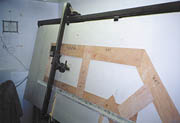
Another option instead of AutoCAD is the use of a digitizing table. For this option, the template is placed on the table, and the operator electronically records the measurements of the template. These measurements are then converted to CNC programming language, which is fed into the machine.
A third option is to manually program the machine from a drawing. This can be the fastest way to program the machine for simple operations, but it is not effective for more complicated pieces.
Adding to the efficiency of the operation, programming of the CNC machine can be done even while the machine is running. "You can program one part of the piece while the machine fabricates another part," Sardo said. The programming for standard shapes such as basin cut-outs are stored and recalled as needed. "We have built a library over time," he said. "Some software companies offer CAD drawings as well."
But even though the CNC technology has been a great benefit for Fordham Marble, Sardo cautioned that it takes a commitment to master the technology. "The learning curve is extensive," he said. "You need someone who is dedicated to learning the machine and knows CNC. The machine tooling and the overall learning curve make it expensive. It takes a minimum couple of months to learn the machine. But the payback is tremendous. There is no comparison to what you can complete, and it's all cleaner and more accurate."
Sardo also pointed out that there is still often a need for skilled handwork, even after a workpiece has been processed by the CNC equipment. "The machine is not the end-all," he said. "You still need to have skilled men in the shop to do certain things." As an example, Sardo pointed to the fabrication of 90-degree end corners, which have to be finished by hand. "You have to be willing to take the time to learn the machine and what it can do," he said. "You need to learn what can be programmed and what needs to be done by hand."
Fordham Marble has trained all of its CNC operators in house, and in addition to Sardo, the company has a specialist in the CNC equipment on staff. "We've been lucky," he said. "The people we have had operating the machine are usually training to be engineers."
Now that both machines are up and running, Fordham Marble is looking to continue its investment in state-of-the-art technology. It has recently begun working with a new high-tech product which allows them to photograph work in the field and automatically calculates the measurements for use in the shop.
As for getting a return on his investments, Sardo expects the new CNC machine to pay for itself within 18 months. "It all depends on utilizing the machine's time, and since this machine can work without you being there, it's almost like adding another shift," he said.
Looking for a reprint of this article?
From high-res PDFs to custom plaques, order your copy today!