Resurrecting Wright's vision
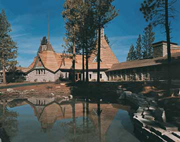
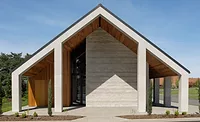
Almost 80 years after Frank Lloyd Wright designed a clubhouse for the Nakoma Country Club in Madison, WI, his vision became a reality. With the efforts of the Frank Lloyd Wright Foundation and Gold Mountain Development, the facility, which reflects the heritage of the American Indian, was recently constructed in Clio, CA, last spring.
The name itself, Nakoma, derives from the Chippewa Indian tribe. In the Longfellow poem "Hiawatha," Nakoma was the daughter of the moon and the mother of Hiawatha. Indian symbolism can be found throughout Wright's design -- from the five roof spires on the clubhouse, which are reminiscent of Indian "teepees," to the tremendous fireplace, which the architect had labeled "campfire."
Adding to the distinctive look of the structure are the massive amounts of roughly cut stone and detailed woodwork combined with a backdrop of the Sierra Nevadas. Located only 50 miles from Lake Tahoe, Nakoma Resort features the Dragon golf course and spa amenities, including saunas, steambaths, massage, body wraps, facials, swimming pools, Jacuzzi and tennis courts.

Working together
In 1995, Dariel and Peggy Garner, the owners of Gold Mountain development, were presented with the proposal to build Wright's design by the Frank Lloyd Wright Foundation, which has been created to oversee Wright's works. The Nakoma Resort is one of only six public buildings that have been built since Wright's death in 1959. Arnold Roy, a student of Wright, a Fellow of the Foundation and a longtime architect of Taliesin[R] Architects -- the continuing architectural practice of Wright established in 1893 -- headed the Nakoma project for the Frank Lloyd Wright Foundation.Additionally, Blossom Design Group Inc. of Tempe, AZ, was hired to create all the construction drawings. Rudow & Berry Inc. of Scottsdale, AZ, engineered the building, and during the construction phase, NST, Inc. of Susanville, CA, was responsible for on-site construction and engineering oversight. All those involved worked together to recreate Wright's original drawings of Nakoma. They coordinated interior layouts, site development work, cabinet work, furnishings, fixtures and general specifications.
The project team also included John Rattenbury -- also a prot? of Wright -- who oversaw all interior designs and details. The architect's understanding of Wright's work played an integral role in developing custom carpets, dishes, dining chairs and tables, art glass windows, screens and lighting -- some of which were not fully denoted on Wright's plans.
The Garners were honored with the opportunity to build Nakoma and were overwhelmed by the importance of making every detail of the building as accurate as the drawings Wright produced in 1924, according to Dariel Garner. "Only by being the general contractor of the Nakoma project could this building exist today," he said. "Overruns experienced in most of Wright's buildings would have been enormous, if we had had to depend on outside contractors to do the work. If we had, it would have very likely killed the project. Every part of this building has been handmade on site; from the 20-ton steel chimney tower to its complicated roof structure to its stone finishes. It was an incredible feat, and it was all done by local workers."
The design
According to the Foundation, several versions of Wright's Nakoma design were pulled from the archives and reviewed. The architect had been experimenting with his concrete textile block techniques during this period, and one such plan of the clubhouse utilized the pre-fabricated blocks. Another version was made of stone laid in the same manner as Taliesin, Wright's home in Spring Green, WI. This design called for local sandstone stacked horizontally with varying depths giving the appearance of unquarried stone.After considering their options, the Garners decided to implement the stone version. They believed that the rugged material would blend nicely with the forested, mountain setting characteristic of the region. Rose, sedimentary, volcanic stone similar to native stone found on their site in the Sierra Nevadas was selected.
The floor plan and elevations from the original drawings were followed, but the interior space had changed to meet today's requirements. Wright had designed the building for a small private golf and country club in the early 1920s, and some of the most beautiful spaces had been designated for locker rooms. It was decided that that the men and women's locker rooms would be moved to the lower level, and a gift shop and dining rooms were put in their place.
Wright designed the clubhouse as a series of contrasting shapes, including octagons, squares and rectangular spaces. "It is a series of complex masses separated and accentuated by a variety of roof shapes," according to the Frank Lloyd Wright Foundation. "The largest 'teepee' -- misnamed by Wright as the 'wigwam' -- is an octagon 52 feet across and is the focus of Wright's design. Above its walls, a huge roof soars 60 feet high, giving the outward appearance of an immense Indian teepee. There was no doubt that Wright had this image in mind when he inscribed 'wigwam' on the plan."
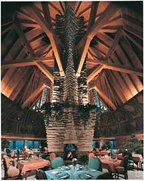
One of the center attractions inside the facility is the large fireplace, which was designed around two rotated squares. "The hearth opens on four sides and rises majestically up over 40 feet through the center of the dining room," the foundation explained. "The remaining spires or 'wigwams' are exquisite variations of the Indian theme, some topped with masts that reach skyward and crowned with blue treated copper caps. Use of natural rock and red cedar siding trimmed with a decorative beading of copper accentuate the Indian wigwam theme."
In addition to the significant amount of stone used for the fireplace and exterior fa?e, the use of natural stone is apparent throughout the facility. Stone columns are used as accents against wood and plastered walls in the Loggia Room, which was originally part of the ladies' locker room. This room seats 50 people for gourmet dining of Asian "fusion" cuisine.
Adjacent to the Loggia Room is the "Tea Pavilion," which was designed as a gathering room or parlor for lady members in the original drawings. This space now creates an intimate setting for private dining. A ribbon of hand-chipped stone is molded into a windowsill, which encircles the entire room.
Nakoma also features a wedding chapel, which provides an elegant area for couple to renew their vows. There is an exterior entrance to this room, and a flagstone patio adds to the outdoor decor.
Constructing the structure
The Garners attribute a great deal of the success of the project to the general contractor, Gold Mountain Construction, and its job superintendent, David Bates. According to the Garners, Bates' ability to oversee such a difficult task as creating a 1920s masterwork 75 years later was remarkable. "He was master of any construction problem and made the most difficult problems seem easy," said Dariel Garner.Bates credits the success of the project to the enthusiasm and pride of the 80 craftsmen that worked on the job for 15 months. "I have worked a lifetime in the construction business, and now I realize that the total of all my skills and experience were to prepare me for building this Wright masterpiece. An experience of all lifetime and one that no one on this project will every forget."
Nakoma Resort & Spa, Clio, CA
Original Architect: Frank Lloyd WrightProject Architect: Taliesin[R] Architects
Project Consultant: The Frank Lloyd Wright Foundation
Developer: Gold Mountain Development
General Contractor: Gold Mountain Construction
Construction Drawings: Blossom Design Group Inc., Tempe, AZ
Building Engineer: Rudow & Berry Inc., Scottsdale, AZ
On-site Contruction and Engineering: NST, Inc., Susanville, CA
Looking for a reprint of this article?
From high-res PDFs to custom plaques, order your copy today!