Recreating A Chapter in History
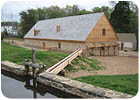
Honoring a man that most remember for being a Founding Father, the George Washington Distillery reconstruction in Mount Vernon, VA, seeks to interpret the nation’s first president further as the flourishing industrialist he was. Uncertain about the success of starting a distillery in northeast America in 1797, Washington quickly became one of the new country’s largest distillers. Leaving the distillery in the hands of other family members when he died in 1799, it was clear that Washington possessed unique entrepreneurship skills -- given the fact that the distillery production immediately declined, and it later burned down in 1814, absent of his supervision.
Today’s reconstruction of the distillery not only involved 18th century construction methods, but it also had to adhere to present day safety and accessibility codes, according to restoration architect James Thompson of Quinn Evans | Architects in Washington, DC. One of these requirements was to make the reconstruction slightly longer than the original distillery to accommodate a new stair and elevator. A vertical joint within the random ashlar stone pattern distinguishes the reconstruction from the circulation addition.
Because many years of archeological, engineering and historical research contributed to the design of this project, the actual stone selection process was not difficult, according to head restoration carpenter John O’Rourke. “Deciding what it should look like, picking the stone and then getting the stone was all very easy,” he said.
Archaeological investigation uncovered the original foundation stones, which had been gathered from the nearby Potomac River, along with remains of the original brick, cobblestone, wood floor and the lowest portions of the sandstone walls. Aquia Creek sandstone - quarried south of Mount Vernon - had been used for the original walls, according to O’Rourke. In keeping with the original distillery, the floor of the reconstruction is also built of brick, cobblestone and wood, while the walls are made of Massillon sandstone from Briar Hill Stone Co. of Glenmont, OH. These materials were chosen “in order to keep with the size, color and consistency of the original,” said Kathryn Slattery of Quinn Evans | Architects.
Altogether, 4,000 cubic feet of sandstone, cut down to 8- to 12-inch-thick pieces, was used, according to head stone installer, John Sines. “However, when the stone came, we cut it to a manageable size and put it in place without giving it any finish,” he said.
For nearly two years, two skilled stonemasons, along with two to three laborers worked together daily in order to complete the project. Mount Vernon’s chief historian and director of preservation, Dennis Pogue, was also there each day, as indicated by O’Rourke.
To determine stone patterning and coursing that would be used, O’Rourke, Pogue and the design team looked at several different stone buildings in the area and from around the same construction time. For example, the stonework from Rockledge Mansion (1758) in Virginia was used as a basis.
Fortunately, the entire reconstruction was made easier with the help of having George Washington’s original records. “We knew the brick sizes, wall thicknesses and most of the plan information from the archaeology,” said Thompson. “The rest of the design was influenced by historical documents. George Washington kept a lot of records, so with resources like insurance records and logs, we were able to figure out how much stone, nails and glass were used. The fact that we were able to reconstruct the building with this information says a lot about the business practices of a late 1700s business owner.”
Thompson also noted that the original distillery was just one of a complex of other agricultural industry buildings on the site. Two of these, a water-powered gristmill and the miller’s cottage, were reconstructed in 1931 and are open for tours showcasing the historic milling process. The distillery will also be an operating example, distilling water and occasionally whiskey. The addition of the distillery is expected to triple visitation to the site.
The George Washington Distillery will be a national distilling museum and the gateway to the “American Whiskey Trail,” which encompasses historic distilling-related sites in New York, Pennsylvania, Virginia, Kentucky and Tennessee. Open to the public as of April 2007, the site has already received much media attention, for instance being featured on NBC’s “Today Show.”
Looking for a reprint of this article?
From high-res PDFs to custom plaques, order your copy today!